
An official statement from the WGGB:
Many members of the Writers’ Guild of Great Britain will shortly receive voting papers for a ballot to fill vacancies on the board of the Authors’ Licensing & Collecting Society Ltd.
You must use all four of your votes, and the Guild recommends that you cast them for the four Guild members who are standing – Edel Brosnan, Gail Renard, Hugh Stoddart and Robert Taylor.
It is more important than ever this year, as changes in the constitution of ALCS mean that the Guild no longer has any right to nominate representatives directly on to the board. Unless one or more of our members wins a seat, the Guild could be unrepresented.
ALCS collects millions of pounds each year from photocopying licences and fees for the overseas cable retransmission of UK television channels and programmes. The Guild is concerned that ALCS may tend to give more attention to photocopying than to audiovisual issues, and a strong vote for Guild candidates would help to avoid this problem.
It is very tough for Guild candidates to be elected, as Guild members are heavily outnumbered within ALCS by scientists, academics and book writers.
You should receive your voting papers within the next few days. Please deal with them immediately – despite the Christmas holiday, the closing date is early in the New Year.
Please also note that ALCS has introduced a strange rule that your ballot paper will not be counted unless you use all four votes. This is different from council and trade union elections, where you can use as many votes as you like up to the maximum number.
Gail Renard, Chair of the Guild's TV Committee, adds:
The ALCS ballot papers are plopping onto your doormats now, and we urge you to follow the Guild’s recommendations and vote for our four candidates: Edel Brosnan, Hugh Stoddart, Robert Taylor and Gail Renard. Edel, Robert and Gail are all current directors of ALCS, who are standing again for our seats. During our time, we’ve been instrumental in lowering ALCS’s commission rate considerably, but we feel there’s still much further to go. And it’s paramount, in this digital age, to find writers as many new sources of income as we can, without sacrificing any of our primary royalties.
ALCS do a lot of good work but Guild members and TV, film and radio writers are greatly outnumbered, although we few bring in about one third of ALCS’s income… almost £6 million a year. The Guild is concerned that ALCS may tend to give more attention to photocopying than to audiovisual issues, so we need reps at ALCS who are up to speed with our profession and its practices. A strong vote for the four Guild candidates would ensure we would all continue to be represented and protected.
Always remember that the money you receive is not a gift from ALCS or manna from heaven. These are your residuals, which literally means the remainder of your payment. Your initial fee takes into consideration the royalties and residuals which you’ll receive in the future; your ALCS money being one of them. It’s your part of your pay and you’ve earned every penny.
We are also committed to investigating the serious issue of secondary commissions. Often the payment you receive from ALCS has already been reduced by up to 40% by the time it’s included other commissions, handling fees and cultural levies imposed by foreign collecting societies and agencies. We will ensure that the ALCS investigates these amounts and re-negotiates contracts wherever exorbitant fees are deducted.
Your vote is vital. We’ll need each and every one of them to win, so please pass this info onto all the writers you know. Also, due to a vagary of the ALCS election, you must vote for four candidates using black ink or your ballot paper will count as spoilt. You don’t have long to return the papers, so please do it immediately. Help us to protect your income, now and in the future. It’s your money!
Monday, December 17, 2007


Friday, December 14, 2007
Save Kids TV blog
There's a new blog, Kids' Character In Search Of A Slot, supporting the Save Kids TV campaign.
I was so excited last night I woke up extra early, even before the pigeons. When I got to ITV land, everyone was asleep except for some Hoobs. Have you noticed how the elderly get up really early? And they forget things a lot? That must be why there are so many old shows repeated first thing in the morning.
Thursday, December 13, 2007
Yorke unveils drama series code of conduct
At a special event at the Writers' Guild last night, John Yorke, BBC Controller Drama Production Studios, unveiled a new code of conduct to cover drama series' work with writers.
In a wide-ranging speech, Yorke explained how he and his team have worked to put writers at the heart of the creative process on drama series. There had, he admitted, been difficulties on shows including Casualty and EastEnders in recent years following the big expansion in the number of episodes commissioned each year. We'll be posting a full report on the event on the Guild's website next week.
The code of conduct is as follows:
• All contracted scripts will be acknowledged on receipt, and writers will then be contacted within 24 hours to be given an indication of when notes will be given.
• Where possible notes will be given at face to face meetings or by phone. If notes are to be given by email, a courtesy phone call should precede the email.
• Productions will make allowances for writers’ time constraints where practicable.
• If scripts delivery schedules are changed, a new schedule will be put in place immediately.
• Adequate times must be scheduled for the completion of each draft.
• Writers will be guaranteed a clear editorial contact throughout the script process that covers for any staff leave or absence.
• Where possible, programmes should communicate clearly with writers as to whether they are likely to be used again.
• Writers will be told immediately when scripts are taken away from them, and the percentage rewrite involved will be indicated to them within two weeks.
• Scripts are deemed to be accepted on publication of the production script.
• Rebriefs are paid at a 10% minimum
In a wide-ranging speech, Yorke explained how he and his team have worked to put writers at the heart of the creative process on drama series. There had, he admitted, been difficulties on shows including Casualty and EastEnders in recent years following the big expansion in the number of episodes commissioned each year. We'll be posting a full report on the event on the Guild's website next week.
The code of conduct is as follows:
• All contracted scripts will be acknowledged on receipt, and writers will then be contacted within 24 hours to be given an indication of when notes will be given.
• Where possible notes will be given at face to face meetings or by phone. If notes are to be given by email, a courtesy phone call should precede the email.
• Productions will make allowances for writers’ time constraints where practicable.
• If scripts delivery schedules are changed, a new schedule will be put in place immediately.
• Adequate times must be scheduled for the completion of each draft.
• Writers will be guaranteed a clear editorial contact throughout the script process that covers for any staff leave or absence.
• Where possible, programmes should communicate clearly with writers as to whether they are likely to be used again.
• Writers will be told immediately when scripts are taken away from them, and the percentage rewrite involved will be indicated to them within two weeks.
• Scripts are deemed to be accepted on publication of the production script.
• Rebriefs are paid at a 10% minimum
Wednesday, December 12, 2007
Authors must become brands
On her blog, journalist Danuta Kean argues that for long-term success authors must be turned into brands.
Despite the mixed signals sent by the book trade, authors do break out of the one hit wonderland to establish brand names and long careers. How is it done, and can publishers reinforce brands outside retail promotions? Joanna Prior, marketing and publicity director at Penguin, is adamant it is possible.
Prior has had a hand in the career of a roster of brand name authors, most notably Zadie Smith. Good branding, she believes, is a matter of confidence. “A lot of what it comes from is an unshakable belief that you have the ‘real thing’ on your hands, that you have an author who is going to write for a career not just one book.” Such belief, she believes, should fuel publishers’ confidence to create distinct identities that set authors apart. In the case of Smith this meant an emphasis on her distinctive name using bold cover design and tactical publicity that showcased her as a voice for a new generation.
Peter Orton 1943-2007
Peter Orton, the founder of children's TV producer, HIT Entertainment, has died at the age of 64. There are obituaries in The Times, The Independent and from Simon Forrest in The Guardian.
At its height, HIT Entertainment, was one of the leading international producers of preschool children's programming, second only to Disney and Warner Brothers. Apart from Bob, the stable of characters included Thomas the Tank Engine, Pingu, Sooty, Kipper, Brambly Hedge, Fireman Sam and Captain Pugwash. Peter's strength was knowing what would appeal, combined with an excellent business brain. He also knew enough about his own shortcomings to surround himself with experts. As he said, he couldn't draw, wasn't really creative, not especially numerate, but he hired people who were.
British Library acquires Pinter archive
From BBC News:
The archive of Britain's leading writer and playwright, Harold Pinter, has been acquired by the British Library.
It includes more than 150 boxes of manuscripts, scrapbooks, letters, photographs and emails from the 2005 Nobel Laureate for Literature.
The British Library said it offered an invaluable resource for researchers and scholars of Pinter's work.
The entire collection, including items that have been on loan to the Library since 1993, was purchased for £1.1m...
The archive is to be catalogued and will be completed at the end of 2008.
A small temporary display, His Own Domain: Harold Pinter, A Life in Theatre, will run at the British Library, in London, from 11 January to 13 April.
Tuesday, December 11, 2007
The Lulu diaries
Over on the Guild website we've put up the article by John Morrison from the most recent copy of the Guild's magazine, UK Writer, about online self-publishing with Lulu.com.
I’ve published two non-fiction books with mainstream publishers and a novel under my own steam, so I’m not exactly a blushing virgin. But publishers require long and careful courtship; like Victorian maidens they won’t step out with gentlemen they don’t know, and their long term relationships are often never consummated.
Lulu, by contrast, is a new girl on the block and she doesn’t expect to be showered with expensive gifts and dinners before she delivers the goods.
Jan Etherington's Comedy Writing Course
Guild member and award-winning comedy writer Jan Etherington is launching her first two-day comedy writing course at the Riverside Arts Centre, Sunbury on Thames, Middlesex on 23-24 February 2008.
Jan co-created the prime-time hit television comedy series, Second Thoughts, Faith In The Future, Next of Kin and Duck Patrol plus many radio comedies and is also a successful journalist and broadcaster.
The course includes lunch on both days and a special guest on Sunday – legendary comedy writer, Alan Simpson, who, with Ray Galton, created Hancock’s Half Hour and Steptoe & Son.
Places are very limited, so book early. Special Introductory Offer for the 2 day Course: £130.
For more details visit the website: comedycourse.biz
Tel: 020 8133 0110
Email: comedycourse@hotmail.co.uk
Jan co-created the prime-time hit television comedy series, Second Thoughts, Faith In The Future, Next of Kin and Duck Patrol plus many radio comedies and is also a successful journalist and broadcaster.
The course includes lunch on both days and a special guest on Sunday – legendary comedy writer, Alan Simpson, who, with Ray Galton, created Hancock’s Half Hour and Steptoe & Son.
Places are very limited, so book early. Special Introductory Offer for the 2 day Course: £130.
For more details visit the website: comedycourse.biz
Tel: 020 8133 0110
Email: comedycourse@hotmail.co.uk
The BBC's new Oliver Twist
In The Times, Daphne Lockyer goes behind the scenes of Sarah Phelps's adaptation of Charles Dickens's Oliver Twist for the BBC.
The choice of Phelps as the adapter is almost a mission statement. She is normally on the writing team of EastEnders and this is her first adaptation of a classic novel. But, as in the BBC’s groundbreaking adaptation of Bleak House, the aim is to give the story an episodic, populist feel. “We wanted a drama that would have resonance even to people who had never picked up a piece of classical literature in their lives,” says Brown.
By choosing Phelps, of course, the BBC also hope to make this version the most gritty and modern of all the Oliver Twist adaptations. “What working in soap teaches you is never to wiffle-waffle around the edges of a story, but to get straight in up to your elbows. And that is exactly what I have tried to do here.”
Monday, December 10, 2007
Doris Lessing's Nobel lecture
2007 Literature laureate, Doris Lessing, delivered her Nobel lecture on Friday - a call for people to recognise the value of books and reading in this country and around the world.
The storyteller is deep inside everyone of us. The story-maker is always with us. Let us suppose our world is attacked by war, by the horrors that we all of us easily imagine. Let us suppose floods wash through our cities, the seas rise ... but the storyteller will be there, for it is our imaginations which shape us, keep us, create us – for good and for ill. It is our stories, the storyteller, that will recreate us, when we are torn, hurt, even destroyed. It is the storyteller, the dream-maker, the myth-maker, that is our phoenix, what we are at our best, when we are our most creative.
EU Online Copyright Bill
From William New for Intellectual Property Watch:
European publishers and copyright holders have a friend in European Information Society Commissioner Viviane Reding, which she reinforced last week in describing efforts to push through a new bill on digital publishing copyrights...On a similar subject, in The Guardian poet Wendy Cope calls for people to respect poets' copyright.
“Copyright is a cornerstone of the information and knowledge-based society,” Reding told the 6 December European Publishers’ Forum. “This is why I introduced in the new framework an appropriate balance between ownership and access.”
A few years ago one of my step-sisters asked me about Jenny Joseph's poem Warning - the one that begins: "When I am an old woman I shall wear purple." My step-sister spends a lot of time in the USA and had heard about the Red Hat Society, a women's organisation inspired by Jenny's poem. As Warning is included in an anthology I edited, I offered to send her a copy. "No," she said. "Don't bother. I'll get it off the internet." That was when it dawned on me that nowadays, if you want a copy of a particular poem, you don't have to buy a book.
Friday, December 07, 2007
US strike talks continue
Talks between the Writers Guild of America and the Alliance of Motion Picture and Television Producers, aimed at ending the ongoing writers' strike, have continued all week
For up-to-date information see the WGA website and the United Hollywood blog.
For up-to-date information see the WGA website and the United Hollywood blog.
Thursday, December 06, 2007
MPs call for tax credits for kids TV
By David Rose for Broadcast:
Political pressure is mounting on ministers to throw a lifeline to stricken independent producers and save UK children's TV.Tax credits for children's TV will be the main subject of the Guild's lobby of MPs at Westminster next week.
Tory and Liberal Democrat media spokesmen backed Labour MPs today in urging the government to respond to the crisis confronting children's programming following ITV's decision to withdraw from the sector.
MPs highlighted the need for an urgent government response by warning that freelance writers, directors and performers were quitting while some companies had already gone to the wall.
As a interim first step, the government was urged to extend tax credits currently available to the film industry to children's television programme makers.
Thanks from the WGA
An open letter from the Writers Guild of America
Dear Members of the International Writers’ Community:
We at the Writers Guild of America extend our heartfelt thanks to members of the international community for your unprecedented and robust outpouring of support for our cause on International Solidarity Day on November 28. We were moved and inspired by the hundreds of scribes who marched in front of the Eiffel Tower in France, at the Brandenburg Gate in Germany, and on the streets of Canada, England, Australia, Spain, Portugal, The Netherlands, Wales, and Mexico. Clearly, our fight to win fair compensation from global media corporations has struck a chord with writers everywhere.
The scope of the protests was truly impressive: In Berlin, over 100 German writers carried WGA picket signs at the Brandenburg Gate. Hundreds of writers marched in freezing temperatures in Montreal and Toronto. In Amsterdam, an auditorium full of writers cheered our cause. We have heard from the Portuguese Screenwriters Guild, the Writers Guild of Great Britain, the International Affiliation of Writers Guilds, the Writers Guild of Canada, the Screenwriters Guild of Germany, and the Federation of Screenwriters in Europe. Members of the Irish Playwrights and Screenwriters Guild marched for our cause dressed as leprechauns!
At home, WGA members with international backgrounds marched at NBC Studios in Burbank, California. Jean-Yves Pitoun, a French native and WGA West member, stressed that the fight in the U.S. has an impact abroad: “Europeans are very carefully watching the writers, actors, and directors in the U.S. because Rupert Murdoch is everywhere.”
We thank you for reinforcing that fair compensation for writers is a worldwide cause. Together our voices will be heard.
Sincerely,
Board of Directors
Writers Guild of America West
Dear Members of the International Writers’ Community:
We at the Writers Guild of America extend our heartfelt thanks to members of the international community for your unprecedented and robust outpouring of support for our cause on International Solidarity Day on November 28. We were moved and inspired by the hundreds of scribes who marched in front of the Eiffel Tower in France, at the Brandenburg Gate in Germany, and on the streets of Canada, England, Australia, Spain, Portugal, The Netherlands, Wales, and Mexico. Clearly, our fight to win fair compensation from global media corporations has struck a chord with writers everywhere.
The scope of the protests was truly impressive: In Berlin, over 100 German writers carried WGA picket signs at the Brandenburg Gate. Hundreds of writers marched in freezing temperatures in Montreal and Toronto. In Amsterdam, an auditorium full of writers cheered our cause. We have heard from the Portuguese Screenwriters Guild, the Writers Guild of Great Britain, the International Affiliation of Writers Guilds, the Writers Guild of Canada, the Screenwriters Guild of Germany, and the Federation of Screenwriters in Europe. Members of the Irish Playwrights and Screenwriters Guild marched for our cause dressed as leprechauns!
At home, WGA members with international backgrounds marched at NBC Studios in Burbank, California. Jean-Yves Pitoun, a French native and WGA West member, stressed that the fight in the U.S. has an impact abroad: “Europeans are very carefully watching the writers, actors, and directors in the U.S. because Rupert Murdoch is everywhere.”
We thank you for reinforcing that fair compensation for writers is a worldwide cause. Together our voices will be heard.
Sincerely,
Board of Directors
Writers Guild of America West
Pegg wins Guild Comedy Award
Simon Pegg won the Writers' Guild Ronnie Barker Award at the British Comedy Awards last night.
Peep Show (written by Sam Bain and Jesse Armstrong) was named Best TV Comedy, while Gavin & Stacey (written by Ruth Jones and James Corden) took the award for Best New British Television Comedy.
Update (7.12.07): A first-hand account from Guild TV Comittee Chair, Gail Renard:
Once again the WGGB was proud to be associated with the British Comedy Awards, which glittered like newly whitened teeth despite not being aired live by ITV this year. The Guild reps on the Brit Com panel were Jonathan Harvey, Simon Brett and myself, and we judged our fellow writers as we would ourselves be judged… only they won awards.
The Guild gave its prestigious Writer Of The Year Award to Simon Pegg who, with his various co-writers (Jessica Stevenson, Edgar Wright, Nick Frost, Michael Ian Black et al) has produced many hit TV shows and films. Pegg’s range has been impressive. From the C4 series Spaced to Shaun Of The Dead and Hot Fuzz, Pegg’s brought a lot of joy with both his writing and performing. I’m sure the WGA strike t-shirt we also gave him was the icing on the cake.
The Best TV Comedy Award was won deservedly by Peep Show, and its writers, Sam Bain and Jesse Armstrong; officers, gentlemen and staunch Guild members. It’s hard enough to create an original, laugh-out-loud comedy series, but to sustain it over 4 years with continued excellence, as Peep Show has done, is a tribute to its entire team.
Gavin And Stacey's James Corden and Ruth Jones won three awards between them, and if that doesn’t count as a good night out, I don’t know what does.
As ever the Guild wants to thank Michael Hurll, exec producer and creator of the Brit Coms. In his incredible comedy career, Michael’s produced everyone from Jack Benny to the Two Ronnies. All of us in comedy owe him a great debt. He definitely deserves his own British Comedy Award.
Peep Show (written by Sam Bain and Jesse Armstrong) was named Best TV Comedy, while Gavin & Stacey (written by Ruth Jones and James Corden) took the award for Best New British Television Comedy.
Update (7.12.07): A first-hand account from Guild TV Comittee Chair, Gail Renard:
Once again the WGGB was proud to be associated with the British Comedy Awards, which glittered like newly whitened teeth despite not being aired live by ITV this year. The Guild reps on the Brit Com panel were Jonathan Harvey, Simon Brett and myself, and we judged our fellow writers as we would ourselves be judged… only they won awards.
The Guild gave its prestigious Writer Of The Year Award to Simon Pegg who, with his various co-writers (Jessica Stevenson, Edgar Wright, Nick Frost, Michael Ian Black et al) has produced many hit TV shows and films. Pegg’s range has been impressive. From the C4 series Spaced to Shaun Of The Dead and Hot Fuzz, Pegg’s brought a lot of joy with both his writing and performing. I’m sure the WGA strike t-shirt we also gave him was the icing on the cake.
The Best TV Comedy Award was won deservedly by Peep Show, and its writers, Sam Bain and Jesse Armstrong; officers, gentlemen and staunch Guild members. It’s hard enough to create an original, laugh-out-loud comedy series, but to sustain it over 4 years with continued excellence, as Peep Show has done, is a tribute to its entire team.
Gavin And Stacey's James Corden and Ruth Jones won three awards between them, and if that doesn’t count as a good night out, I don’t know what does.
As ever the Guild wants to thank Michael Hurll, exec producer and creator of the Brit Coms. In his incredible comedy career, Michael’s produced everyone from Jack Benny to the Two Ronnies. All of us in comedy owe him a great debt. He definitely deserves his own British Comedy Award.
Tuesday, December 04, 2007
Increase of minimum rates for TV writers negotiated with the BBC
The minimum rates for writers commissioned under the WGGB / PMA / BBC TV agreement have been increased by 4% as a result of negotiations between the three parties, effective from 1 November 2007.
The following per minute minimum rates for TV writers will now apply:
The following per minute minimum rates for TV writers will now apply:
- Teleplays: £166.47
- Series/Serials: £151.00
- Dramatisations: £104.34
- Adaptations: £66.06
- Educational Drama: £101.44
- Attendance fees: £88.73
Polly Stenham interview
Last week Polly Stenham won the The Charles Wintour Award for Most Promising Playwright at The Evening Standard Awards. In The Independent, Ciar Byrne meets her.
Stenham, who wrote That Face as part of the Royal Court's Young Writers programme, fell into the theatre almost by accident. "I wanted to write fiction really, but I couldn't find any courses and then I heard about the Royal Court," she said. Writing the play was, "a lot of fun".
She is now "in the murky depths" of writing a second. "It would be completely possible that I now write four or five terrible plays," she said. "You lose your innocence a bit. The first one you just write for you and the complete joy of it."
Monday, December 03, 2007
Channel 4 schools moves online
From Bobbie Johnson for Media Guardian:
For years they have been a fixture of Channel 4's schedules, but next year early morning programmes for schools will become a thing of the past - replaced by a sweeping initiative on the internet.
In a pioneering move for a broadcaster, the £6m annual budget spent on education programmes aimed at teenagers is being moved from traditional TV shows to multimedia projects.
The relevance of sci-fi
In The Sunday Times, Brian Appleyard argues that science-fiction writing is more relevant than ever.
“The truth is,” [Brian] Aldiss has written, “that we are at last living in an SF scenario.” A collapsing environment, a hyperconnected world, suicide bombers, perpetual surveillance, the discovery of other solar systems, novel pathogens, tourists in space, children drugged with behaviour controllers – it’s all coming true at last. Aldiss thinks this makes SF redundant. I disagree. In such a climate, it is the conventionally literary that is threatened, and SF comes into its own as the most hardcore realism.
BBC cues up new Aussie soap
Any hopes that the impending move of Neighbours from BBC One to Five would lead to the commissioning of a British replacement have been dashed by the announcement that the BBC has commissioned a new Australian daytime soap called Out of the Blue.
Though long-running show Neighbours comes to an end on BBC1, the channel will keep an Antipodean flavour with a new show set in Sydney.
Out of the Blue will begin shooting in the new year and is set in the Sydney beach resort of Manly.
The story opens when a group of thirtysomething friends return to their home town for a high school reunion.
However, the celebrations are brought to an abrupt end when one of the group is murdered.
Out of the Blue is being made by Southern Star Entertainment, the company behind hits such as The Secret Life of Us and Love My Way.
The BBC has ordered 130 half-hour episodes of Out of the Blue, which will run in an as yet unspecified slot in daytime.
Derby Playhouse closes
From Pat Ashworth in The Stage:
Derby Playhouse has gone dark, after the theatre’s board took the decision to place the company in liquidation...
The news comes after last week’s revelation that the venue faced a £300,000 shortfall in expected revenue and needed £70,000 to pull it out of danger of closure. Venue officials blamed the financial problems on disruption caused by the development of the surrounding Westfield shopping centre. Productions staged during that period performed below expectations.
Friday, November 30, 2007
Tony Holland 1940-2007
One of the co-creators of EastEnders, Tony Holland, has died at the age of 67. Holland who devised the Walford soap with his partner Julia Smith, also created Eldorado, Angels and District Nurse.
From Media Guardian:
From Media Guardian:
Former EastEnders lead scriptwriter Tony Jordan, who went on to work with Holland on Eldorado, paid tribute to him.And former EastEnders writer, Andrew Collins, pays tribute.
"He was probably the only writer I have ever been in awe of," Jordan told MediaGuardian.co.uk.
"He just had a grasp of story and imagination that went to a different place. He had a gift of taking a story and finding the heart of it. That is why EastEnders was so strong in the early days."
I never met Tony Holland. But as a scriptwriter for EastEnders between 1999 and 2002, I benefited in many ways from the roots he laid down with Julia Smith between 1985 and 1989: the focus on character as much as on story (think of the great "two-handers", Den and Angie; Dot and Ethel - this was Play For Today disguised as soap opera), the courage to venture into dark places (yes, they called the show "depressing" and "miserable" - and it did start in 1985 with a corpse - but isn't some of the best British drama depressing?), and an attention to structure that was handed down, and continues to be handed down, as if some of those episodes were not merely built to pass half an hour and fade like soap suds, but to stand as textbook examples of how to write dramatic television.
Shed buys Wall To Wall
Shed Media (producer of dramas including Bad Girls and Footballers' Wives) has finalised a takeover of Wall To Wall (New Tricks) for £25m.
More from C21 Media and Media Guardian.
More from C21 Media and Media Guardian.
Wednesday, November 28, 2007
"We support the Writers Guild of America"
 British writers and US expats turned out in force today for a demonstration in London in support of the American writers' strike.
Speaking to the assembled crowd and media, WGGB President, David Edgar, sent best wishes to the American writers and stressed that their fight was for the recognition of the fundamental right of authorship.
Guild General Secretary, Bernie Corbett, also emphasised the international importance of the dispute. Although British writers have secured many of the rights being sought by the WGA, if the American writers were to be unsuccessful it could have a knock-on effect around the world.
TUC General Secretary, Brendan Barber, pledged the support of the wider British trades union movement in what he said was a very important dispute over important matters of principle.
Actor Timothy West also addressed the demonstration, speaking for many other actors present in offering support for the American writers' cause.
 Guild President, David Edgar, addresses the demonstration.
 Writers gathered outside the TUC Congress in central London.
 Guild General Secretary, Bernie Corbett, pledges the WGGB's support for striking American writers.
The London demonstration was part of an international day of solidarity, with events also taking place in Australia, New Zealand, France, Germany, Holland, Canada and Mexico.
Update (29/11/07): Welsh members of the WGGB held their own demonstration in Cardiff (pictured below), along with members of Equity and the National Union of Journalists.
 The video from yesterday's event in London is also now up on YouTube, part of a YouTube group featuring videos from around the world.
Thanks to Jill Golick (see comments) for links to events in Toronto, on her own blog and on Denis McGrath's. Plus, from Montreal, Alex Epstein and a Facebook Group.
Update(2): Coverage of yesterday's London demonstration on BBC News. And scriptwriter James Moran offers a personal view on his blog.
Ready for action
 Guild General Secretary, Bernie Corbett, tries on a WGA T-shirt ahead of today's demonstration outside Congress House at 12 noon (all welcome).
Eileen Gallagher interview
In Media Guardian, Owen Gibson talks to writer and Chief Executive of Shed Media, Eileen Gallagher.
"I grew up with television and I love it. It's very hard to make popular programmes. It's so hard to make a big rating programme that gets a big audience on BBC1. I'm really proud of Waterloo Road - it's beating The Bill and it's about educational issues. Try that for a party trick," she says. "If I ever hear anyone saying, 'I won't like it but they will,' it drives me mad. It's so snobby. We make programmes we like and it just so happens we like big, popular programmes."
BAFTA Children's Awards
That Summer Day, written by Clive Bradley, won the Children's BAFTA for Best Drama at the awards ceremony on Sunday. Writer Of The Year was Bridget Hurst for her episodes of Charlie And Lola, based on the books by Lauren Child.
Overall the BBC took ten awards, including Channel of the Year for CBeebies.
However, the event was overshadowed by concerns about the future of children's TV.
Overall the BBC took ten awards, including Channel of the Year for CBeebies.
However, the event was overshadowed by concerns about the future of children's TV.
Laurence Bowen, producer of the nominated show My Life as a Popat, said: “Unless immediate action is taken the 2007 kids’ Baftas will be seen historically as the defining wake for children’s TV.”
Broadcasters' on-demand partnership
From BBC News:
The BBC, ITV and Channel 4 are to launch a joint on-demand service, which will bring together thousands of hours of television programmes in one place.
The service is set to go live in 2008 and will offer viewers access to current shows and archive material.
Plans will have to be approved by the BBC Trust and the other broadcasters' boards, and a name for the service will be unveiled ahead of its launch.
The three broadcasters currently offer their own separate on-demand services.
The BBC's iPlayer and ITV's catch-up service will continue to exist along the new online "aggregator", which will provide a complement to the established providers.
However, Channel 4's 4oD will no longer be a standalone service once it is incorporated within the project.
Monday, November 26, 2007
Reminder: support the US strike
 Remember, 12 noon on Wednesday is your chance to show your support for the US writers' strike by joining the public demonstration outside the Trades Union Congress HQ in Great Russell Street, central London (link to StreetMap).
All are welcome, whether Guild members or not.
See you there.
Update (26/11/07): Welsh members are planning an event in Cardiff at 12 noon on Wednesday. Full details to follow.
Movies and graphic novels
 Graphic novels are establishing an ever closer relationship with feature films, explains Ryan Gilbey in The Guardian.
 A movie was once just a movie - a self-contained entity, perhaps with a lucrative line of tie-in products that might include a comic-book spin-off. But now there is a cross-pollination between cinema and graphic novels that cannot be described or dismissed as mere merchandising. It used to be the case that studios would simply adapt a graphic novel for the screen, usually with dubious results. Increasingly, though, the traffic is moving in the opposite direction, with film-makers themselves branching out into graphic novels, incorporating that art form as an alternative storytelling tool rather than simply an adjunct or cash-in.
When Joss Whedon's television series Firefly was cancelled, and he was preparing its movie sequel, Serenity, he first bridged the narrative gap between the two by co-writing a Serenity comic book; his television series Buffy the Vampire Slayer was prolonged in a similar vein, with season eight now emerging as a graphic novel long after the season seven finale. And when Darren Aronofsky's initial attempt to film The Fountain collapsed, the director diverted his energies into collaborating with Kent Williams on a graphic novel version based on his screenplay; the result is strikingly different from the film that was eventually made.
Panto season
Pantomime is going from strength to strength, argues Robert Hanks in The Independent.
Pantomime... is showing signs of being the drama par excellence of the 21st century, one that connects all parts of our society and our history, and doesn't feel like an exercise in piety.
Verity Lambert 1935-2007
TV producer Verity Lambert has died at the age of 71. She was the first producer of Doctor Who in 1963 and also produced dramas including The Newcomers, Adam Adamant Lives!, Minder and Quatermass.
There are obituaries in The Telegraph, The Times and The Guardian.
At the end of the piece in The Guardian, fellow producer Kenith Trodd recalls how pivotal the role used to be.
There are obituaries in The Telegraph, The Times and The Guardian.
At the end of the piece in The Guardian, fellow producer Kenith Trodd recalls how pivotal the role used to be.
In drama, not the controller nor even the writer, let alone the accountant, was king, but the producer, now a creature extinct in all but name. He (Verity, was a very rare she) was poised professionally on that rich cusp between the management and the talent - writers, directors and the hundreds of skilled creatives - outside. If the bosses trusted the producer, and often they did with a combative generosity, it was the producer who made a crucial difference to the health and vitality of the entire system. Verity was at the very top of this steep, wary tree. She had the greatest range, charisma and durability. Not only the producer's producer, but the audience's finest ally.
Friday, November 23, 2007
Call for action - Support the US screenwriters' strike
 An official statement from the Writers' Guild of Great Britain:
British writers and trade unionists will hold a public demonstration on Wednesday 28 November 2007 in support of the American screenwriters’ strike.
The demo, which is part of an International Day of Solidarity, will take place at 12 noon outside the Trades Union Congress HQ in Great Russell Street, central London (link to StreetMap).
The event will be headed by the President of the Writers’ Guild of Great Britain, David Edgar, and we hope that as many members as possible will join us to show their support.
Official Writers Guild of America T-shirts and placards will be distributed to participants in the demo. The event will be filmed and we hope that a video compilation covering demos in Britain, Ireland, Australia, Canada and other countries will be added to the many strike-related clips on YouTube.
Supporters from other British trade unions will also be taking part. A top-level TUC meeting will be discussing the US screenwriters’ strike earlier the same day.
WGGB General Secretary Bernie Corbett said: “Guild members and other supporters are urged to come to the TUC in Great Russell Street (near Tottenham Court Road tube station and the British Museum) at 12 noon sharp on Wednesday to make this a convincing demonstration of support.
“This demo coincides with reopened negotiations aimed at settling the strike by achieving fair payments for the use of writers’ work on new media platforms such as the internet and mobile phones.”
For more strike information please visit http://www.unitedhollywood.com/ or http://www.wga.org/.
US strike videos
While US TV and film production grinds to a halt as the US writers' strike starts to bite, one form of entertainment is burgeoning: strike videos.
Here's two via BBC News: the Writers' Police and a 'studio boss' speaks.
Highest profile has been the Speechless series, starring famous actors short of words. The first three feature Sean Penn, Richard Benjamin and Paula Prentiss, and Holly Hunter.
Here's two via BBC News: the Writers' Police and a 'studio boss' speaks.
Highest profile has been the Speechless series, starring famous actors short of words. The first three feature Sean Penn, Richard Benjamin and Paula Prentiss, and Holly Hunter.
Thursday, November 22, 2007
DCMS overstated Arts Council funding
In The Stage, Alistair Smith reveals that, following the newspaper's investigation, officials at the Department for Media Culture and Sport (DCMS) have now admitted that they overstated Arts Council funding.
In the official release accompanying the results of the DCMS’s settlement for the arts at last month’s spending review, the department claimed it had given Arts Council England a “real-terms increase year-on-year of 1.1%”.
This claim has proved to be incorrect and an exaggeration of around £9 million over the three years. The real “year-on-year” increase is significantly lower. While the DCMS was informed of the potential error by The Stage at the time, it has taken until now - more than a month later - to acknowledge that mistake.
Liverpool's culture vultures
 As Liverpool prepares to become the European Capital of Culture 2008, in The Times James Collard, Alexia Skinitis and Alan Jackson talk to writers and performers who come from Merseyside.
Canning Street and the rows of 19th-century merchant’s houses which surround it are familiar territory to poets Roger McGough and Brian Patten and playwright Willy Russell (centre). McGough and Patten both lived near here before the 1967 publication of The Mersey Sound (with the late Adrian Henri) made them celebrated figures. McGough later went on to gain a chart No 1 with The Scaffolds’ Lily the Pink. Russell’s success began later with John, Paul, Ringo... and Bert (for the Everyman), but came thick and fast with Educating Rita and Shirley Valentine (both plays which became films) and the long-running Blood Brothers. But the street housing Russell’s offices has changed “beyond recognition”, from the rundown place of “brothels, squats and bars” which McGough recalls, to the swanky district estate agents now call the Georgian Quarter. “People have mixed feelings about regeneration, but it has saved these buildings,” argues Russell, “and I’m glad about that.”
Wednesday, November 21, 2007
Chillis sue over 'Californication'
Titles have generally been assumed to be beyond copyright, but now rock band the Red Hot Chili Peppers are suing the Showtime network over the name of its TV show, Californication, reports BBC News.
The band says the title is "immediately associated in the mind of the consumer" with its 1999 album and single release.If you're interested, here's the full text of the lawsuit (pdf).
It has filed a lawsuit against Showtime Network - the makers of the TV show, which stars David Duchovny as a writer going through a mid-life crisis.
"For some TV show to come along and steal our identity is not right," said the band's singer, Anthony Kiedis.
He described Californication as "the signature CD, video and song of the band's career".
Beowulf - movies and games converge
 On the Wired Game/Life blog Chris Kohler predicts that the new Beowulf film heralds a new era of film and videogame development.
 Give it another five to ten years and you'll have your choice of CGI action movies. And if they star Angelina Jolie, they'll likely just pull her digital likeness straight out of Beowulf's asset files.
This will mean that tie-in video games will become even more important, because soon enough there will be no technological difference between what you're playing and what you're watching. It'll all look the same. They'll share assets. They'll build movies and games together from the ground up.
And video games will become even more mainstream as the average moviegoer's taste in visuals becomes closer and closer to what gamers experience on the small screen. This won't just affect licensed movie games. As the two media become closer and closer, even original games will start to click more with the mainstream consumer simply because everything will all have grown so closely together.
Tuesday, November 20, 2007
Salmon outlines his Vision
In case you've not kept pace with restructuring at the BBC, their in-house production was brought together a year ago into a single department called BBC Vision.
Last night the Chief Creative Officer of BBC Vision, Peter Salmon, outlined his plans in a speech to the Royal Television Society. Among the initiatives singled out was the BBC Writers' Academy.
Last night the Chief Creative Officer of BBC Vision, Peter Salmon, outlined his plans in a speech to the Royal Television Society. Among the initiatives singled out was the BBC Writers' Academy.
We've also had terrific success with the Writers' Academy run by John Yorke, training many writers for Continuing Drama Series on BBC Television. Some of the new crop – this year's rising stars – are here tonight. They do an initial three-month course made up of lectures and workshops with the best in the business – and each writer is commissioned to write an episode of Doctors. If their script if accepted for broadcast, they then go on to do a year's intensive writing for EastEnders, Casualty and Holby, mentored by the lead writer on the show.
One graduate, Ian Kershaw, now a core writer on Holby, described the scheme like this: "Writing for television can feel like running across a muddy field at night pursued by man-eating pigs... the Academy gives you a torch."
I think I understand that...
It's a really imaginative and successful scheme. At present it only covers England – but I'd like to find a way to spread coverage to the rest of the UK, and also across other programme areas.
British success at International Emmy Awards
British TV shows dominated the 35th International Emmy Awards, presented in New York last night.
British programmes won seven categories including Best Drama Series for The Street (written by Jimmy McGovern), Best Comedy for Little Britain Abroad (written by Matt Lucas and David Walliams) and Best TV Movie/Mini-Series for Death Of A President (written by Simon Finch and Gabriel Range).
British programmes won seven categories including Best Drama Series for The Street (written by Jimmy McGovern), Best Comedy for Little Britain Abroad (written by Matt Lucas and David Walliams) and Best TV Movie/Mini-Series for Death Of A President (written by Simon Finch and Gabriel Range).
Guild Awards photos
Shiny happy people: some of the winners from the Guild Awards on Sunday. (All photos by Simon Denton)
 Simon Blackwell, Tony Roche and Jesse Armstrong - The Thick Of It (Best TV Comedy / Light Entertainment)
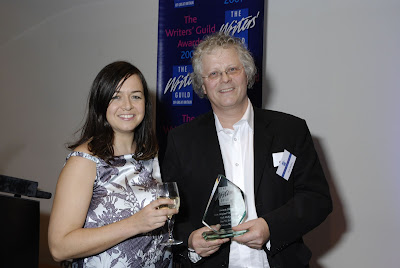 Neil McKay with producer Lisa Gilchrist - See No Evil: The Moors Murders (Best Original TV Drama)
 Gregory Burke - Best Play (Black Watch)
 Alan Brownjohn (right) receiving his Special Award from the Guild Books Committee, presented by publisher Stephen Stuart-Smith
 Matt Greenhalgh (centre), winner of the Guild/List Edinburgh Film Festival Screenplay Award, for Control. With director Don Boyd (left) and Paul Dale, Assistant Editor of The List
 This Is England actors Andrew Shim and Vicky McClure collect the Best Screenplay (Feature Film) award on behalf of Shane Meadows
 Gareth Robers, Stephen Greenhorn, Paul Cornell and Steven Moffat - four of the writers on Doctor Who Series 3 (Best Soap/Series)
 Alan Plater, winner of the Lifetime Achievement Award
 Simon Blackwell, Tony Roche and Jesse Armstrong - The Thick Of It (Best TV Comedy / Light Entertainment)
 Neil McKay with producer Lisa Gilchrist - See No Evil: The Moors Murders (Best Original TV Drama)
 Gregory Burke - Best Play (Black Watch)
 Alan Brownjohn (right) receiving his Special Award from the Guild Books Committee, presented by publisher Stephen Stuart-Smith
 Matt Greenhalgh (centre), winner of the Guild/List Edinburgh Film Festival Screenplay Award, for Control. With director Don Boyd (left) and Paul Dale, Assistant Editor of The List
 This Is England actors Andrew Shim and Vicky McClure collect the Best Screenplay (Feature Film) award on behalf of Shane Meadows
 Gareth Robers, Stephen Greenhorn, Paul Cornell and Steven Moffat - four of the writers on Doctor Who Series 3 (Best Soap/Series)
 Alan Plater, winner of the Lifetime Achievement Award
Monday, November 19, 2007
Guild Award winners
The winners of the Writers’ Guild of Great Britain Awards 2007 were announced at a ceremony hosted by Jeremy Hardy last night at BAFTA.
Before the presentations Guild General Secretary Bernie Corbett pledged support for the 12,000 striking American writers and urged all writers to join the International Day Of Solidarity on 28 November, details of which will be announced soon.
The Guild Award winners were:
Best Videogame Script
Dan Houser and Jacob Krarup - Canis Canem Edit
Best Radio Play
Steve Gooch - McNaughton
Best Original Drama (TV)
Neil McKay - See No Evil: The Moors Murders
Best Soap / Series (TV)
Chris Chibnall, Paul Cornell, Russell T. Davies, Stephen Greenhorn, Steven Moffat, Helen Raynor and Gareth Roberts - Doctor Who, Series 3
Best Comedy / Light Entertainment (TV)
Jesse Armstrong, Simon Blackwell, Tony Roche - The Thick of It
Best Play (Theatre)
Gregory Burke - Black Watch
Best Screenplay (Feature Film)
Shane Meadows - This Is England
Other awards presented at the ceremony on Sunday 18 November were:
A full list of Award nominees can be found on the Guild website.
Before the presentations Guild General Secretary Bernie Corbett pledged support for the 12,000 striking American writers and urged all writers to join the International Day Of Solidarity on 28 November, details of which will be announced soon.
The Guild Award winners were:
Best Videogame Script
Dan Houser and Jacob Krarup - Canis Canem Edit
Best Radio Play
Steve Gooch - McNaughton
Best Original Drama (TV)
Neil McKay - See No Evil: The Moors Murders
Best Soap / Series (TV)
Chris Chibnall, Paul Cornell, Russell T. Davies, Stephen Greenhorn, Steven Moffat, Helen Raynor and Gareth Roberts - Doctor Who, Series 3
Best Comedy / Light Entertainment (TV)
Jesse Armstrong, Simon Blackwell, Tony Roche - The Thick of It
Best Play (Theatre)
Gregory Burke - Black Watch
Best Screenplay (Feature Film)
Shane Meadows - This Is England
Other awards presented at the ceremony on Sunday 18 November were:
- Outstanding Contribution to Children’s Writing - J.K. Rowling
- A Special Award from the Writers’ Guild’s Books Committee - Alan Brownjohn
- The Edinburgh International Film Festival 2007, Best Screenplay Award, presented by the Writers’ Guild and The List - Matt Greenhalgh (Control)
- Lifetime Achievement Award - Alan Plater
A full list of Award nominees can be found on the Guild website.
Saturday, November 17, 2007
Why the US strike matters to UK writers
If you need persuading about why the US writers' strike matters to those of us in the UK, then read the concise and powerful case set out by Guild President David Edgar in today's Guardian.
As screenwriters were quick to argue when I visited LA during the final countdown, the dispute comes at a propitious time. One of the reasons for the upsurge of creativity in American television drama has been the increased importance of the writer/producer in the making of major, groundbreaking series such as Aaron Sorkin's The West Wing, Marc Cherry's Desperate Housewives and now Tim Kring's Heroes. Likewise, the turnaround in British series drama has been largely because of writer/producers such as Paul Abbott (Clocking Off, Shameless) and Russell T Davies (Queer as Folk, the new Doctor Who). This is a very good time to be reminding American and British film and television producers of what they can't do without.As mentioned in this article and elsewhere, there will be an International Day Of Solidarity on 28 November, so whether you're a WGGB member or not, if you're a writer put the date in your diary. Details, I'm told, will come soon.
Friday, November 16, 2007
International Guilds support US strike
Leaders of major writers' guilds from around the world – representing more than 21,000 screenwriters internationally - have pledged to take action in support of the WGA strike against multi-national media conglomerates.
At the annual International Affiliation of Writers Guilds' meeting in Montreal, Canada, screenwriters announced an International Day of Solidarity on Wednesday, November 28, 2007. Writers will demonstrate in Australia, Ireland, New Zealand, English and French Canada, United Kingdom, Mexico and France.
"Their fight is our fight," asserts Rebecca Schechter, President, Writers Guild of Canada. "Screenwriters around the world are entitled to receive their fair share of revenues from the internet, and that is what our American colleagues are fighting for."
Katharine Way, Chair, Writers’ Guild of Great Britain, argues that "The future of our industry is shifting toward new media. Writers have always had to fight for a small share of the revenues generated from their work and this case is no different."
Audrey O'Reilly, Chair, Irish Playwrights and Screenwriters Guild, added that "Our solidarity means that no self-respecting screenwriter in any country will undermine the US strike. The overwhelming majority of our members will never take work from striking American colleagues because the fight now taking place in the US is a fight for screenwriters across the globe."
Tim Pye, President, Australian Writers Guild, says that "the IAWG urges the international corporate giants to share just a few more drops from their buckets of money with the creators – without whose work their TV shows, movies, webisodes and downloads would not exist. The networks and studios must return to the negotiating table without delay."
The International Day of Solidarity on Wednesday, November 28, 2007, will demonstrate the resolve of the worldwide screenwriting community.
More details on how the day will be marked in the UK will follow soon.
At the annual International Affiliation of Writers Guilds' meeting in Montreal, Canada, screenwriters announced an International Day of Solidarity on Wednesday, November 28, 2007. Writers will demonstrate in Australia, Ireland, New Zealand, English and French Canada, United Kingdom, Mexico and France.
"Their fight is our fight," asserts Rebecca Schechter, President, Writers Guild of Canada. "Screenwriters around the world are entitled to receive their fair share of revenues from the internet, and that is what our American colleagues are fighting for."
Katharine Way, Chair, Writers’ Guild of Great Britain, argues that "The future of our industry is shifting toward new media. Writers have always had to fight for a small share of the revenues generated from their work and this case is no different."
Audrey O'Reilly, Chair, Irish Playwrights and Screenwriters Guild, added that "Our solidarity means that no self-respecting screenwriter in any country will undermine the US strike. The overwhelming majority of our members will never take work from striking American colleagues because the fight now taking place in the US is a fight for screenwriters across the globe."
Tim Pye, President, Australian Writers Guild, says that "the IAWG urges the international corporate giants to share just a few more drops from their buckets of money with the creators – without whose work their TV shows, movies, webisodes and downloads would not exist. The networks and studios must return to the negotiating table without delay."
The International Day of Solidarity on Wednesday, November 28, 2007, will demonstrate the resolve of the worldwide screenwriting community.
More details on how the day will be marked in the UK will follow soon.
Ira Levin 1929-2007
Ira Levin, novelist, playwright and screenwriter, has died at the age of 78. His best known work included Rosemary's Baby, The Stepford Wives and The Boys From Brazil - blockbuster novels that went on to become successful and influential hit films.
There are obituaries in all the major newspapers, including The L.A. Times and The Times.
There are obituaries in all the major newspapers, including The L.A. Times and The Times.
Levin was an adept at creating an apparently mundane domestic atmosphere in which it gradually becomes clear to the reader that innocents are being hemmed around by evil from which there appears to be no escape. On the screen, the pallid features of Mia Farrow, as the young wife Rosemary, who has been drugged and impregnated, with her husband's connivance, by the seed of the Devil himself, came to be iconic for a generation. The atmosphere of evil that pervaded the screen had its origins in Levin's fictional skills.
Norman Mailer 1923-2007
Novelist Norman Mailer died last weekend, and if you haven't caught up on the obituaries the best place to start is probably with Charles McGrath in The New York Times.
In The Guardian, Mark Lawson argues that Mailer's greatest legacy was the invention of 'faction'.
Mr. Mailer belonged to the old literary school that regarded novel writing as a heroic enterprise undertaken by heroic characters with egos to match. He was the most transparently ambitious writer of his era, seeing himself in competition not just with his contemporaries but with the likes of Tolstoy and Dostoyevsky.The New York Times also has an extensive archive of Mailer-related articles.
He was also the least shy and risk-averse of writers. He eagerly sought public attention, and publicity inevitably followed him on the few occasions when he tried to avoid it. His big ears, barrel chest, striking blue eyes and helmet of seemingly electrified hair — jet black at first and ultimately snow white — made him instantly recognizable, a celebrity long before most authors were lured out into the limelight.
In The Guardian, Mark Lawson argues that Mailer's greatest legacy was the invention of 'faction'.
When I interviewed Mailer in January, for Radio 4's Front Row - his knees and breathing going, but his mind ferociously and provocatively intact - I pointed out that his major books all had a slab of fact behind them, whether billed as fiction (his second world war novel of 1948, The Naked and the Dead, or 1991's Harlot's Ghost: A Novel, about the CIA) or as non-fiction (1995's Oswald's Tale, which applied to Lee Harvey Oswald the techniques perfected on Gary Gilmore).However, in the same paper, Joan Smith sounds a dissenting note.
Mailer's reply was that he would rather spend his energy on prose than plotting, but he also acknowledged a deeper reason: that he had lived through a century in which a writer's greatest stories were as likely to come through his eyes as his mind's eye.
More grand reactionary than great writer, Mailer was a faux-radical who used the taboo-breaking atmosphere of the 60s as cover for a career of lifelong self-promotion.
Thursday, November 15, 2007
Hytner calls for right-wing plays
From Lalayn Baluch in The Stage:
National Theatre artistic director Nicholas Hytner has issued a call for “offensive” plays challenging liberal values that he could stage at the flagship South Bank venue.
The statement follows comments made last year when Hytner said he would like to see a “good, mischievous, right-wing play”, which he could put on at the NT.
Speaking at the Soho Theatre this month, Hytner suggested that truly progressive work should challenge the beliefs of regular theatre-going audiences.
He said: “I would seriously like to feel that somebody will deliver me a play that will really get up your noses. I would love to deliver a play that ended up in a position that, for instance, was highly sceptical about abortion rights. I would like to see a play about the white working class communities that were completely displaced by waves of immigration. These are the offensive plays we’re not doing."
Wednesday, November 14, 2007
Soap shake-up at ITV
From Ben Dowell for Media Guardian:
ITV is bracing itself for a shakeup two of its most lucrative programmes after Coronation Street producer Steve Frost and Emmerdale series producer Kath Beedles both decided to leave their respective soaps.Update (16/11/2007): Kim Crowther has been appointed to the top job on Coronation Street, while Anita Turner will take the helm at Emmerdale. Full details from Ben Dowell on Media Guardian.
Beedles is to leave her job at the end of the year while Frost will depart early next year, MediaGuardian.co.uk can reveal. Both have been in their roles for two years.
ITV confirmed the duo's departures and said that they will be staying within ITV in new but unspecified roles.
Tuesday, November 13, 2007
Muddled thinking on the strike
As the American writers' strike continues, some commentators just can't bring themselves to sympathise. Their arguments, an uninspiring mix of the inaccurate (All Hollywood writers are rich) and the defeatist (We're all going to be victims of the internet) are neatly encapsulated by Emily Bell who, as director of digital content for Guardian News and Media, surely ought to know better.
I'll leave it to American writers and bloggers John August and Craig Mazin to explain just why the writers' cause is worth striking for. And, if that doesn't make it clear enough, here, via Craig's Artful Writer blog, is a short video...
Update (14/11/2007): The WGAw have got a new-look website with loads of strike info. And Variety is reporting the WGGB's support for the strike, and our upcoming Awards (or "kudosfest" as they call it).
I'll leave it to American writers and bloggers John August and Craig Mazin to explain just why the writers' cause is worth striking for. And, if that doesn't make it clear enough, here, via Craig's Artful Writer blog, is a short video...
Update (14/11/2007): The WGAw have got a new-look website with loads of strike info. And Variety is reporting the WGGB's support for the strike, and our upcoming Awards (or "kudosfest" as they call it).
Theatre's civil war?
On The Guardian Theatre Blog, Andrew Haydon argues that the real battle being waged in theatre is not left versus right, but "between traditional and new forms of work." The traditional revolves around the writer and director, Haydon states, while the new... Well, Haydon doesn't really define that except as being "non-mainstream" and "innovative".
He does, however, link to a blog post by Chris Goode, who quotes comments made by Royal Court Artistic Director, Dominic Cooke:
Other theatres such as the Young Vic (which now offers no commissions to writers) are certainly not beholden to the idea of the writer's centrality and it was the National, remember, that commissioned Punchdrunk's Masque Of The Red Death. Such companies are hardly excluded from the mainstream.
However, while Haydon calls this argument a "near civil war currently raging in British theatre", I'm not sure that it's a subject that worries most writers. As David Edgar said at a recent Guild event, there have been forecasts of the end of traditional playwright-generated theatre since the sixties and it's still with us.
Of course, playwrights want opportunities to have work commissioned and performed. But the enemy is not, surely, new forms and approaches (many of which writers find stimulating to their own theatrical imaginations) but lack of funding and the kind of conservatism that works against new or challenging work of any kind.
Update (14/11/2007): David Edgar touches on this subject again in an article about the Dorchester Community Play Association in today's Guardian.
He does, however, link to a blog post by Chris Goode, who quotes comments made by Royal Court Artistic Director, Dominic Cooke:
"With the formally inventive companies like Punchdrunk or Shunt, I'm always impressed by the exploration of theatrical language. But the challenge is to ally that to rich content. To get those two things working together, you need a writer. Explorations of space are always more interesting when they're linked to an argument or a provocation or an idea."While Goode despairs at this viewpoint, arguing that notions of a single writer for a theatrical piece are not always valid and that form can be as important as content, it's surely worth bearing in mind that the Royal Court is a new writing theatre.
Other theatres such as the Young Vic (which now offers no commissions to writers) are certainly not beholden to the idea of the writer's centrality and it was the National, remember, that commissioned Punchdrunk's Masque Of The Red Death. Such companies are hardly excluded from the mainstream.
However, while Haydon calls this argument a "near civil war currently raging in British theatre", I'm not sure that it's a subject that worries most writers. As David Edgar said at a recent Guild event, there have been forecasts of the end of traditional playwright-generated theatre since the sixties and it's still with us.
Of course, playwrights want opportunities to have work commissioned and performed. But the enemy is not, surely, new forms and approaches (many of which writers find stimulating to their own theatrical imaginations) but lack of funding and the kind of conservatism that works against new or challenging work of any kind.
Update (14/11/2007): David Edgar touches on this subject again in an article about the Dorchester Community Play Association in today's Guardian.
Community theatre not only challenges the division between performer, spectator, professional and amateur, but also between the two schools of postwar British theatre that are often placed in contention. Ever since I've been in the business, there has been a persistent chant from academics and critics, some claiming that visually based, site-specific, non-text-based performance theatre is about to take over; others praying that one day these two wings of postwar theatre might unite. Well, brilliant though they can be, I don't think Desperate Optimists, Forced Entertainment or even Kneehigh are going to displace theatre based on the written text. But if you were looking for one specific site where those two strands had, like the tributaries of a river, flowed into each other and mingled, then it would be the community play.
Monday, November 12, 2007
Bringing Gaskell to BBC One
 Kimberley Nixon in Cranford (Photo: BBC/Nick Briggs)
In The Times, Jenny Uglow looks at the long process of bringing Elizabeth Gaskell’s Cranford to BBC TV.
Bringing Cranford to the screen has been difficult, partly because of this vexed issue of tone and partly because Gaskell fixes her eye, with great humour, but also anger and compassion, on the dramas of daily life rather than on a single grand plot. In this, it is unlike any other classic serials. Persuading people of its power and veracity was the first problem that faced Sue Birtwistle, producer of the BBC’s famous Pride and Prejudice.Cranford (adapted by Heidi Thomas) starts on BBC One next Sunday.
High Tide Theatre Festival
High Tide Theatre Festival is seeking new, unproduced plays on any subject. Selected writers will receive £3,000 in respect of a one-year exclusive option for HighTide Festival Productions Ltd to produce the play at the Festival and beyond.
The closing date for submissions is 4 January 2008.
The first High Tide Festival ran last year, and received considerable press coverage. The second will be in Halesworth 2-5 May 2008.
The closing date for submissions is 4 January 2008.
The first High Tide Festival ran last year, and received considerable press coverage. The second will be in Halesworth 2-5 May 2008.
Notes From The Underground
From Publishing News:
December will see the launch of a London-based "creative writing tabloid", to be distributed for free to commuters and edited by two recent university graduates, Tristan Summerscale and Christopher Vernon.
Notes from the Underground, a sixteen-page tabloid-format publication, will contain "a broad variety of high quality content, ranging from short stories to cartoons and stimulating non-fiction, from both up-and-coming young writers and more high-profile published authors". The pair received hundreds of submissions, and at least three household names are in talks to contribute short stories free of charge to the debut issue, out on 17 December. Thereafter the publication will be bi-weekly, with a print run of 100,000 copies printed on 100% recyclable paper that will be distributed for free at over 30 commuter locations.
Friday, November 09, 2007
Five pulls plug on scripted comedy
From Jessica Rogers for Broadcast:
Five will not develop or commission any more scripted comedy shows for at least the next 12 months and will instead concentrate on light entertainment and comedy panel shows.
Broadcast understands that the channel already has a number of these types of shows in development.
Controller of comedy Graham Smith recently had his remit extended to include entertainment and is thought to have been tasked with poaching top comedy and presenting talent from other channels to front new shows.
Thursday, November 08, 2007
US writers on strike
 Photo: Erik Patterson
What's it like to be on strike? Blogger and comedy writer Ken Levine reveals all.
A number of writers were eating doughnuts while on line. Doesn’t that defeat the “exercise and cardiovascular” benefit of marching? Actor Gary Sinese made homemade cookies. They were delicious!...
Lots of folks from SAG (Screen Actors' Guild) were on the line. They were the ones not eating doughnuts...
I didn’t see anyone with a megaphone trying to whip us into a frenzy. I guess they got wise. The only way to get this bunch to shout out protest chants is to hire the Laker Girls to lead them.
Of course, there's really no need for the rah-rah people. The producers themselves have managed to galvanize the union into such a state that to a man writers will fight this contract till the end of time.
Black Watch in New York
In The Daily Telegraph, playwright Gregory Burke recounts the experience of seeing his play, Black Watch, open in New York.
It had been a beautiful, unseasonably warm (if such a thing exists any more) day, and the walk afforded spectacular views of the lower Manhattan skyline. Looking across at the part of the city where the twin towers used to stand, Lorraine, my wife, said to me that it was a very weird feeling to think that what had happened over there in 2001 had led to this play being here six years later. It was a bit of a moment.
I wanted to say to her that it wasn't what happened over there that started it. No, it was the decision of the Royal Navy (quickly followed by the US Navy) to switch from coal-fired to oil-fired boilers for reasons of frequency of resupply.
That this in turn necessitated the dismantling of the Ottoman Empire into a series of easily controlled vassal states to ensure a readily available supply of cheap crude. I wanted to say that but I didn't. Like I said, we were having a moment. I didn't want to spoil it.
Plus, I think she was just distracting me before she hit me with the total extent of her spending in Bergdorf Goodman.
The Times / Chicken House Children's Fiction competition
The Times and publisher Chicken House are inviting entries from previously unpublished authors for their Children's Fiction Competition. Submissions should be suitable for a worldwide children’s audience aged 9 to 16.
The closing date for entries is 17 November.
The closing date for entries is 17 November.
Wednesday, November 07, 2007
Selling myself on Facebook
On The Guardian Books Blog, Sam Jordison investigates whether authors can use Facebook to sell their books.
Prolific toilet-book author Chas Newkey-Burden, for instance, has recently snared hundreds of members in a group about email slip-ups to advertise his latest: Great Email Disasters. He's also successfully suggested to members of just about every other disaster-related group on Facebook that they might want to buy his wares and the book has been climbing up the Amazon chart pretty steadily.
Matthew Carnahan interview
In The L.A. Times, John Horn talks to screenwriter Matthew Carnahan about his new film, Lions For Lambs.
"I truly believe this, and it may bite me on the ass, that writing in Chicago and now Virginia gives me a degree of naiveté that is self-serving: It helps me write things that I think are compelling, rather than what I imagine other people in the business would think is compelling."
Judith Kerr interview
In The Daily Telegraph, Helen Brown talks to Judith Kerr, the creator of Mog, about her late husband, Nigel Kneale, and her new book, Twinkles, Arthur and Puss.
"I am so glad you thought the book was funny," she says, relieved.
"The awful thing about a picture book is that you think of something funny but then the drawings take such a long time and by the end of the year the joke doesn't seem quite so funny. You just can't tell any more."
Tuesday, November 06, 2007
EWC elects new board
A new Board has been elected for the European Writers' Congress (EWC) for the period 2007-2009.
The new President is John Erik Forslund from Sweden, while WGGB member Graham Lester George becomes Vice-President alongside Anna Menyhért from Hungary.
The Ordinary Board Members are Adi Blum (Switzerland), Tiziana Colusso, Mette Møller (Norway) and Anna Dünnebier (Germany). Graham Lester George said: "These are challenging times for writers; the concentration of media power in fewer and fewer hands, and the onward march of digitisation means that we have to fight to retain our rights and our incomes on a European and a global stage.
"The EWC is carrying that fight to Brussels and beyond, but with limited financial and personnel resources versus the might of several media empires it is truly a David and Goliath struggle.
"However we are highly motivated and determined to combat their power with forceful argument in support of our rights as the creators of everything that that power is founded upon."
The new President is John Erik Forslund from Sweden, while WGGB member Graham Lester George becomes Vice-President alongside Anna Menyhért from Hungary.
The Ordinary Board Members are Adi Blum (Switzerland), Tiziana Colusso, Mette Møller (Norway) and Anna Dünnebier (Germany). Graham Lester George said: "These are challenging times for writers; the concentration of media power in fewer and fewer hands, and the onward march of digitisation means that we have to fight to retain our rights and our incomes on a European and a global stage.
"The EWC is carrying that fight to Brussels and beyond, but with limited financial and personnel resources versus the might of several media empires it is truly a David and Goliath struggle.
"However we are highly motivated and determined to combat their power with forceful argument in support of our rights as the creators of everything that that power is founded upon."
LIPS Festival

Guild member Richard Deakin is organising LIPS: The London International Poetry and Song Festival, 10-12 November.
The Festival is celebrating the fiftieth anniversary of Jack Kerouac's On The Road with three nights of poetry (including by Richard himself), song, bands and friends of Kerouac (including. David Amram and Carolyn Cassady) at the Marquee Club near Leicester Square.
As part of the Festival Richard's play about Kerouac, Angels Still Falling, will be presented in a staged reading at the nearby Arts Theatre.
Monday, November 05, 2007
Event for Writers of BBC Long-Running Drama Series
Do you write for a long-running drama series? Would you like to write Holby City, Casualty, EastEnders or Doctors? Do you have experience of working on any of those shows? If so, this is a unique opportunity to hear about how the BBC have been adapting their shows - and the working conditions on them - to make them more writer-friendly shows.
John Yorke, Controller Drama Production Studios for the BBC will be talking about changes he's made to the BBC's working practices and ways in which he is working to put writers back at the heart of the creative process. He will also be taking questions on this subject.
Other senior BBC drama executives will also be attending this event and will be available for questions.
This event is intended primarily for professional writers working in the TV industry and not as an opportunity to learn about ways in. Speakers will focus on current working practices in the BBC and ways in which the role and profile of writers on long-running drama series are changing.
The session will be chaired by Gail Renard, Chair of the Writers' Guild TV Committee on Wednesday 12 December 2007, 7pm until 9pm at the Writers' Guild Centre, 15 - 17 Britannia Street, London WC1X 9JN.
If you would like to submit questions anonymously in advance of the event, please send them to naomi@writersguild.org.uk
Tickets cost £5 for Guild members and £7.50 for non-members. There will be an opportunity to have a complimentary glass of wine and socialise after the event.
To book, please send a cheque to 'BBC Long-running Series Event', Writers' Guild, 15 - 17 Britannia Street, London WC1X 9JN. Cheques should be made out to the Writers' Guild of Great Britain or email: moe@writersguild.org.uk
Gail Renard, Chair of the WGGB TV Committee, adds:
From time to time, the Guild receives complaints from members about series on which they’re writing. We always look into these complaints and take them seriously. Being writers, I’m surprised we don’t all complain a lot more. We work in a stressful, fast-paced, competitive industry where niceties… on both sides… can often fall by the wayside. And rumour has it we’re all human.
A few months ago, the Guild received many similar grievances about long-running series which we couldn’t ignore. A brave writer even wrote about his experiences on this blog. We took the issues to the BBC Forum, the meeting ground of the BBC/ PMA (Personal Managers Association) and the Guild; a civilised arena where we all get to share our concerns and resolve problems in a mature, Zen-like way. (I’m also pleased to announce an ITV Forum will be starting soon.)
As always, the BBC had enough respect for our members’ worries that they arranged a meeting for us with John Yorke, Controller Drama Production Studios for the BBC, and some producers from BBC soaps and long-running series, who were able to give us and our members many assurances. The outcome is that John Yorke, along with other senior BBC drama execs, will be coming to the Guild on December 12th for an event, to talk to you themselves. This is your chance to hear what they have to say, and to put any questions you’d like to the panel. The questions can be submitted to the Guild anonymously in advance, and I’ll read them out in my best voice. I’d like to thank John Yorke and all the execs for taking the Guild’s members’ concerns so seriously, and we look forward to seeing them.
The Guild listens to writers’ problems and does our best to solve them. This is your Guild in action.
John Yorke, Controller Drama Production Studios for the BBC will be talking about changes he's made to the BBC's working practices and ways in which he is working to put writers back at the heart of the creative process. He will also be taking questions on this subject.
Other senior BBC drama executives will also be attending this event and will be available for questions.
This event is intended primarily for professional writers working in the TV industry and not as an opportunity to learn about ways in. Speakers will focus on current working practices in the BBC and ways in which the role and profile of writers on long-running drama series are changing.
The session will be chaired by Gail Renard, Chair of the Writers' Guild TV Committee on Wednesday 12 December 2007, 7pm until 9pm at the Writers' Guild Centre, 15 - 17 Britannia Street, London WC1X 9JN.
If you would like to submit questions anonymously in advance of the event, please send them to naomi@writersguild.org.uk
Tickets cost £5 for Guild members and £7.50 for non-members. There will be an opportunity to have a complimentary glass of wine and socialise after the event.
To book, please send a cheque to 'BBC Long-running Series Event', Writers' Guild, 15 - 17 Britannia Street, London WC1X 9JN. Cheques should be made out to the Writers' Guild of Great Britain or email: moe@writersguild.org.uk
Gail Renard, Chair of the WGGB TV Committee, adds:
From time to time, the Guild receives complaints from members about series on which they’re writing. We always look into these complaints and take them seriously. Being writers, I’m surprised we don’t all complain a lot more. We work in a stressful, fast-paced, competitive industry where niceties… on both sides… can often fall by the wayside. And rumour has it we’re all human.
A few months ago, the Guild received many similar grievances about long-running series which we couldn’t ignore. A brave writer even wrote about his experiences on this blog. We took the issues to the BBC Forum, the meeting ground of the BBC/ PMA (Personal Managers Association) and the Guild; a civilised arena where we all get to share our concerns and resolve problems in a mature, Zen-like way. (I’m also pleased to announce an ITV Forum will be starting soon.)
As always, the BBC had enough respect for our members’ worries that they arranged a meeting for us with John Yorke, Controller Drama Production Studios for the BBC, and some producers from BBC soaps and long-running series, who were able to give us and our members many assurances. The outcome is that John Yorke, along with other senior BBC drama execs, will be coming to the Guild on December 12th for an event, to talk to you themselves. This is your chance to hear what they have to say, and to put any questions you’d like to the panel. The questions can be submitted to the Guild anonymously in advance, and I’ll read them out in my best voice. I’d like to thank John Yorke and all the execs for taking the Guild’s members’ concerns so seriously, and we look forward to seeing them.
The Guild listens to writers’ problems and does our best to solve them. This is your Guild in action.
Writers’ Guild Open Mic Night
If you’re a poet, a comic, a novelist with a desire to share your latest chapter or a playwright with a favourite scene, then don’t miss this chance to showcase your talent!
The Writers’ Guild will be hosting an Open Mic Night on Monday 3rd December from 7pm until 9pm at the Writers’ Guild Centre in King’s Cross.
Performance slots are limited to five minutes, to reserve a place please email: moe@writersguild.org.uk
Tickets cost: £5 for Guild members and £7.50 for non members. There will be an opportunity to have a complimentary glass of wine and network after the performances.
To book, please send a cheque to Open Mic Night, Writers' Guild, 15 - 17 Britannia Street, London WC1X 9JN. Cheques should be made payable to the Writers' Guild of Great Britain.
The Writers’ Guild will be hosting an Open Mic Night on Monday 3rd December from 7pm until 9pm at the Writers’ Guild Centre in King’s Cross.
Performance slots are limited to five minutes, to reserve a place please email: moe@writersguild.org.uk
Tickets cost: £5 for Guild members and £7.50 for non members. There will be an opportunity to have a complimentary glass of wine and network after the performances.
To book, please send a cheque to Open Mic Night, Writers' Guild, 15 - 17 Britannia Street, London WC1X 9JN. Cheques should be made payable to the Writers' Guild of Great Britain.
Friday, November 02, 2007
American Writers on Strike - WGGB Pledges Support
An official statement from the WGGB
The Writers’ Guild of Great Britain pledges support to colleagues in the Writers Guild of America who have voted to go on strike.
We call on our members – and all UK writers – to refuse to break the strike by filling in for US writers in dispute. WGGB General Secretary Bernie Corbett said: “Strikebreaking would at best bring a short-term payday, but would have a devastating long-term effect on a writers’ US career.”
The 12,000 members of the Writers Guild of America are striking to get better payments when the shows they write are re-sold as DVDs, internet downloads and mobile phone transmissions. Weeks of talks with representatives of US TV networks and film studios broke down earlier this week.
Last night nearly 3,000 WGA members packed the Los Angeles Convention Center. At this meeting, the largest membership meeting in WGA history, writers expressed their anger at the companies’ refusal to bargain seriously.
Under UK trade union laws the WGGB cannot issue a strike instruction, nor can it discipline any members who defy the strike, however the WGGB points out the serious implications of the WGA strike rules.
Rule 13 of the WGA Strike Rules states: “The Guild does not have the authority to discipline non members for strike breaking and/or scab writing. However, the Guild can and will bar that writer from future Guild membership. This policy has been strictly enforced in the past and has resulted in convincing many would be strike breakers to refrain from seriously harming the Guild and its members during a strike.”
Without WGA membership, it is virtually impossible for a writer to work for the main networks and studios in the USA.
The Writers’ Guild of Great Britain recalls that during the last WGA strike in 1988, there was solid support by UK writers, with very few cases of strikebreaking. We expect the same to be the case this time round as well.
At the time of writing it was not known when the strike would officially begin. It follows a 90 per cent vote by members in favour of action. The TV networks and film studios, represented by the Association of Motion Picture and Television Producers (AMPTP) have refused to budge from their existing DVD deal, which pays the writer a mere 4 cents on each $15 DVD, and would extend the same minimal terms to internet downloads and mobile phone viewing.
The Writers’ Guild of Great Britain, along with writers’ guilds in Canada, Australia, New Zealand, Ireland, South Africa and other countries, is a signatory to the “Auckland Declaration”, signed in 2000, which states:
“To the greatest extent permitted by contract and law, the guilds pledge to honor work stoppages, publicize information about work stoppages to their repective memberships, and to lend all aid possible to each other in support of negotiating goals.”
Corbett said: “This means we strongly advise our members not to engage in strikebreaking, and on top of that if we learn of any cases of strikebreaking either by WGGB members or non-members, we will not hesitate to inform the WGA so that they can follow it up according to their rules.
“As it happens the Writers’ Guild of Great Britain has been able to negotiate satisfactory terms with UK broadcasters covering DVDs, internet downloads, mobile phones, etc. It is right that we should support our American colleagues as they fight to achieve the same kind of terms.
“We are contacting the major UK broadcasters and producers, and the UK Film Council, asking them not to dump UK material into the US market, and not to dress up American projects to look as though they are British. Any such manoeuvres would bring at best a short-term advantage, whereas the adverse consequences could last for years.
“Last time the WGA went on strike, in 1988, it lasted five months and for all that time WGGB members kept up their support. We are sure that this time our members will show the same discipline and solidarity. In a global industry, it is in our interests as well as theirs.”
The WGGB will keep members informed about the progress of the WGA strike by emails and postings on our website. Members can also get information by checking www.wga.org or www.wgaeast.org. WGGB members with individual queries should contact the Guild on 020 7833 0777 or email admin@writersguild.org.uk
Update (05.11.07): The strike has now started.
The Writers’ Guild of Great Britain pledges support to colleagues in the Writers Guild of America who have voted to go on strike.
We call on our members – and all UK writers – to refuse to break the strike by filling in for US writers in dispute. WGGB General Secretary Bernie Corbett said: “Strikebreaking would at best bring a short-term payday, but would have a devastating long-term effect on a writers’ US career.”
The 12,000 members of the Writers Guild of America are striking to get better payments when the shows they write are re-sold as DVDs, internet downloads and mobile phone transmissions. Weeks of talks with representatives of US TV networks and film studios broke down earlier this week.
Last night nearly 3,000 WGA members packed the Los Angeles Convention Center. At this meeting, the largest membership meeting in WGA history, writers expressed their anger at the companies’ refusal to bargain seriously.
Under UK trade union laws the WGGB cannot issue a strike instruction, nor can it discipline any members who defy the strike, however the WGGB points out the serious implications of the WGA strike rules.
Rule 13 of the WGA Strike Rules states: “The Guild does not have the authority to discipline non members for strike breaking and/or scab writing. However, the Guild can and will bar that writer from future Guild membership. This policy has been strictly enforced in the past and has resulted in convincing many would be strike breakers to refrain from seriously harming the Guild and its members during a strike.”
Without WGA membership, it is virtually impossible for a writer to work for the main networks and studios in the USA.
The Writers’ Guild of Great Britain recalls that during the last WGA strike in 1988, there was solid support by UK writers, with very few cases of strikebreaking. We expect the same to be the case this time round as well.
At the time of writing it was not known when the strike would officially begin. It follows a 90 per cent vote by members in favour of action. The TV networks and film studios, represented by the Association of Motion Picture and Television Producers (AMPTP) have refused to budge from their existing DVD deal, which pays the writer a mere 4 cents on each $15 DVD, and would extend the same minimal terms to internet downloads and mobile phone viewing.
The Writers’ Guild of Great Britain, along with writers’ guilds in Canada, Australia, New Zealand, Ireland, South Africa and other countries, is a signatory to the “Auckland Declaration”, signed in 2000, which states:
“To the greatest extent permitted by contract and law, the guilds pledge to honor work stoppages, publicize information about work stoppages to their repective memberships, and to lend all aid possible to each other in support of negotiating goals.”
Corbett said: “This means we strongly advise our members not to engage in strikebreaking, and on top of that if we learn of any cases of strikebreaking either by WGGB members or non-members, we will not hesitate to inform the WGA so that they can follow it up according to their rules.
“As it happens the Writers’ Guild of Great Britain has been able to negotiate satisfactory terms with UK broadcasters covering DVDs, internet downloads, mobile phones, etc. It is right that we should support our American colleagues as they fight to achieve the same kind of terms.
“We are contacting the major UK broadcasters and producers, and the UK Film Council, asking them not to dump UK material into the US market, and not to dress up American projects to look as though they are British. Any such manoeuvres would bring at best a short-term advantage, whereas the adverse consequences could last for years.
“Last time the WGA went on strike, in 1988, it lasted five months and for all that time WGGB members kept up their support. We are sure that this time our members will show the same discipline and solidarity. In a global industry, it is in our interests as well as theirs.”
The WGGB will keep members informed about the progress of the WGA strike by emails and postings on our website. Members can also get information by checking www.wga.org or www.wgaeast.org. WGGB members with individual queries should contact the Guild on 020 7833 0777 or email admin@writersguild.org.uk
Update (05.11.07): The strike has now started.
WGA considers strike action
From the Writers Guild Of America West website:
This article by John Patterson in today's Guardian caught my eye.
Thursday night, nearly 3,000 WGA members packed the LA Convention Center. At this meeting, the largest membership meeting in Guild history, writers heard the WGA Negotiating Committee’s report on the status of negotiations. The Negotiating Committee reported that the AMPTP had called a halt to negotiations by demanding we accept the extension of the current DVD formula to new media. They also reported that in three months of negotiations, the AMPTP has not responded in any serious manner to our initial proposals.Update: Obviously there's loads of coverage in the American press - LA Times, New York Times, Hollywood Reporter etc - as well as in the British papers. This is the WGAW's main page for updates on the contract negotiations. There's also a WGAW Strike Captain's blog, United Hollywood.
The Negotiating Committee then announced its unanimous recommendation that the WGAW Board and the WGAE Council call a strike.
Members spent three hours in frank discussion of the Negotiating Committee’s report and recommendation. The membership expressed their anger at the Companies’ refusal to bargain seriously, and voiced their overwhelming support for the Negotiating Committee, Guild leadership, and for the bargaining agenda of the WGA.
The WGAW Board and the WGAE Council will meet Friday to consider the recommendation of the Negotiating Committee and to decide the next steps. The decision of the Board and Council whether and when to strike will be communicated to the membership by e-mail and through the Captains system, and will be posted on the WGAW and WGAE websites.
This article by John Patterson in today's Guardian caught my eye.
It's terrible folly for the moguls to mistake the Writers Guild for wimps, but 19 years [since the last strike] is an eternity in forgetful Hollywood. Even more thoroughly forgotten is the fact that the Writers Guild is the oldest union in Hollywood, that it paved the way for collective bargaining within an anti-union industry head-quartered in a notoriously open-shop city, and that the studios tried to strangle it in its cradle, even packing it with conservative writers in the 1930s, the better to sabotage it from within. The studios were heavily invested in the McCarthy witchhunts, not because of commie-phobia per se, but because it gave them a perfect patriotic cover for more union-busting. And still the WGA stands.
Remember, most of the Hollywood 10 were writers, many of them founders of the WGA. When they went to prison for their political beliefs, and thereafter into exile for decades, people called them lots of nasty names, but no one called them wimps.
Thursday, November 01, 2007
David Lemon - MySpace Movie Mashup winner
Over on the WGGB website, screenwriter David Lemon has written a piece about how his feature script, Faintheart, has gone from a TAPS workshop to filming, via a £1 million online competition.
I must admit that when we won I became worried that the interactive element would mean people I never met being allowed to change the story out of recognition. I felt that with all the extra producers now on board, I’d have more than enough script notes to be dealing with without some 16-year-old from Arkansas e-mailing me to say “U suk and so duz ur script”.
Radio drama faces cuts
BBC radio drama will face reductions in output as part of the BBC's cost-reduction strategy, reports Matthew Hemley in The Stage.
Radio 4 has revealed it will decrease the number of plays it airs as part of its weekly strand The Friday Play by six a year.
The amount of drama currently broadcast in popular show Woman’s Hour will also be reduced, with more emphasis placed on dramatic readings rather than fully-produced plays.
A spokeswoman said: “With multi-readings you can have a number of people reading from a book or whatever that sounds like a play, but it is not in a studio with all the costs incumbent on that."
Peter Morgan interview
In The New York Times, Caryn James talks to Peter Morgan about his career so far, including his forthcoming screen adaptation of his own Writers' Guild Award-nominated play, Frost/Nixon.
As soon as the play had its premiere at the Donmar Warehouse in London, there was enormous interest in the film rights from a list of directors with intellectual and artistic cachet, including Martin Scorsese, Sam Mendes and George Clooney. [Ron] Howard, whose last film was “The Da Vinci Code,” doesn’t seem like the obvious guy to pick, but Mr. Morgan had at least one shrewd show-business reason for choosing him. “Frost/Nixon” is, as Mr. Morgan put it, “a talky, talky, talky piece, and it’s about a political interview.” But, he said, “it’s an extremely accessible piece of entertainment, and I wanted somebody whose name up on the poster would make an audience feel comfortable.”
Subscribe to:
Posts (Atom)


