
Writers have long been grateful for Britain's excellent Public Lending Right (PLR) scheme, which pays 6p each time one of our books is borrowed from public libraries. Funded by the Department for Culture Media and Sport, the scheme is efficiently run. The payments are especially valuable to many writers whose books do not have large sales but are widely borrowed. The top limit of £6,600 per year ensures that the scheme favours writers on low incomes.The Guild has also written to the brand new Culture Secretary, Andy Burnham, and hosted a meeting of the PLR Advisory Committee, which agreed to make efforts to get the cuts reversed.
Recently the DCMS achieved a good three-year funding settlement. It was therefore a major blow to learn that it intends to cut the PLR allocation next year and that there will be no increase over three years. At the same time, the government has designated 2008 the National Year of Reading. We are not only extremely disappointed by the fall in PLR, we are also confused: does the government support writers or not?
The plan to reduce PLR, when the arts budget is rising, seems perverse and mean-spirited. We call on the new secretary of state, Andy Burnham, to reconsider it.
Tracy Chevalier
Chair, Society of Authors
David Edgar President
Writers' Guild of Great Britain
Antony Beevor, Margaret Drabble, Helen Dunmore, Philippa Gregory, AC Grayling, Peter James, David Lodge, David Nobbs, Harold Pinter, Philip Pullman, Andrew Roberts and Rose Tremain
Monday, February 04, 2008
Top writers make PLR complaint
Top writers including Guild President David Edgar, have written to The Guardian complaining about proposed cuts in money spent on Public Lending Right (PLR).


Phil Collinson to head new BBC drama hub in Manchester
From the BBC Press Office:
Peter Salmon, Chief Creative Officer, BBC Vision Productions, today announces that Phil Collinson is joining the BBC to become Head of Drama, Manchester, returning to the city where he started his television career.
Collinson will be charged with developing links with both on and off-screen talent in the region and contributing shows to the overall slate of BBC Drama Production when he begins in the spring.
The appointment of the Doctor Who producer reflects the commitment of the BBC to grow the drama slate across the UK. Phil will take up his new role after he completes work on series four of Doctor Who in a few weeks time.
Amazon buys Audible.com
Internet retailer Amazon has bought leading audio publisher, Audible.com
"Audible.com offers the best customer experience, the widest content selection and the broadest device compatibility in the industry," said Steve Kessel, Amazon.com's senior vice president for worldwide digital media. "Working together, we can introduce more innovations and bring this format to an even wider audience."
Friday, February 01, 2008
Pitch your sitcom
Attention budding sitcom writers!
Come along to our event celebrating The Revival Of The Audience Sitcom, and you can pitch your beautifully honed ideas to the biggest gathering of influential people you'll ever see in one room.
BBC Comedy Controller Lucy Lumsden and legendary sitcom producer Beryl Vertue OBE are among the panellists who'll be talking about the continued success of the audience sitcom, in the face of numerous pronouncements of its demise. The event, to be held at the Writers' Guild Centre on Tuesday 12 February at 7pm, will celebrate the growing new audiences for shows like Not Going Out and The IT Crowd, and look at how sitcoms will be developed in the future.
After the discussion you can pitch your ideas to the panel that includes Vertue (producer Coupling, Men Behaving Badly etc) Charlie Hanson (producer of Not Going Out and Extras) and writer-producers James Hendrie and Ian Brown (My Family, After You've Gone). The event will be chaired by comedian and writer Dave Cohen.
The Writers Guild Centre is at 15 Britannia Street, London W1X 9JN, two minutes from Kings Cross tube. Tickets are £10, £5 to members of the Writers' Guild. Further information contact moe@writersguild.org.uk or call 0207 833 0777.
Opportunities for UK playwrights overseas
On the Guild website we've published the article that first appeared in the Autumn 2007 issue of our magazine, UK Writer, about opportunities for UK playwrights to get work produced overseas.
Thursday, January 31, 2008
A lit crit crisis?
In Prospect, William Skidelsky ponders the falling status of book reviewing.
Reviewers rarely attempt more than a plot summary and some perfunctory reflections on style. Trends are rarely analysed. A supplementary argument for taking fiction reviewing seriously is that it might go some way to addressing that familiar complaint: "Where have all the critics gone?" In fact, there are still plenty around, and good ones too—it's just that no one pays them much attention. It says something that the two most important positions in literary journalism in America—the jobs of chief critic at the New Yorker and the Atlantic—are occupied by James Wood and Christopher Hitchens, both of whom are British-born. Even if America's newspapers no longer take book reviewing seriously, magazines do—which may help explain why two of our best critics have decamped.
Skins to debut online
Skins Series 2 Preview Trailer
The first episode of the second series of Skins (created by Bryan Elsley) will be made available on the web before it airs on E4, reports Digital Spy.
The first episode of the second series of Skins (created by Bryan Elsley) will be made available on the web before it airs on E4, reports Digital Spy.
"Getting programming out to where our viewers are is an ongoing and important part of E4's strategy," said E4 marketing manager Sarah Martin. "It's great that we're able to reward Skins fans by giving them the chance to watch it ahead of it being on the channel."
BBC credits to be enlarged
From Matthew Hemley in The Stage:
Credits on BBC shows are to be enlarged following complaints that a new format rolled out last year makes it difficult to read the names of actors and production staff who have worked on a programme...
A BBC spokesman said: “End credits are commonly used throughout the broadcast industry as a means of giving viewers the information they are searching for at that moment. The new end credit format was rolled out last year and we have been canvassing feedback since then. Some people have said the font is too small to read and we are currently looking to enlarge it.”
Wednesday, January 30, 2008
Friend or Foe - Working with Directors
On the WGGB website, Moe Owoborode reports from the first in a series of events about writers collaborating with directors that took place at the Writers’ Guild Centre last week.
Rupert Walters contrasted the situation with the US where the main job of movie directors is reading and working on screenplays whereas he found that British directors moving from TV over to film often have no experience or training in how to work with a writer. On most British TV dramas there is little contact between the writer and director as the script work is done by a script editor. He felt that directors need more training on how to collaborate with writers because this should be how much of their time will be spent.
Writing partnerships
On the WGGB website, Gail Renard outlines some key considerations when writing with a partner:
Writing partnerships can end up as Brad and Angelina, or as a replay of Sydney Poitier and Tony Curtis chained together in The Defiant Ones; but whatever happens, you should have a simple letter of agreement between you. It doesn’t have to be the Treaty of Versailles or be drawn up by a lawyer.
The movie on the page
On his blog, Billy Mernit finds a common theme in all ten of this year's Oscar-nominated screenplays:
...they read like movies. Their writers have put the movie in their minds on the screenplay page -- so specifically that any director worth his lens-knowledge could tell what the movie was supposed to look, sound and feel like.
Tuesday, January 29, 2008
Life on strike
In The New York Times, Melena Ryzik speaks to American screenwriters about life on strike.
Career shifts may be more common in the coming weeks, as residual checks dwindle. Depending on many factors — including the length of the show and whether it is on cable or a network — payments can be lucrative for first-time reruns, but they decrease exponentially with each broadcast. Still, for people like Nina Bargiel, who wrote 17 episodes of the Disney hit “Lizzie McGuire” a few years ago but isn’t currently working in television, that money is much appreciated. “If they’re doing a marathon, and they play six of your shows, that’s $300,” she said. “I’m lucky if I make that in a week.”
£3m extra for arts in Northern Ireland
From Michael Quinn in The Stage:
Northern Ireland’s arts sector has secured an additional £3 million funding from the region’s legislative Assembly, thanks to a high-profile protest campaign against proposals that would have led to an uplift of just £500,000 for 2008/9.
The announcement comes after a several years of “chronic under-funding” and a proposal in the Assembly’s draft budget that arts council chairman Rosemary Kelly described as “tantamount to sounding a death knell over large areas of arts activity”. The new allocation of £7.55 million for 2008/11 represents a 67% increase on the original sum proposed for the period and includes £1.7 million for the year ahead.
Joan Brady's eight year struggle
Award-winning novelist Joan Brady was working on her new book in a sleepy Devon town when she began suffering from the fumes produced by the shoe factory next door. Her response? To abandon literary fiction and write crime instead. And to start a lawsuit. She tells Stuart Jeffries in The Guardian how it took her eight years to win the case.
The legal wrangling may be over, but Brady is left with dead nerves, heightened allergies and a rage against the legal system and local democracy. On the plus side, she also has a lucrative new career: a few years after abandoning Cool Wind From the Future, she channelled her rage over the dispute into writing a new book, a thriller called Bleedout, which has become an international bestseller.Meanwhile, Mark Lawson ponders what coverage of the case tells us about attitudes to crime fiction.
One example given of her problems - and here we come to the reason that Brady should probably not walk down any dark alleys filled with crime writers - was that she had become so confused by the fumes that she was forced to abandon a serious novel, Cool Wind from the Future, and turn instead to mystery fiction, with Bleedout.
So, in the course of a compensation dispute, we have medical and legal support for the traditional libel against crime writing: that it is done by authors whose brains aren't fully working. Perhaps, in the way that the dim in showbusiness became known as airheads, leading crime and thriller writers should in future be designated fumeheads.
Welsh writers in online archive dispute
From BBC News:
Scores of writers are refusing to let their works be scanned for an online archive at the National Library of Wales because they are not being paid.
A year after a near-£1m project was awarded to digitise modern Welsh writing, a dispute between authors and the library has not been resolved.
The library is putting some 3.5m words from 20th Century English and Welsh periodicals and magazines on the web.
But literature promotion agency Academi wants writers to be paid a share.
Nominations sought for 17th Meyer-Whitworth Award
Nominations are being sought for the 17th Meyer-Whitworth Award, the largest annual monetary prize for playwriting in the UK. It is intended to help further the careers of UK playwrights who are not yet established. The Award is now administered by the Playwrights' Studio, Scotland in association with the UK Playwrights Network, with a prize fund of £10,000 from the Royal National Theatre Foundation.
Nominations must be made by directors of professional theatre companies.
Plays nominated must be in the English language and have been produced professionally in the UK for the first time between 1 November 2006 and 30 November 2007.
Candidates will have had no more than two of their plays professionally produced, including the play submitted.
No writer who has previously won the award may reapply, and no play that has previously been submitted for the award is eligible. A play submitted for consideration must be an original work. Translations are not eligible. Writers must be resident in the British Isles or Republic of Ireland.
To nominate a play contact Playwrights' Studio, Scotland on info@playwrightsstudio.co.uk or 0141 332 4403 to request an application form.
The deadline for entries is 28 February 2008.
Monday, January 28, 2008
Ronald Harwood on Diving Bell
 Mathieu Amalric and Emmanuelle Seigner in The Diving Bell And The Butterfly
Following his Oscar nomination, announced last week, British screenwriter Ronald Harwood explains in The Times how he set about adapting Jean-Dominique Bauby's book, The Diving Bell And The Butterfly.
There is only one golden rule when writing a screenplay and that is: there is no golden rule. Every screenplay is different. Each one has its own imperative, dictating its own construction with the characters making their individual demands as if everything is preordained. I try to “learn” the book and absorb its contents. Only then am I able to define the story the book tells in the hope of translating it to the screenplay.
Wesker's Roots
In The Guardian, Arnold Wesker remembers how his play Roots (revived at the Manchester from Wednesday) overcame the initial doubts of George Devine and Tony Richardson's English Stage Company.
Devine and Richardson rejected it. They wanted me to rewrite the play combining the first and second act, making the existing third act into the second act, and to write a new third act in which Ronnie appeared. They argued, not unreasonably (but unsubtly) that the audience's interest in the boy had been aroused and now they wanted to see him. The brilliant men of the theatre had missed the point of the play - as they had done with Chicken Soup With Barley, which began its life at the newly built Belgrade Theatre in Coventry (50 years ago this coming July), and as they were to do with Chips With Everything, which also began its life at the Belgrade before transferring to the Court and later to the Vaudeville Theatre, where it ran for a year. Their suggestions for changing Roots shocked me somewhat; they were so banal. I rejected them and prepared to face the end of my career as a playwright.
Burnham comes in at DCMS
Following the resignation of Peter Hain last week, and his replacement as Secretary of State for Work and Pensions by James Purnell, Andy Burnham has been appointed as Secretary of State at the Department for Culture, Media and Sport.
In Media Guardian, Emily Bell profiles Burnham and says that, even if the faces change, the policies are likely to remain the same.
In Media Guardian, Emily Bell profiles Burnham and says that, even if the faces change, the policies are likely to remain the same.
Media policy has a very tight circle of not only like-minded but astonishingly alike individuals: Tim Allan, former press aide to Alastair Campbell and head of PR at Sky, and now public relations consultant; Ed Richards, former BBC strategist, Number 10 policy unit member and now CEO of Ofcom; James Purnell, Richards' friend, his successor on media issues at Number 10 and briefly minister for culture; and now Burnham, who had advisory roles to two previous culture secretaries, Chris Smith and Tessa Jowell, and as a young MP rose rapidly to become first secretary to the Treasury in Brown's first cabinet.
Thursday, January 24, 2008
The long life of Pest Control
In The L.A. Times, Jay A. Fernandez outlines the long and winding road travelled by Bill Fitzhugh and Matt Hansen's feature film script, Pest Control.
Sixteen years after it was first written, it has been through numerous rejections, landed a $500,000 option, been turned into a novel and is now being considered for a German radio adaptation and a Broadway musical. Still no film, though.
Sixteen years after it was first written, it has been through numerous rejections, landed a $500,000 option, been turned into a novel and is now being considered for a German radio adaptation and a Broadway musical. Still no film, though.
"People get excited about stuff and then they lose their enthusiasm," he [Fitzhugh] says, while pointing out that writing the novel in the wake of the screenplay's "failure" led to a bigger payday and more complete version of the story than if the original script had just been sold and sat on a shelf all these years. "I'm aware enough that you've got no control over it, so that it's insane to sit there and worry about, 'Are they gonna do it?' If it happens, great. Meanwhile, be working on the next thing."
Nestlé book prize to end
Fro Michelle Pauli for The Guardian:
The Nestlé book prize, which has been honouring children's authors for the past 23 years, is being discontinued by its administrator Booktrust and sponsor Nestlé.
According to Katherine Solomon, press officer at Booktrust, the future of the prize has been in discussion for some time and the decision to end the partnership was "mutual and there was no hostility". It was a "natural time to conclude", she added, as the literacy charity's focus moves increasingly into its national book-giving scheme - the Bookstart and Booked Up programmes that provide free books to babies and year seven schoolchildren.
Penguin closes Scottish office
From Phil Miller for The Herald:
One of the world's leading publishers, Penguin, is closing its office in Scotland.
For the past four years, Judy Moir, a leading literary editor and former publisher at Canongate books, has found and nurtured writers north of the border for the London-based publisher.
However, Ms Moir is now to leave her post of Scottish editor at Penguin at the end of January after the publisher said it has changed its business model. Last night, she said she was "baffled" by the company's decision and that she still had great faith in the writing talent north of the border.
Wednesday, January 23, 2008
A.L. Kennedy wins Costa Book Of The Year
Novelist A.L. Kennedy has won the prestigious Costa Book Of The Year award for her novel, Day.
In one of the most open contests since the Book of the Year award was introduced in 1985, A.L. Kennedy beat best-selling biographer, Simon Sebag Montefiore for Young Stalin, first-time novelist Catherine O'Flynn for What Was Lost, poet Jean Sprackland for Tilt and children's writer Ann Kelley for The Bower Bird for the overall prize.
Tuesday, January 22, 2008
Oscar nominations
Two British writers are among the nominees for the 2008 Oscars, announced today. Christoper Hampton (Atonment, from the novel by Ian McEwan) and Ronald Harwood (The Diving Bell And The Butterfly, from the novel by Jean-Dominique Bauby) are both nominated for Best Adapted Screenplay. You can read interviews with Hampton and Harwood in the latest issue of Written By magazine.
The full screenplay Oscar nominations are as follows:
Adapted screenplay
The full screenplay Oscar nominations are as follows:
Adapted screenplay
- Atonement - Screenplay by Christopher Hampton
- Away from Her - Written by Sarah Polley
- The Diving Bell and the Butterfly - Screenplay by Ronald Harwood
- No Country for Old Men - Written for the screen by Joel Coen & Ethan Coen
- There Will Be Blood” - Written for the screen by Paul Thomas Anderson
- Juno - Written by Diablo Cody
- Lars and the Real Girl - Written by Nancy Oliver
- Michael Clayton - Written by Tony Gilroy
- Ratatouille - Screenplay by Brad Bird; Story by Jan Pinkava, Jim Capobianco, Brad Bird
- The Savages - Written by Tamara Jenkins
Authors' poisoned pens
On The Guardian Books Blog, Stuart Walton wonders why authors seem so frequently to be misanthropic.
Opening his diary for 2007 (published in the London Review of Books), Alan Bennett mused that the literary world was an endemically cantankerous place. Contrasting it with the theatre, he put this literary grumpiness down to the fact that actors don't generally have supplementary careers as critics, in the way that writers do. Review sections are largely written by biographers, historians and writers of fiction who need the extra cash to fill the penurious gaps between instalments of the advance. "It's harmless enough," commented Bennett, "but it makes literature a nastier world."
Hopes rise for US strike resolution
Does the agreement between the Directors Guild of America and the studios mean that a resolution of the writers' strike has moved closer? Possibly. As Craig Mazin writes on his Artful Writer blog, the DGA deal saw a number of crucial issues addressed in a way that could also be extended to a deal with writers.
Meanwhile, The Hollywood Reporter says that, having studied the DGA deal, Writers Guild of America representatives will meet informally with studio bosses this week with a view to getting negotiations back on track.
Meanwhile, The Hollywood Reporter says that, having studied the DGA deal, Writers Guild of America representatives will meet informally with studio bosses this week with a view to getting negotiations back on track.
Monday, January 21, 2008
Novelists writing comics
In The Times, Tim Martin looks at the growing number of novelists writing (or overseeing) comic books.
The size of the influx is startling. Stephen King, one of the world's bestselling authors, has recently overseen the first in a series of comic adaptations from his Dark Tower novels. Ian Rankin, having retired the bibulous Inspector Rebus from print, has turned his attention to John Constantine, the hard-bitten Chandlerian sorcerer of Vertigo's Hellblazer comics. Michael Chabon has published several issues of The Escapist, a superhero created by the fictional protagonists of his novel The Amazing Adventures of Kavalier and Clay, while his contemporary Jonathan Lethem is halfway through a run on Omega the Unknown, a timely resurrection for one of the most philosophically baffling superheroes.
Diablo Cody interviews
It's not every day that a screenwriter becomes a star. But not every screenwriter used to be a lapdancer. And not every screenwriter has changed their name to Diablo Cody. And not every screenwriter produces a debut as acclaimed as Juno.
Here's an interview in The Times ahead of Juno's Uk release on 8th February.
And in Written By, Matt Hoey falls head-over-heels.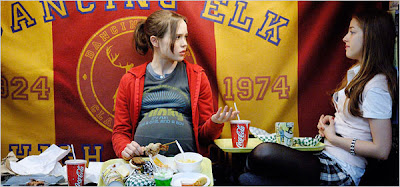 Ellen Page and Olivia Thirlby in Juno, written by Diablo Cody and directed by Jason Reitman
Here's an interview in The Times ahead of Juno's Uk release on 8th February.
And in Written By, Matt Hoey falls head-over-heels.
The waiter arrives with our check. No! Breakfast is finished and our time almost concluded. In humble, nerdy fashion I ask Cody if she will autograph my copy of Candy Girl. She obliges - a memento of our time together!
From her blog to her book to her movie, all the work shares an original voice that is honest, hilarious, and real. As we leave and I pay her this final compliment, she thanks me for the interview (She really, really likes me!) and says, “I'm glad that I have a voice. I think you spend years experimenting with different voices as a writer so when you hit on one that feels real, it's a good feeling.”
She's gone and I think to myself, I wish I'd known a girl like Juno MacGuff when I was in high school. Just like in the movie, she'd tell me I'm the coolest person she's ever met. And that I don't even have to try.
 Ellen Page and Olivia Thirlby in Juno, written by Diablo Cody and directed by Jason Reitman
Friday, January 18, 2008
NPA networking event in collaboration with the Writers' Guild
New Producers Alliance and the Writers' Guild are pleased to announce a post-New-Year networking session on Wednesday 23rd January.
This event will be held The Verge,114 Bethnal Green Road, E2 6DG from 6:30pm until 9pm and is geared towards writers wishing to meet producers and vice versa. Please bring along business cards and a networking hat. To book your free place please email admin@npa.org.uk .
Weblink to map to get to The Verge. The nearest tubes to the venue are either Liverpool Street or Bethnal Green ( 5 min bus ride or 12 min walk from each).
Arts Council latest
In The Stage, Alistair Smith reports on a war or words between National Theatre Artistic Director, Nicholas Hytner and Arts Council England (ACE) Chief Executive, Peter Hewitt.
Peter Hewitt has defended the funding body against criticisms from National Theatre artistic director Nicholas Hytner, by claiming that the organisation has received “a large number of communications welcoming both the strategy” and “specific proposals” of its latest funding round.Meanhile, on The Guardian's Theatre Blog, Lyn Gardner looks at what happens now that organisations have submitted their appeals against funding cuts.
Speaking at the NT’s season launch yesterday, Hytner said that ACE should be “encouraged to act boldly”, but branded its recent funding proposals as “bollocks”, and its spending review a “strategic catastrophe”.
Today, Hewitt responded: “It is pleasing that the director of the National Theatre and others so strongly support the arts council’s arts funding strategy - in Hytner’s words, ‘being encouraged to act boldly, otherwise new companies and new ideas would not emerge’. But it is disappointing that they are less able to countenance the practical consequences of that strategy, which means reducing or not renewing funding to some organisations, in order to create a vibrant artistic culture.
The timetable continues with the meeting of the national council on January 29 2008, which will consider any funding of organisations over £5m and which will also have to approve the budget for the whole of the proposed expenditure. What is clear, according to the Arts Council, is that the amount of money available is fixed. If any of the proposed cuts do not happen, then the money will have to be shaved from the budgets of either those who have been offered continued inflation-level funding, uplifts or some of those 80 organisations (whose identity is not yet known) who are going to get revenue funding.
US directors sign deal with producers
The Directors Guild of America have signed a new deal with producers.
“Two words describe this agreement - groundbreaking and substantial,” said Gil Cates, chair of the DGA's Negotiations Committee, in announcing the terms of the new agreement. “The gains in this contract for directors and their teams are extraordinary – and there are no rollbacks of any kind.”The Writers Guild of America has issued the following response:
Now that the DGA has reached a tentative agreement with the AMPTP, the terms of the deal will be carefully analyzed and evaluated by the WGA, the WGA's Negotiating Committee, the WGAW Board of Directors, and the WGAE Council. We will work with the full membership of both Guilds to discuss our strategies for our own negotiations and contract goals and how they may be affected by such a deal.
For over a month, we have been urging the conglomerates to return to the table and bargain in good faith. They have chosen to negotiate with the DGA instead. Now that those negotiations are completed, the AMPTP must return to the process of bargaining with the WGA. We hope that the DGA's tentative agreement will be a step forward in our effort to negotiate an agreement that is in the best interests of all writers.
Licence fee could be shared
From Owen Gibson for Media Guardian:
The government last night said the BBC's licence fee could be shared with other broadcasters to pay for public service programming. The culture secretary, James Purnell, promised to be "bold" in devising a new structure for broadcasting and may bring forward legislation to preserve the public service ethos in the digital world.
It is the first time the government has admitted it is considering the move and Purnell said it would be "perverse" not to ask whether or not some of the licence fee should go to other providers. He asked: "Do we think it's sustainable for every penny of the licence fee to go to a single organisation in an industry which now has very many providers?"
He is believed to have decided to address the issue head on after the BBC's chairman, Sir Michael Lyons, suggested that "top slicing" the licence fee might harm the corporation's output.
Thursday, January 17, 2008
Arts world unites to complain about Arts Council
As Alistair Smith reports for The Stage, the Arts world has united in a letter to Culture Secretary James Purnell to voice “grave concerns” over the way Arts Council England has handled its recent funding announcement. The letter is written by the National Campaign for the Arts and signed by all the major industry bodies including the Writers' Guild.
It... complains that ACE’s proposals “do not always appear to be based on solid, reliable evidence” and that data used by the council to come to its decisions was, in some cases, “inaccurate and flawed”.
The letter continues: “The timing and the lack of notice for these proposals contravene government’s own compact about how public bodies should deal with voluntary sector organisations (which many arts organisations are). In the past, ACE has tried to ensure an adequate notice and preparation period when taking funding decisions, and has always advised that the sector does the same in regard to its own long-term planning. In fact, the council’s own disinvestment policy refers to timescales of a six-month notice period. It is worrying that ACE is not following its own advice in this instance.
“While we absolutely support the arm’s-length principle, we feel that this situation is of such seriousness that it merits closer inspection.”
Chris Chibnall interview
BBC Writersroom has published an interview with Chris Chibnall, the lead writer of Torchwood. 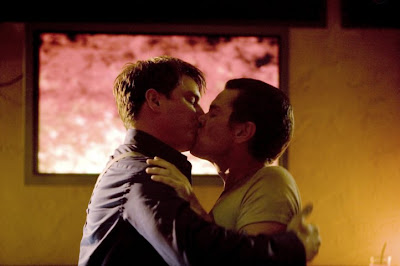 Captain Jack (John Barrowman) gets up close and personal with Captain John (James Marsters)in the new series of Torchwood (Photo: Adrian Rogers/BBC)
The key to it is emotional reality. In terms of images, pictures, and concepts, you can go as far as you like as long as it's grounded in relatable human emotions for the team. The Torchwood quintet are the way in for the audience – they should be seeing absolutely extraordinary things, whether it's a time agent or a huge animal beyond comprehensible size, but everything comes back to how that affects the team and their reaction. If you or I were in that situation how would we feel?
 Captain Jack (John Barrowman) gets up close and personal with Captain John (James Marsters)in the new series of Torchwood (Photo: Adrian Rogers/BBC)
Tuesday, January 15, 2008
Martin McDonagh, from theatre to film
In The New York Times, Sylvaine Gold talks to playwright Martin McDonagh about In Bruges, the feature film he has written and directed.
“In Bruges,” which opens [in America] Feb. 8, was not supposed to be Mr. McDonagh’s first feature. He had been writing screenplays along with his plays, though he found them much more difficult. “You can write eight scenes, and that’s a play,” he said. “Eight scenes can be the first half-page in a film.” He found “the jigsawlike” elements of screenwriting — “the idea that you can jump back in time, space, and come back” — unnerving. Still, he said, he kept at it, and “each one was getting a little better.”In Bruges trailer
The McMaster Review
Against an unhelpful background of the Arts Council's recent funding review, Sir Brian McMaster, former Director of the Edinburgh International Festival, has been undertaking a review for the government into how the arts are supported.
Launching the report last week, Sir Brian said:
Launching the report last week, Sir Brian said:
“British society today is, I believe, the most exciting there has ever been. It has the potential to create the greatest art ever produced. We could even be on the verge of another Renaissance. So we should do all we can to make this happen. That means moving away from simplistic targets and recognising instead the profound value of art and culture in itself.Critic Michael Billington has hailed the document:
“I have found a hunger in the cultural sector for public funding to be more ambitious, and to lift the pressures that favour financial and artistic safety. My recommendations are founded on the simple belief that we have a genuine opportunity to build on our success so far and create some of the most exciting culture the world has ever seen.”
Unusually for such reports, McMaster's is full of radical ideas. The biggest is free admission to publicly funded arts organisations for a week. Clearly that raises an equally big question: how do companies make up for loss of box-office revenue? I'd modify the idea to six "free" days scattered through the year rather than one big-bang week. But, whichever way you look at it, it's a bold, brilliant concept that would open hitherto closed doors. McMaster has lots of other schemes up his sleeve. Ten-year-funding cycles for 10 specially targeted groups. A communal knowledge bank on which boards and trusts can draw before making key appointments. Above all, allowing arts groups to be assessed by their peers in the pursuit of excellence.However, as Billington acknowledges, quite how any of this can be put into action if the arts community has lost confidence in funding bodies, remains to be seen.
Sean O'Brien win T.S. Eliot Prize
Forward Prize winner Sean O'Brien has done an unprecedented double by winning the prestigious 2007 T.S. Eliot Prize as well.
As Dalya Alberge reports in The Times:
As Dalya Alberge reports in The Times:
Peter Porter, chairman of the judges, said: “Sean O’Brien is undoubtedly a major artist, a consistently good poet who sees us living in the middle of a kind of detritus left over from the 19th century . . . In The Drowned Book it’s almost as though he’s seeing into a kind of pool in which the past is there, held in a sort of suspension that’s still around in the 20th century. What’s exhilarating is the way he puts words together, his sentence structure.”
Monday, January 14, 2008
So You Want To Be A Playwright ?
Are you interested in writing for theatre? Would you like find out more about how to get started? If so then this event on Monday 17th March at The Writers' Guild Centre, 17 Britannia Street, London WC1X 9JN from 7 until 9pm is for you.
The session will focus on getting your first commission, building relationships with theatres and the initiatives and opportunities available to new playwrights.
Panelists include Writers' Guild President and playwright David Edgar (Nicholas Nickleby and Destiny) and playwright Kwame Kwei Armah (Statement of Regret and Elmina's Kitchen). Further speakers will be announced shortly.
Tickets cost £5 for Guild members and New Writing South Members and £7.50 for non-members. If you would like to attend please send a cheque payable to The Writers' Guild to 'So you want to be a Playwright?', Writers' Guild of Great Britain, 15-17 Britannia Street, London, WC1X 9JN.
For more information please email : moe@writersguild.org.uk or call 0207 833 0777.
Meet the Agents - Part 3 ( Brighton)
The Writers' Guild in collaboration with New Writing South will be hosting the third in its series of Meet the Agents events. The session will be held on Monday 18th February at the Nightingale Theatre, 29- 30 Surrey Street , Brighton, BN1 3BE from 7- 9:30pm.
The evening offers an informal opportunity to meet with agents working with playwrights, screenwriters and film and prose writers. Find out if you need an agent, what agents do and how and when an agent can help your career.
Speakers include Elaine Steel from the Elaine Steel Agency. Other panelists will be announced shortly.
Tickets for this event will be £5 for Guild and New Writing South Members and £20.00 for non-members. If you would like to attend please contact the New Writing South office on 01273 735353 or book online .
The Revival of The Audience Sitcom
The Writers' Guild presents The Revival of The Audience Sitcom on Tuesday 12th February from 7pm until 9pm. The event will be held at the Writers' Guild Centre, 17 Britannia Street, London WC1 9JN.
Despite numerous pronouncements of its imminent death the audience sitcom is alive, well, and re-inventing itself for the 21st Century. With The IT Crowd, Channel 4's first audience hit since 'Black Books', BBC1's Not Going Out and After You've Gone all re-commissioned for third series - and ITV re-entering the market with Teenage Kicks - the signs are good for television's most loved (and hated) format.
We've assembled an all-star panel to discuss the revival, and offer us pointers to the future. Joining us on the night will be Lucy Lumsden(Comedy Commissioning Editor, BBC), Beryl Vertue OBE (Producer of Coupling, Men Behaving Badly and countless hit shows), Ian Brown and James Hendrie(Writer-Producers of After You've Gone and My Family) and Charlie Hanson (Producer of Not Going Out). More names to be confirmed.
The discussion will be chaired by writer and comedian Dave Cohen (My Family)
Tickets for this event will be £5 for Guild members and £10.00 for non-members. If you would like to attend this exciting event please send a cheque payable to The Writers' Guild to 'The Revival of The Audience Sitcom', Writers' Guild of Great Britain, 15-17 Britannia Street, London, WC1X 9JN.
For more information email : moe@writersguild.org.uk or call 0207 833 0777.
'No confidence' after Arts Council cuts
On the Writers' Guild website, playwright and Guild Theatre Committee member Amanda Whittington has written her account of the stormy Equity-organised meeting with Arts Council England (ACE) last week.
Meanwhile, press coverage of the controversial proposed funding cuts continues in The Observer and The Guardian.
Organisations have until tomorrow to register protests over cuts, before ACE announces its final decisions early next month.
Meanwhile, press coverage of the controversial proposed funding cuts continues in The Observer and The Guardian.
Organisations have until tomorrow to register protests over cuts, before ACE announces its final decisions early next month.
Friday, January 11, 2008
Trial scripts
A guest post from Gail Renard, Chair of the Guild's TV Committee:
Calling all TV writers! The Guild recently has received queries from members writing trial scripts, particularly for long-running series. There seem to be many variations on the theme. Sometimes writers are well paid; other times not at all. Sometimes the scripts are used; sometimes binned. The feedback from production personnel on these scripts runs the gamut from helpful to you must be joking.
The Guild takes the working conditions and welfare of writers seriously, so we’re gathering information about how production companies and broadcasters elicit, pay for (or not) and contract trial scripts. If you have an experience to share (good or bad; experienced writer or novice) then we'd love to hear from you. Of course all info will be treated as confidential.
Email your comments to Naomi at naomi@writersguild.org.uk
As ever, you speak and the Guild acts!
Tributes to Catherine Wearing
Tributes have been paid to BAFTA-winning producer, Catherine Wearing, reports Ben Dowell in The Guardian, following her sudden death at the age of 41.
Her producing credits for the BBC include Sandy Welch's adaptation of Our Mutual Friend, A Mug's Game by Donna Franceschild, Nature Boy by Bryan Elsley and series two of Common As Muck, written by William Ivory.
Her credits outside the BBC include two series of Rose and Maloney, written by Bryan Elsley and Peter Flannery and Second Generation, written by Neil Biswas.
William Ivory told The Guardian:
"Both as a script editor and a producer Catherine was something of a rarity in that her primary concern was always to realise the writer's voice before all else. She was a hard taskmaster but her relentless drive to get to the heart of a script or an idea ... or a single scene was invariably predicated by 'What do you want to say?'....
"She bothered with the thorny issues of scheduling, star names and what the broadcasters wanted, only when the heart of the piece had been thus settled."
Thursday, January 10, 2008
Moxie Makers - The Big Pitch 2008
Moxie Makers, a "micro studio" managed by Ipso Facto Films, has launched The Big Pitch 2008.
The closing date for applications is noon on 22 February 2008.
Moxie Makers and our Partners are proud to present The Big Pitch.Applications are invited from production teams (director, writer, producer) or writers alone. Full details are in the Guidelines for Applicants - writers (pdf), including that applicants must:
The Big Pitch will provide comprehensive training and development for six producer/writer/director teams as they compete to win the most dynamic feature film pitching competition and the largest film production prize in the UK.
The Big Pitch is looking for:The winner of The Big Pitch 2008 will receive production finance from Moxie Makers for their film (a minimum of £150,000) together with a post-production deal with Molinare, guaranteed UK distribution with Soda Makers and international sales representation with Moxiehouse Entertainment. The film will receive its red-carpet Gala Premiere as part of the Northern Lights Film Festival in 2009.
- fresh, original and dynamic work in a recognised genre
- diverse and innovative, up and coming filmmakers
- commercially orientated projects that can find an audience in the UK and around the world
- projects that can be realised on budgets up to £250,000.
- be resident in the UK
- have the demonstrable professional talent to realistically achieve the project on budget and within the timeframes outlined in the schedule
- have a feature film project already at a developed script stage.
The closing date for applications is noon on 22 February 2008.
Adapting short stories
On the Picador blog, Bruon Vincent argues that adapted short stories often make better films than adapted novels.
It seems to benefit both forms: it allows all of the event in the short story to be included and given proper space. It also allows the filmmaker to expand rather than condense.
Novelists' distractions
For Media Circus, Tim Dowling considers the five biggest distractions faced by novelists.
Try to arrange things so that there are several flights of stairs between you and anything remotely worth eating. My office is in the attic of our house and the kitchen is on the ground floor, so when I weigh up the choice between starting a new chapter and having some toast, I have to factor in the journey. This is, of course, exactly the wrong way round - walking down the stairs is no real bother, and once I am in the kitchen the prospect of going all the way back up again means that making several dozen profiteroles shaped like swans suddenly seems a better use of my time.
Equity meeting with Arts Council England
An Equity-organised meeting with the Arts Council England (ACE) brought theatre professionals face-to-face with ACE chief executive Peter Hewitt yesterday for some angry exchanges about proposed funding cuts. The Guild was well represented and we'll have a report on our website soon.
In the meantime, here's an account in The Times, and Lyn Gardner's comments.
In the meantime, here's an account in The Times, and Lyn Gardner's comments.
By the end of the meeting Hewitt did look visibly shaken, and several times struggled to keep his anger under control. If he is a wise man, he will have rushed back to the office and demanded to see every scrap of evidence on which each and every one of these decisions has been made. Hewitt leaves the Arts Council at the end of the month, and the mess he leaves is wretched. He'll be gone - but the arts community will be living with it for years to come.
Wednesday, January 09, 2008
Tony Jordan's soap gamble
Tomorrow night ITV1 will broadcast a new prime time soap, Echo Beach. Risky enough, you might think. But not as risky as showing a behind the scenes 'mockumentary', Moving Wallpaper beforehand, and running the two shows in parallel every week.
The man behind the concept is writer and producer, Tony Jordan. He tells BBC News why he thinks it will succeed.
The man behind the concept is writer and producer, Tony Jordan. He tells BBC News why he thinks it will succeed.
Jordan is convinced the concept is easier to sell on screen than it is on paper.
"It's not breaking new ground," he concludes. "It's a sitcom and a soap."
Tuesday, January 08, 2008
Strike kills off Golden Globes ceremony
Hollywood suits might not listen to striking writers outside their studio lots, but the silence emanating from what would have been the Golden Globes ceremony on Sunday will be deafening. As Steven Zeitchik explains for the Hollywood Reporter, all that will take place is a short press conference - actors and other talent are refusing to cross Writers Guild of America picket lines to pick up their gongs.
Next month's Oscars could also be in doubt. As BBC News reports:
Next month's Oscars could also be in doubt. As BBC News reports:
On Saturday, the Screen Actors' Guild, the union which represents Hollywood actors, said there was "unanimous agreement" among members not to cross picket lines set up by writers.
The WGA thanked the actors' union for its "solidarity and support".
It says it is engaged in a "crucial struggle that will protect our income and intellectual property rights for generations to come".
Monday, January 07, 2008
Attacking Arts Council cuts
In The Times, director Holly Kendrick speaks out against the withdrawal of the Arts Council grant to the National Student Drama Festival.
Manwhile, in The Guardian, Guild President David Edgar attacks the cut in The Bush Theatre's grant by 40%.
Manwhile, in The Guardian, Guild President David Edgar attacks the cut in The Bush Theatre's grant by 40%.
From its tiny theatre on Shepherd's Bush Green, the Bush not only presents, tours and transfers new plays by upcoming and established writers (as it has done for over 30 years), but its unique skills and experience enables it regularly to risk putting on playwrights' first plays.
Its literary department reads 1,000 scripts a year and reports on them to their authors, distributes bursaries, mounts workshops, commissions playwrights. This winter, two Bush plays by unknown writers (Jack Thorne and Abbie Spallen) play off-Broadway. It is this work - the seedcorn of British playwriting in the future - which would be threatened if this proposed cut is implemented.
Persuading DCI Hunt to return
In The Guardian, writers Ashley Pharoah and Matthew Graham attempt to persuade DCI Gene Hunt to return for Ashes To Ashes, a follow up to Life On Mars.
ASHLEY PHAROAH: OK, we've been asked by the Guardian to discuss why we've made a sequel to Life On Mars.
MATTHEW GRAHAM: It's a fair question. After Sam Tyler died in -
GENE HUNT: (Sneering) The Guardian? Bunch of snivelling pinkos and sandal-wearing poofs. We had an outdoor lav when I was a kid and my Dad wouldn't even let us wipe our arses on it.
MATTHEW GRAHAM: We were all taken aback by the success of Life On Mars and by the response to the last episode -
ASHLEY PHAROAH: Which was a fine piece of writing, Matthew, if I may say so.
MATTHEW GRAHAM: (Modest) Thank you, Ashley. There are still so many stories to tell, stories that can only be told in a series like this.
ASHLEY PHAROAH: Social realism has been the dominant narrative form in television for decades now. As writers it's incredibly exciting to break out of that straitjacket, to explore that "other" wing of British storytelling, the tradition of Blake and Wells and Pressburger and Powell and Terry Nation.
GENE HUNT: Unemployed Scouse postmen shouting at their wives. That's real television.
US strike continues
As the US writers' strike continues, in The LA Times Thom Taylor argues that the studios are making the same mistakes as during the last dispute in 1988.
During the 1988 strike, writers worked independently on "spec scripts" (written on the speculation that they would eventually sell them) and a pipeline-dry studio system snapped them up. TV producers also sought alternatives to traditional, high-cost scripted series. The strike resulted in the 1990s' spec script boom and reality television -- two new business models.
It's not strikers' demands but the work stoppage itself that creates a new paradigm. By fighting the writers over the new-media issues today, the studios are effectively creating what they fear most: a major tectonic shift in the entertainment business that will reduce the role of the studios even further.
Friday, January 04, 2008
How to get your first novel published
Catherine O'Flynn's debut novel, What Was Lost, was rejected by 14 agents, before winning the Costa First Novel Award this week.
So, in The Independent Boyd Tonkin asks "What should you do if you want to get your first novel published?"
So, in The Independent Boyd Tonkin asks "What should you do if you want to get your first novel published?"
George MacDonald Fraser obituaries
Novelist and scriptwriter George MacDonald Fraser has died at the age of 82. The creator of the Flashman novels also wrote numerous screenplays including Octopussy (with Richard Maibaum & Michael G. Wilson, based on the stories by Ian Fleming).
There are obituaries in all the major newspapers including The Telegraph, The Guardian, The Times and The Independent .
There are obituaries in all the major newspapers including The Telegraph, The Guardian, The Times and The Independent .
It needed only a few moments exposure to one of his reminiscing public performances to establish that George MacDonald Fraser had led quite a life. His experiences included being held upside down by his heels, while strafed by Japanese sniper fire, as he foraged for water during the Burma Campaign of the Second World War, basking in the admiration of Charlie Chaplin and worrying about whether Burt Lancaster disliked his film scripts. Posterity, on the other hand, will remember him for a single achievement. This was the creation, or rather the re-creation, of Harry Flashman, originally the villain of Thomas Hughes's Victorian morality tale Tom Brown's Schooldays (1857), but remodelled, under MacDonald Fraser's expert grasp, into the star of a dozen books that changed the face of British historical fiction.
Neil Cross interview
On the BBC Writersroom, novelist and scriptwriter Neil Cross talks about his writing life.
As a novelist, I'm slightly suspicious of outlines. When I was a teenager I read a book about becoming a writer which cautioned - wisely, I think - against telling anybody your plot, even yourself, before you've actually written it. This is because writing, as much as reading, a novel is a process of storytelling. Once a story is told, it's told - and telling it, even verbally, diminishes the imperative to tell it again. So for novels, I tend to keep the story to myself and work from the loosest possible guidelines. I very rarely have much of an idea where a book is going next, although usually I know where its going to end up.
Thursday, January 03, 2008
Friend or Foe - Working with Directors
An update on an upcoming Guild event:
The first in a series of discussions on screenwriters' working lives will be held on Monday 21st January 2008 from 7pm - 8:30pm at the Writers' Guild Centre in King’s Cross and will focus on the working relationship between screenwriters and directors.
The panel includes screenwriters Tony Grisoni who has worked with directors including Terry Gilliam, Michael Winterbottom, Jon Amiel and Gillian Armstrong, and has scripted a fantastic slate of films including The Lives of the Saints, In This World, Fear and Loathing in Las Vegas, and the brilliant Laurence Coriat (writer of three Michael Winterbottom films including Wonderland and the innovative Seven Days).
If you’re interested in hearing how some of the UK’s most successful writers and directors work together then this event is for you! There will be a panel discussion with a Q&A session afterwards. Refreshments will be served.
Tickets for this event will be £5 for Guild members and £7.50 for non-members. If you would like to attend this exciting event please send a cheque payable to the Writers' Guild to ‘ Friend or Foe - Working with Directors ’, Writers' Guild of Great Britain, 15-17 Britannia Street, London, WC1X 9JN. Alternatively please email moe@writersguild.org.uk or call 0207 833 0777
Challenging the 'liberal consensus' on stage
In The Telegraph, Dominic Cavendish goes in search of right wing plays.
Canvassing the opinions of three artistic directors at the heart of the new writing culture, I was struck by a number of things: on the one hand, there remains a disheartening willingness to caricature "Right wing" as the embodiment of all that is reactionary and simplistic; on the other, all three declared themselves willing to stage work that tested liberal pieties.
Edward Bond interview
In The Guardian, Michael Billington talks to playwright Edward Bond whose play The Sea is being revived at the Theatre Royal Haymarket from January 17.
What is sad is that Bond's attempts to deal with the big issues of our time go largely unseen in Britain. Paris has become his working home, where the Theatre National de la Colline is staging a five-play cycle addressing what Bond calls "the search for human freedom". But it is difficult to determine where the blame lies for Bond's cultural isolation. He talks to me of the "nightmare" of staging his own play, The Woman, at the National in 1978: "It was a nightmare to do because the whole place was run like a biscuit factory. We had a run-through of The Woman and it was fantastic. I went back to see it after it had been playing for a week and the actors were doing it as if it were Tom Stoppard. They were doing 'theatre'. But drama is not 'theatre'. When I first went to work at the Colline, people said, 'You remind us of why we became actors.' For the French, there is a tradition of using art, drama and painting to create an interpretation of human society."
Wednesday, January 02, 2008
BBC iPlayer launched
 The BBC have launched their online watch-again service, BBC iPlayer. Many BBC shows will be available for seven days after first broadcast. At the moment downloads only work on Microsoft XP or Vista, but Mac and Linus users can still stream programmes.
Andrew Davies on Sense And Sensibility
In The Times, Rosie Millard talks to Andrew Davies about his new adaptation of Jane Austen's Sense And Sensibility which started on BBC One last night.
“I think Jane Austen should have written another draft of Sense and Sensibility. There are quite a few odd little things in it, and I think she published it before she needed to. She left all sorts of 18th-century stuff in it, which shouldn’t be in there. And left lots of things out. So I thought, ‘Let’s put these things in’.”
Forty libraries lost in 2007
From Ciar Byrne in The Independent
Margaret Hodge, the minister responsible for libraries, has conceded that a net 40 libraries have been closed in the past year. In the West Midlands, Dudley council revealed plans to shut five, prompting Ms Hodge to step in to ask how the needs of residents could be met, although she admitted there was little she could do to prevent the closures going ahead...
The novelist Will Self, who campaigned against cuts to his local library in Lambeth, south London, believes the trend for libraries to have coffee shops, DVD rentals and internet access is a diversion from their primary purpose – providing books. "Libraries are the bedrock of literate culture."
Remembering Bugs
On his blog, Stephen Gallagher recalls writing episodes for hit nineties Saturday-night drama, Bugs.
I tackled every story thinking it would be my last. I didn't warm to every aspect of the format - I suppose my natural urge was to Goth it up a bit to contrast/juxtapose with all the shiny docklands architecture - but I worked within the style and had more fun than any series writer can decently hope for.As a prompt for the hard of memory, here's the title sequence:
Damehood for Jacqueline Wilson
Among those receiving honours in the New Year list was children's writer Jacqueline Wilson, reports BBC News.
In a career spanning 35 years, she has sold more than 30 million books and, for the past four years, has been the most-borrowed author in British libraries.
Her most famous creation, Tracy Beaker, is a 10-year-old girl placed in a care home as a result of domestic violence.
But Wilson has written more than 80 books, many dealing with gritty social subjects such as teenage pregnancy, divorce and failed suicides.
Thursday, December 20, 2007
British Council to disband specialist departments
In The Daily Telegraph, Richard Dorment laments the news that the British Council is set to close many of its specialist departments including those dealing with film, drama and literature.
Earlier this year the executive board abolished all the advisory panels - the writers, curators, museum directors and musicians who freely gave their professional advice and expertise to the council. Now the staff are being reorganised to focus on the following areas: "Progressive Facilitation", "Market Intelligence Network", "Knowledge Transfer Function" and "Modern Pioneer". If you have no idea what that gobbledygook management speak means, don't worry: neither does anyone else. All we do know is that the council will no longer deliver the arts internationally, and that this will happen when the thirst for British arts has never been greater. What an incalculable loss.
Coping with rejection
On the 5th Estate blog, Daniel Clay recalls coping with years of rejections before an agent finally took on his novel, Broken.
There’s no pretending rejection doesn’t hurt, but some rejections hurt less than others. The slush pile rejections I received rarely offered a specific reason for why I was being rejected, so it was just a case of crossing these agents off the list and sending out my next submission. I tried to look on these as the literary equivalent of a blind date not turning up – not exactly nice, but not exactly personal, either.
The hardest rejections were the near misses, and it’s frightening how close I came to giving up on Broken because of one specific rejection.
The Rocking Horse by Arnold Wesker
Yesterday, to mark its 75th anniversary, BBC World Service broadcast The Rocking Horse, a new play by Arnold Wesker.
There's an interview with Wesker on BBC News, and you can listen again (for a limited time) online.
There's an interview with Wesker on BBC News, and you can listen again (for a limited time) online.
Tuesday, December 18, 2007
Guild events next month
Early warning for two Guild events next month:
Friend or Foe - Working with Directors
The Guild's Film Committee will be holding an event focusing on how film screenwriters and film directors work together. There will be general discussion and then a Q&A session afterwards.
The event will be held at the Writers' Guild Centre in King’s Cross on Monday 21st January 2008 from 7pm - 8:30pm.
Speakers will be announced shortly.
Tickets for this event will be £5 for Guild members and £7.50 for non-members. If you would like to attend this exciting event please send a cheque payable to the ' Writers' Guild' to ‘ Friend or Foe - Working with Directors ’, Writers' Guild of Great Britain, 15-17 Britannia Street, London, WC1X 9JN. Or please email : moe@writersguild.org.uk or call 0207 833 0777.
New Members Evening
The Writers' Guild will be hosting a new members evening on Tuesday 29th January 2008 from 7pm - 9pm at the Writers' Guild Centre, 17 Britannia Street, King's Cross, London WC1X 9JN.
The event will be a good opportunity to learn more about the Guild and the work that we will be doing on your behalf in 2008. You will also have a chance to meet and hear from the chairs of the Guild's craft committees, members of the EC Council, the General Secretary and other Guild staff.
Please RSVP to moe@writersguild.org.uk or call 0207 833 0777 if you are able to attend.
A Pitch In Time
The Cheltenham Screenwriters' Festival pitching contest is now open for submissions.
As well as the opportunity to pitch your idea you will also be able to network with other writers, producers, directors and developers by selling your idea and yourself. So as well as pitching your idea to the live audience, you may also get the chance to pitch to a producer that may be interested in optioning you or an agent who may be interested in signing you up.
Arts Council funding
From Mark Brown in The Guardian:
Nearly 200 arts organisations in England have been told that their funding will end from next April in the biggest and most bloody cull since the Arts Council was set up more than 50 years ago.No official list of winners and losers has yet been released, but as The Stage reports, the funding review has upset many organisations.
Pre-Christmas letters from Arts Council England have been dropping on the mats of groups across the arts, telling them they cannot expect to continue receiving public money.
Many organisations will, however, have had good news. Of the 990 bodies which get funding, three-quarters have been told to expect inflation or above rises.
Richard Pulford, a former deputy secretary general of the arts council and now chief executive of the Society of London Theatre and the Theatrical Management Association - many of whose members have been affected - told The Stage he was “extremely unhappy at both the process and the outcomes” of ACE’s decisions.There's also comment from Lyn Gardner on The Guardian's Theatre Blog.
He added: “It seems extraordinary to me there could have been nearly 200 organisations that were worth funding this year, that aren’t next year. It looks like cutting for the sake of cutting. I don’t understand the rationale for it. We are very concerned that many organisations were given little or no forewarning and some have been cut by regional offices when they aren’t regional organisations. There seems to be no central policy.
“If you are cutting around a quarter of your portfolio, then there must have been something wrong with your portfolio in the first place - and whose fault is that?”
Monday, December 17, 2007
Lisa Appignanesi elected President of English PEN
Novelist and critic Lisa Appignanesi has been elected as the twenty-fourth President of the writers’ organisation English PEN.
Appignanesi has announced a campaign to repeal the law of blasphemous libel.
"Despite significant victories, the battle for imaginative free expression is far from over," she said. "This year has seen the sentencing of Samina Malik simply for possessing books and poems, whilst the film of Monica Ali’s Brick Lane almost didn’t happen because of censorious protests. Meanwhile, the producers of Jerry Springer the Opera continue to be threatened with charges of blasphemy. The law of blasphemous libel is not only obsolete; it contravenes our right to free expression under Article 10 of the European Convention on Human Rights. It has no place in our plural society, where it can only divide people of different faiths and none. It is high time that the law of blasphemous libel is revoked."
Andrew Wylie interview
On Portfolio.com, Lloyd Grove talks to one of the world's leading literary agents, Andrew Wylie.
...the key point in the business is that the investment is made in the wrong areas in the business, and I think that quality — which is more valuable over time — has been undervalued, and quantity — which is less valuable over time — has been overvalued. And I think this is a reaction to the dominance of the influence of the chains. In England right now, this is a catastrophe. The retail side is leading the business by the nose, and publishers have not reacted with sufficient strength, and they should have. And so the business in England is just in the tank basically.
Cast your votes in Collecting Society election
An official statement from the WGGB:
Many members of the Writers’ Guild of Great Britain will shortly receive voting papers for a ballot to fill vacancies on the board of the Authors’ Licensing & Collecting Society Ltd.
You must use all four of your votes, and the Guild recommends that you cast them for the four Guild members who are standing – Edel Brosnan, Gail Renard, Hugh Stoddart and Robert Taylor.
It is more important than ever this year, as changes in the constitution of ALCS mean that the Guild no longer has any right to nominate representatives directly on to the board. Unless one or more of our members wins a seat, the Guild could be unrepresented.
ALCS collects millions of pounds each year from photocopying licences and fees for the overseas cable retransmission of UK television channels and programmes. The Guild is concerned that ALCS may tend to give more attention to photocopying than to audiovisual issues, and a strong vote for Guild candidates would help to avoid this problem.
It is very tough for Guild candidates to be elected, as Guild members are heavily outnumbered within ALCS by scientists, academics and book writers.
You should receive your voting papers within the next few days. Please deal with them immediately – despite the Christmas holiday, the closing date is early in the New Year.
Please also note that ALCS has introduced a strange rule that your ballot paper will not be counted unless you use all four votes. This is different from council and trade union elections, where you can use as many votes as you like up to the maximum number.
Gail Renard, Chair of the Guild's TV Committee, adds:
The ALCS ballot papers are plopping onto your doormats now, and we urge you to follow the Guild’s recommendations and vote for our four candidates: Edel Brosnan, Hugh Stoddart, Robert Taylor and Gail Renard. Edel, Robert and Gail are all current directors of ALCS, who are standing again for our seats. During our time, we’ve been instrumental in lowering ALCS’s commission rate considerably, but we feel there’s still much further to go. And it’s paramount, in this digital age, to find writers as many new sources of income as we can, without sacrificing any of our primary royalties.
ALCS do a lot of good work but Guild members and TV, film and radio writers are greatly outnumbered, although we few bring in about one third of ALCS’s income… almost £6 million a year. The Guild is concerned that ALCS may tend to give more attention to photocopying than to audiovisual issues, so we need reps at ALCS who are up to speed with our profession and its practices. A strong vote for the four Guild candidates would ensure we would all continue to be represented and protected.
Always remember that the money you receive is not a gift from ALCS or manna from heaven. These are your residuals, which literally means the remainder of your payment. Your initial fee takes into consideration the royalties and residuals which you’ll receive in the future; your ALCS money being one of them. It’s your part of your pay and you’ve earned every penny.
We are also committed to investigating the serious issue of secondary commissions. Often the payment you receive from ALCS has already been reduced by up to 40% by the time it’s included other commissions, handling fees and cultural levies imposed by foreign collecting societies and agencies. We will ensure that the ALCS investigates these amounts and re-negotiates contracts wherever exorbitant fees are deducted.
Your vote is vital. We’ll need each and every one of them to win, so please pass this info onto all the writers you know. Also, due to a vagary of the ALCS election, you must vote for four candidates using black ink or your ballot paper will count as spoilt. You don’t have long to return the papers, so please do it immediately. Help us to protect your income, now and in the future. It’s your money!
Friday, December 14, 2007
Save Kids TV blog
There's a new blog, Kids' Character In Search Of A Slot, supporting the Save Kids TV campaign.
I was so excited last night I woke up extra early, even before the pigeons. When I got to ITV land, everyone was asleep except for some Hoobs. Have you noticed how the elderly get up really early? And they forget things a lot? That must be why there are so many old shows repeated first thing in the morning.
Thursday, December 13, 2007
Yorke unveils drama series code of conduct
At a special event at the Writers' Guild last night, John Yorke, BBC Controller Drama Production Studios, unveiled a new code of conduct to cover drama series' work with writers.
In a wide-ranging speech, Yorke explained how he and his team have worked to put writers at the heart of the creative process on drama series. There had, he admitted, been difficulties on shows including Casualty and EastEnders in recent years following the big expansion in the number of episodes commissioned each year. We'll be posting a full report on the event on the Guild's website next week.
The code of conduct is as follows:
• All contracted scripts will be acknowledged on receipt, and writers will then be contacted within 24 hours to be given an indication of when notes will be given.
• Where possible notes will be given at face to face meetings or by phone. If notes are to be given by email, a courtesy phone call should precede the email.
• Productions will make allowances for writers’ time constraints where practicable.
• If scripts delivery schedules are changed, a new schedule will be put in place immediately.
• Adequate times must be scheduled for the completion of each draft.
• Writers will be guaranteed a clear editorial contact throughout the script process that covers for any staff leave or absence.
• Where possible, programmes should communicate clearly with writers as to whether they are likely to be used again.
• Writers will be told immediately when scripts are taken away from them, and the percentage rewrite involved will be indicated to them within two weeks.
• Scripts are deemed to be accepted on publication of the production script.
• Rebriefs are paid at a 10% minimum
Wednesday, December 12, 2007
Authors must become brands
On her blog, journalist Danuta Kean argues that for long-term success authors must be turned into brands.
Despite the mixed signals sent by the book trade, authors do break out of the one hit wonderland to establish brand names and long careers. How is it done, and can publishers reinforce brands outside retail promotions? Joanna Prior, marketing and publicity director at Penguin, is adamant it is possible.
Prior has had a hand in the career of a roster of brand name authors, most notably Zadie Smith. Good branding, she believes, is a matter of confidence. “A lot of what it comes from is an unshakable belief that you have the ‘real thing’ on your hands, that you have an author who is going to write for a career not just one book.” Such belief, she believes, should fuel publishers’ confidence to create distinct identities that set authors apart. In the case of Smith this meant an emphasis on her distinctive name using bold cover design and tactical publicity that showcased her as a voice for a new generation.
Peter Orton 1943-2007
Peter Orton, the founder of children's TV producer, HIT Entertainment, has died at the age of 64. There are obituaries in The Times, The Independent and from Simon Forrest in The Guardian.
At its height, HIT Entertainment, was one of the leading international producers of preschool children's programming, second only to Disney and Warner Brothers. Apart from Bob, the stable of characters included Thomas the Tank Engine, Pingu, Sooty, Kipper, Brambly Hedge, Fireman Sam and Captain Pugwash. Peter's strength was knowing what would appeal, combined with an excellent business brain. He also knew enough about his own shortcomings to surround himself with experts. As he said, he couldn't draw, wasn't really creative, not especially numerate, but he hired people who were.
British Library acquires Pinter archive
From BBC News:
The archive of Britain's leading writer and playwright, Harold Pinter, has been acquired by the British Library.
It includes more than 150 boxes of manuscripts, scrapbooks, letters, photographs and emails from the 2005 Nobel Laureate for Literature.
The British Library said it offered an invaluable resource for researchers and scholars of Pinter's work.
The entire collection, including items that have been on loan to the Library since 1993, was purchased for £1.1m...
The archive is to be catalogued and will be completed at the end of 2008.
A small temporary display, His Own Domain: Harold Pinter, A Life in Theatre, will run at the British Library, in London, from 11 January to 13 April.
Tuesday, December 11, 2007
The Lulu diaries
Over on the Guild website we've put up the article by John Morrison from the most recent copy of the Guild's magazine, UK Writer, about online self-publishing with Lulu.com.
I’ve published two non-fiction books with mainstream publishers and a novel under my own steam, so I’m not exactly a blushing virgin. But publishers require long and careful courtship; like Victorian maidens they won’t step out with gentlemen they don’t know, and their long term relationships are often never consummated.
Lulu, by contrast, is a new girl on the block and she doesn’t expect to be showered with expensive gifts and dinners before she delivers the goods.
Jan Etherington's Comedy Writing Course
Guild member and award-winning comedy writer Jan Etherington is launching her first two-day comedy writing course at the Riverside Arts Centre, Sunbury on Thames, Middlesex on 23-24 February 2008.
Jan co-created the prime-time hit television comedy series, Second Thoughts, Faith In The Future, Next of Kin and Duck Patrol plus many radio comedies and is also a successful journalist and broadcaster.
The course includes lunch on both days and a special guest on Sunday – legendary comedy writer, Alan Simpson, who, with Ray Galton, created Hancock’s Half Hour and Steptoe & Son.
Places are very limited, so book early. Special Introductory Offer for the 2 day Course: £130.
For more details visit the website: comedycourse.biz
Tel: 020 8133 0110
Email: comedycourse@hotmail.co.uk
The BBC's new Oliver Twist
In The Times, Daphne Lockyer goes behind the scenes of Sarah Phelps's adaptation of Charles Dickens's Oliver Twist for the BBC.
The choice of Phelps as the adapter is almost a mission statement. She is normally on the writing team of EastEnders and this is her first adaptation of a classic novel. But, as in the BBC’s groundbreaking adaptation of Bleak House, the aim is to give the story an episodic, populist feel. “We wanted a drama that would have resonance even to people who had never picked up a piece of classical literature in their lives,” says Brown.
By choosing Phelps, of course, the BBC also hope to make this version the most gritty and modern of all the Oliver Twist adaptations. “What working in soap teaches you is never to wiffle-waffle around the edges of a story, but to get straight in up to your elbows. And that is exactly what I have tried to do here.”
Monday, December 10, 2007
Doris Lessing's Nobel lecture
2007 Literature laureate, Doris Lessing, delivered her Nobel lecture on Friday - a call for people to recognise the value of books and reading in this country and around the world.
The storyteller is deep inside everyone of us. The story-maker is always with us. Let us suppose our world is attacked by war, by the horrors that we all of us easily imagine. Let us suppose floods wash through our cities, the seas rise ... but the storyteller will be there, for it is our imaginations which shape us, keep us, create us – for good and for ill. It is our stories, the storyteller, that will recreate us, when we are torn, hurt, even destroyed. It is the storyteller, the dream-maker, the myth-maker, that is our phoenix, what we are at our best, when we are our most creative.
EU Online Copyright Bill
From William New for Intellectual Property Watch:
European publishers and copyright holders have a friend in European Information Society Commissioner Viviane Reding, which she reinforced last week in describing efforts to push through a new bill on digital publishing copyrights...On a similar subject, in The Guardian poet Wendy Cope calls for people to respect poets' copyright.
“Copyright is a cornerstone of the information and knowledge-based society,” Reding told the 6 December European Publishers’ Forum. “This is why I introduced in the new framework an appropriate balance between ownership and access.”
A few years ago one of my step-sisters asked me about Jenny Joseph's poem Warning - the one that begins: "When I am an old woman I shall wear purple." My step-sister spends a lot of time in the USA and had heard about the Red Hat Society, a women's organisation inspired by Jenny's poem. As Warning is included in an anthology I edited, I offered to send her a copy. "No," she said. "Don't bother. I'll get it off the internet." That was when it dawned on me that nowadays, if you want a copy of a particular poem, you don't have to buy a book.
Friday, December 07, 2007
US strike talks continue
Talks between the Writers Guild of America and the Alliance of Motion Picture and Television Producers, aimed at ending the ongoing writers' strike, have continued all week
For up-to-date information see the WGA website and the United Hollywood blog.
For up-to-date information see the WGA website and the United Hollywood blog.
Thursday, December 06, 2007
MPs call for tax credits for kids TV
By David Rose for Broadcast:
Political pressure is mounting on ministers to throw a lifeline to stricken independent producers and save UK children's TV.Tax credits for children's TV will be the main subject of the Guild's lobby of MPs at Westminster next week.
Tory and Liberal Democrat media spokesmen backed Labour MPs today in urging the government to respond to the crisis confronting children's programming following ITV's decision to withdraw from the sector.
MPs highlighted the need for an urgent government response by warning that freelance writers, directors and performers were quitting while some companies had already gone to the wall.
As a interim first step, the government was urged to extend tax credits currently available to the film industry to children's television programme makers.
Thanks from the WGA
An open letter from the Writers Guild of America
Dear Members of the International Writers’ Community:
We at the Writers Guild of America extend our heartfelt thanks to members of the international community for your unprecedented and robust outpouring of support for our cause on International Solidarity Day on November 28. We were moved and inspired by the hundreds of scribes who marched in front of the Eiffel Tower in France, at the Brandenburg Gate in Germany, and on the streets of Canada, England, Australia, Spain, Portugal, The Netherlands, Wales, and Mexico. Clearly, our fight to win fair compensation from global media corporations has struck a chord with writers everywhere.
The scope of the protests was truly impressive: In Berlin, over 100 German writers carried WGA picket signs at the Brandenburg Gate. Hundreds of writers marched in freezing temperatures in Montreal and Toronto. In Amsterdam, an auditorium full of writers cheered our cause. We have heard from the Portuguese Screenwriters Guild, the Writers Guild of Great Britain, the International Affiliation of Writers Guilds, the Writers Guild of Canada, the Screenwriters Guild of Germany, and the Federation of Screenwriters in Europe. Members of the Irish Playwrights and Screenwriters Guild marched for our cause dressed as leprechauns!
At home, WGA members with international backgrounds marched at NBC Studios in Burbank, California. Jean-Yves Pitoun, a French native and WGA West member, stressed that the fight in the U.S. has an impact abroad: “Europeans are very carefully watching the writers, actors, and directors in the U.S. because Rupert Murdoch is everywhere.”
We thank you for reinforcing that fair compensation for writers is a worldwide cause. Together our voices will be heard.
Sincerely,
Board of Directors
Writers Guild of America West
Pegg wins Guild Comedy Award
Simon Pegg won the Writers' Guild Ronnie Barker Award at the British Comedy Awards last night.
Peep Show (written by Sam Bain and Jesse Armstrong) was named Best TV Comedy, while Gavin & Stacey (written by Ruth Jones and James Corden) took the award for Best New British Television Comedy.
Update (7.12.07): A first-hand account from Guild TV Comittee Chair, Gail Renard:
Once again the WGGB was proud to be associated with the British Comedy Awards, which glittered like newly whitened teeth despite not being aired live by ITV this year. The Guild reps on the Brit Com panel were Jonathan Harvey, Simon Brett and myself, and we judged our fellow writers as we would ourselves be judged… only they won awards.
The Guild gave its prestigious Writer Of The Year Award to Simon Pegg who, with his various co-writers (Jessica Stevenson, Edgar Wright, Nick Frost, Michael Ian Black et al) has produced many hit TV shows and films. Pegg’s range has been impressive. From the C4 series Spaced to Shaun Of The Dead and Hot Fuzz, Pegg’s brought a lot of joy with both his writing and performing. I’m sure the WGA strike t-shirt we also gave him was the icing on the cake.
The Best TV Comedy Award was won deservedly by Peep Show, and its writers, Sam Bain and Jesse Armstrong; officers, gentlemen and staunch Guild members. It’s hard enough to create an original, laugh-out-loud comedy series, but to sustain it over 4 years with continued excellence, as Peep Show has done, is a tribute to its entire team.
Gavin And Stacey's James Corden and Ruth Jones won three awards between them, and if that doesn’t count as a good night out, I don’t know what does.
As ever the Guild wants to thank Michael Hurll, exec producer and creator of the Brit Coms. In his incredible comedy career, Michael’s produced everyone from Jack Benny to the Two Ronnies. All of us in comedy owe him a great debt. He definitely deserves his own British Comedy Award.
Tuesday, December 04, 2007
Increase of minimum rates for TV writers negotiated with the BBC
The minimum rates for writers commissioned under the WGGB / PMA / BBC TV agreement have been increased by 4% as a result of negotiations between the three parties, effective from 1 November 2007.
The following per minute minimum rates for TV writers will now apply:
The following per minute minimum rates for TV writers will now apply:
- Teleplays: £166.47
- Series/Serials: £151.00
- Dramatisations: £104.34
- Adaptations: £66.06
- Educational Drama: £101.44
- Attendance fees: £88.73
Polly Stenham interview
Last week Polly Stenham won the The Charles Wintour Award for Most Promising Playwright at The Evening Standard Awards. In The Independent, Ciar Byrne meets her.
Stenham, who wrote That Face as part of the Royal Court's Young Writers programme, fell into the theatre almost by accident. "I wanted to write fiction really, but I couldn't find any courses and then I heard about the Royal Court," she said. Writing the play was, "a lot of fun".
She is now "in the murky depths" of writing a second. "It would be completely possible that I now write four or five terrible plays," she said. "You lose your innocence a bit. The first one you just write for you and the complete joy of it."
Monday, December 03, 2007
Channel 4 schools moves online
From Bobbie Johnson for Media Guardian:
For years they have been a fixture of Channel 4's schedules, but next year early morning programmes for schools will become a thing of the past - replaced by a sweeping initiative on the internet.
In a pioneering move for a broadcaster, the £6m annual budget spent on education programmes aimed at teenagers is being moved from traditional TV shows to multimedia projects.
The relevance of sci-fi
In The Sunday Times, Brian Appleyard argues that science-fiction writing is more relevant than ever.
“The truth is,” [Brian] Aldiss has written, “that we are at last living in an SF scenario.” A collapsing environment, a hyperconnected world, suicide bombers, perpetual surveillance, the discovery of other solar systems, novel pathogens, tourists in space, children drugged with behaviour controllers – it’s all coming true at last. Aldiss thinks this makes SF redundant. I disagree. In such a climate, it is the conventionally literary that is threatened, and SF comes into its own as the most hardcore realism.
BBC cues up new Aussie soap
Any hopes that the impending move of Neighbours from BBC One to Five would lead to the commissioning of a British replacement have been dashed by the announcement that the BBC has commissioned a new Australian daytime soap called Out of the Blue.
Though long-running show Neighbours comes to an end on BBC1, the channel will keep an Antipodean flavour with a new show set in Sydney.
Out of the Blue will begin shooting in the new year and is set in the Sydney beach resort of Manly.
The story opens when a group of thirtysomething friends return to their home town for a high school reunion.
However, the celebrations are brought to an abrupt end when one of the group is murdered.
Out of the Blue is being made by Southern Star Entertainment, the company behind hits such as The Secret Life of Us and Love My Way.
The BBC has ordered 130 half-hour episodes of Out of the Blue, which will run in an as yet unspecified slot in daytime.
Derby Playhouse closes
From Pat Ashworth in The Stage:
Derby Playhouse has gone dark, after the theatre’s board took the decision to place the company in liquidation...
The news comes after last week’s revelation that the venue faced a £300,000 shortfall in expected revenue and needed £70,000 to pull it out of danger of closure. Venue officials blamed the financial problems on disruption caused by the development of the surrounding Westfield shopping centre. Productions staged during that period performed below expectations.
Subscribe to:
Posts (Atom)


