
To round off the year, my awards for 2006. Completely unofficial. Chosen solely by me.
Writer of the year: Peter Morgan a writer who leapt into the big-time on small screen (Longford), big screen (The Queen, The Last King Of Scotland) and in the West End (Frost/Nixon). Listen to a podcast, read a profile or read one of many interviews with him from the past year.
Blogger of the year: Ken Levine – blogging is spreading among writers this side of the Atlantic but Americans like Levine still lead the way. Unsurprisingly for a man who helped write MASH, Cheers and Frasier, his blog is consistently funny.
Best event: Royal Court 50th anniversary readings. A great play every night, often with original cast and director. When the plays are this good the actors can bring them to life from their chairs.
Best event I didn’t go to: Screenwriters' Festival, Cheltenham. Those who went seemed to think it was worth the money. Set to run again in 2007.
Most notable WGGB achievement: Publishing the world’s first guidelines for videogames writers (.pdf file).
Second most notable WGGB achievement: Opening the brand new Writers’ Centre.
Technological development: The self-publishing website, Lulu.com, has set the pace for digital printing and now has a distribution centre in the UK.
Sad decline: Children’s ITV – production closed, future uncertain.
Biggest hope for 2007: That Michael Grade can help revitalise ITV comedy and drama.
Feel free to suggest your own best of 2006. See you next year.
Friday, December 22, 2006


60-second film
If you've got some spare time over the festive period why not drag yourself away from the TV and go do something less boring instead - like making a 60-second film for the BAFTA/Orange competition.
In The Guardian, there's some advice from Martha Fiennes.
In The Guardian, there's some advice from Martha Fiennes.
I'm always meeting people who say, "I really want to direct a film." Well, just do it. Equipment has never been easier to get hold of. If you come up with a good idea, just run with it. A film doesn't have to be explosions and car chases. A conversation around a table can be a movie. I firmly believe if you really want to be a film-maker, then you will get there. Persistence is the key.
Thursday, December 21, 2006
Narrative nailed dead
 Nicholas Cage, as Charlie Kaufman, dares to ask a fictional Robert McKee a question in Adaptation, written by Charlie Kaufman and (ahem) Donald Kaufman, adapted (kinda) from a book by Susan Orlean, directed by Spike Jonze.
In The Guardian, playwright Steve Waters takes aim at screenwriting guru Robert McKee.
The most lethal fallout from McKee's approach comes in his proposition that good stories must be engineered in advance like municipal car parks, thus ushering in the stultifying world of 80-page story treatments where the improvised life of the narrative is nailed dead before a line of dialogue is written.
And this is not simply about fiction; I heard a TV producer admit that story is now colonising narrative history; and where the facts don't fit the template they are simply set aside. In the recent BBC docu-drama on the history of Rome it became apparent that the life and times of Emperor Augustus didn't conform to the demands of story to make the series: where was his third act crisis?
Goodbye TV, hello broadband
An interesting experiment in Wired magazine, as Robert Lemos gives up cable and tries watching TV solely through broadband. His conclusion? Within a few years we'll all be doing the same - although there are still some problems to iron out.
Microsoft's rental system is essentially the same as cable companies' video-on-demand options. You pay, download a movie, get two weeks to play it and, once you begin, you have to finish in 24 hours. Not the strongest model, in my mind. For my wife and I, finishing a movie in a day can be a struggle, so we had to wait for a night when all the kids had fallen asleep to take the plunge, gambling we could eke two hours of movie-time out of the next 24.
Wednesday, December 20, 2006
Virtual self-publishing
On the Guardian's books blog, Victor Keegan explains how he self-published a book of poems in the virtual online world of Second Life.
Last night I launched my book of poems, Big Bang, in the virtual world known as Second Life, a massive three-dimensional simulation of the world in which participants control avatars that can do practically anything the participants can do in real life. About 20 people turned up at the Writing and Performance Centre run by Karen Wheatley on Info Island 11, some of them poets themselves. The event generated an hour-long rapid-fire conversation ranging from the roots of poetic inspiration to the influence of rap. It was as fascinating as any real event I have been involved with. And so it should be: Second Life attracts interested people from all over the world who can "teleport" themselves instantly to any event.
Dealing with the digital revolution
On the WGGB website, Gail Renard, Chair of the TV Committee, explains how the Guild is facing up to the challenge of the digital future.
Tuesday, December 19, 2006
Ugly Betty and the TV novel
 America Ferrera in Ugly Betty, coming to Channel 4 on 5th January.
In The Guardian, Mark Lawson anticipates the arrival of American TV drama series Ugly Betty in the UK next month and looks at the rise of the "TV novel".
Most of American television's recent hits have been structured as "television novels", a phrase first floated by Steve Bochco, creator of LA Law and NYPD Blue, to describe Murder One, his 1995 legal procedural following a single case across a 20-week season, rather than the traditional plotlines resolved within a single episode or, for high days and holidays, a two-parter.
The American audience wasn't ready at that time for the 20-parter but, a decade on, the stand-out dramas - 24, Desperate Housewives, Lost, The Sopranos and now Ugly Betty - all extend a single plot arc across half a year of programmes. HBO's brilliant police procedural The Wire employs novelists, including George Pelecanos and Dennis Lehane, as scriptwriters to achieve a long, chaptered narrative.
Ugly Betty is typical of the US television novel in that, while each episode has a new central plotline, the major stories are continuous: Betty's relationship with Daniel, and a possible mystery involving the death of a previous editor. The paradox of this new style of television, though, is that series aspiring to tell their stories over a longer time often involve dramatic scenarios with limited potential to develop. In Lost, plane-crash passengers are stranded on an island; in Ugly Betty, a young woman has got the wrong job. These are situations so static they initially seem more suited to a sitcom, the most repetitive kind of fiction, rather than a form that seeks to bring the expansiveness of the Victorian novel to the screen. So, just as Lost has always suffered a tension over how long its survivors could hang on without being found, Ugly Betty is haunted from its opening episode by the question of when the central character will submit to a makeover. But, in resolving these strains, both shows would destroy their central premise.
Arts funding threat
On The Guardian theatre blog, Lyn Gardner warns that 2007 could be a critical year for funding of the arts.
In 2007, Arts Council clients will discover what level of funding they can expect for the three years from April 2008. As local governments feel the pressure to cut spending and money is diverted to sport in the run up to the 2012 Olympics, it seems likely that screams of anguish will ring out all over the theatrical community. And that's just from established clients, let alone those who still hope to get a foot on the funding ladder.
Monday, December 18, 2006
Thomas Lennon and Robert Ben Garant interview
 Robin Williams and Ben Stiller in Night At The Museum, written by Thomas Lennon and Robert Ben Garant, based on the book by Milan Trenc, directed by Shawn Levy.
In the New York Times John Anderson talks to screenwriters Thomas Lennon and Robert Ben Garant.
If they can be comfortably compared to any other screenwriting pair, it is probably Lowell Ganz and Babaloo Mandel, the once-ubiquitous studio comedy team responsible for ’90s hits like “City Slickers” and “A League of Their Own.” Mr. Lennon and Mr. Garant, however, push the limits of movie comedy to realms unimagined back then.
And they churn it out. This year alone, the team, creators and stars of Comedy Central’s “Reno 911!” — and the upcoming feature film, “Reno 911! Miami” — have seen “Prison” open (and close). They have seen shooting wrap on their “Jean-Claude Van Damme meets Ping-Pong” comedy “Balls of Fury.” They are to begin writing the fifth season of their TV show. And with the upcoming special-effects-and-Ben Stiller-powered holiday extravaganza, “Night at the Museum,” they — and the other writers who worked on the project — are giving exhibitors a reason to live.
“I’ve been hearing great things about it for months,” said Paul Dergarabedian, president of Media By Numbers LLC, the box-office-tracking company. “You know, there’s this viral marketing that happens in the industry, the buzz, the talk around the campfire. This is just one of those films.”
Jesus on stage
Why, wonders Mark Ravenhill in The Guardian, are there so few good plays based on the life of Christ?
The absence of the story of Christ from the stage is not a new phenomenon. In medieval England we had the Mystery Plays, most famously in York and Coventry - epic Biblical cycles performed by amateurs on wagons passing through the city. But with the dissolution of the monasteries and the split from Rome, stagings of Biblical events became heretical. It wasn't until the 20th century that these plays were restaged, first by amateur groups, and then in a celebrated production by Bill Bryden at the National Theatre. The success of Bryden's production was in part due to his setting of the plays in a Northern working-class culture, just as it was under attack from the Thatcher government.
Adapting novels
Eric Roth, who has reworked everything from novels (Forrest Gump) to nonfiction (Munich) to magazine articles (The Insider) outlines what he feels to be the basic process. “I do what most screenwriters probably do,” he says. “I start breaking down the book to the scenes that I think are dramatic, that I think are characterized in an interesting way and then try to utilize them in some coherent form that represents what you can do in a movie and not in a book.Denis Faye, for the Writers Guild of America, west, talks to screenwriters about their approach to adapting novels.
Sunday, December 17, 2006
British Comedy Awards
The Guild-backed Writers Of The Year Award at the British Comedy Awards last week went to Sacha Baron Cohen, Dan Mazer, Anthony Hines and Peter Baynham, writers of Borat: Cultural Learnings Of America For Make Benefit Glorious Nation Of Kazakhstan.
The Guild also presented an award to Jonathan Ross, on his 15th anniversary of hosting the Awards and for his continuing support and recognition of writers.
Guild members among the winners were Jesse Armstrong and Sam Bain, who won the Best Comedy Award for their sitcom Peep Show. The Curse Of The Were-Rabbit, for which one of the writers was Guild member Bob Baker, won Best Comedy Film.
Gail Renard has written a full report on the Guild's website.
 Sacha Baron Cohen at the British Comedy Awards. (Photo: Anne Hogben)
The Guild also presented an award to Jonathan Ross, on his 15th anniversary of hosting the Awards and for his continuing support and recognition of writers.
Guild members among the winners were Jesse Armstrong and Sam Bain, who won the Best Comedy Award for their sitcom Peep Show. The Curse Of The Were-Rabbit, for which one of the writers was Guild member Bob Baker, won Best Comedy Film.
Gail Renard has written a full report on the Guild's website.
 Sacha Baron Cohen at the British Comedy Awards. (Photo: Anne Hogben)
Friday, December 15, 2006
Support for writers
In The Independent, Christina Patterson looks at support available for writers.
Traditionally, there have been two models for being a writer. The first is one of daily assignations with the muse after a hard day at work. The second is abject poverty. There is a third, of course. In this model, you get garlanded with praise, showered with awards, fêted, flattered and filthy rich. In this model, your unassuming and slightly hard-going first novel gets made into a glitzy epic starring Nicole Kidman, and the advance for your second novel beats all records. How happy it is when art and money are conjoined in perfect harmony! Happy indeed, but about as common, I'm afraid, as a politician's apology or a lunar eclipse.
Thursday, December 14, 2006
The Tony Doyle Bursary for New Writing
From the BBC Press Office:
The Tony Doyle Bursary for New Writing opens its doors once more to a new generation of writers.
The bursary is open to writers who have a different story to tell and who are passionate about starting a writing career in television. This is the fifth time the bursary scheme run by BBC Northern Ireland has been offered to new writing talent.
Patrick Spence, BBC Northern Ireland's Head of Drama, said: "The television landscape is changing by the second. We need to find the next generation of writers who are bold, pioneering, and determined to help us make better drama.
"We are so very eager to hear from writers with a voice, with passion, and with a clear understanding that screenwriting is a craft that demands hard work, and conviction."
The Tony Doyle Bursary For New Writing provides a fantastic opportunity for writers new to television.
Previous winners of the prestigious £2,000 award are Bill Murphy, Brian Dungan, Dominque Maloney and Danny Stack.
The aim of the bursary is to encourage Irish writing for television – the medium in which Tony excelled – and to forge creative links between broadcasters and writers in Ireland.
The judging panel for entries will include Sally Doyle, Robert Cooper, Alan Maloney, Peter Norris, Lorcan Cranitch and Tina Kellegher.
The bursary's core aim is to assist the development of new writers. To achieve this, the four chosen finalists will take part in a residential seminar where they will undergo intensive, structured, script sessions with members of BBC Northern Ireland Drama's development team and with top script writers and producers...
All submissions should be received by 31 January 2007.
Submissions to:
The Tony Doyle Bursary for New Writing 2007
BBC NI Drama Department
Broadcasting House
Ormeau Avenue
Belfast
BT2 8HQ
Northern Ireland
Tel: 028 9033 8845
Email: tvdrama.ni@bbc.co.uk
Website: bbc.co.uk/ni/drama
The aim of the Tony Doyle Bursary for New Writing
The aim of the bursary is to encourage television drama about Ireland by writers new to the medium. This may include writers experienced in other forms of fiction as well as new writers.
Prize
The winner will receive a cash prize of £2,000. The winner along with three finalists will be invited to a residential seminar run by the BBC Northern Ireland Drama Department. The aim of the seminar is to introduce the writers to the world of television drama through a series of intensive sessions with the BBC Northern Ireland development team and experienced practitioners – producers, directors, actors and fellow writers. We intend to announce the winner and runners–up in May or early June 2007 and to hold the seminar in late June 2007.
Criteria
1. We are inviting submissions from writers with an Irish background.
2. The submission should be either a 60 or 90-minute script for an original television drama. This can be a single drama or the first episode of a two-parter, serial or series. For series etc, you must attach a synopsis (maximum 2 pages) outlining the remainder of the story.
3. Please submit two typed copies of the script.
4. Only one entry will be accepted per person.
5. Entries must be in the English language.
6. Entries must be the original work of the writer (ie entries must not be based on the work of any other writer).
7. The writer must not have had either a drama in the English language previously produced for television or a feature film produced (this does not include short films subsequently broadcast on television).
8. If the submitted script has been through a development process with a production company, agent, training scheme etc then this must be declared on the submission.
9. If the rights for any part of the work submitted have been licensed, assigned or disposed of to any third party then this must be declared on the submission.
10. No previous finalists will be considered.
11. All submissions should be received by 31 January 2007. Submissions received after this deadline will not be considered.
The Bursary was established six years ago in memory of Tony Doyle. Tony was one of Ireland's foremost television actors who starred in many BBC, ITV and RTE dramas including Ballykissangel, Amongst Women and Between The Lines. A shortlist of submissions will be judged by a panel of former associates of Tony's, including Liam Cunningham, Alan Moloney, Peter Norris, Lorcan Cranitch, Tina Kellegher and Robert Cooper, together with Tony's widow Sally Doyle.
In choosing a winner, the panel will be considering the originality of the television idea and the writer's ability.
Maugham at the movies
If there were a prize for authors who have had the most movies made from their work, W. Somerset Maugham would be at or near the top of the list. Jeffrey Meyers, Maugham’s latest biographer, counts 48 Maugham-based movies, and that’s not including made-for-TV movies or foreign films, in which case the total runs into the hundreds. Maugham himself felt, grudgingly, that he was better known for the film adaptations of his books than for the books themselves.More from Charles McGrath in The New York Times.
The latest adaptation is The Painted Veil (screenplay by Ron Nyswaner, based on the novel by W. Somerset Maugham).
 Edward Norton in The Painted Veil, screenplay by Ron Nyswaner, based on the novel by W. Somerset Maugham, directed by John Curran (Photo: © 2006 Warner Bros. Entertainment Inc)
Sky promises more homegrown drama
Sky director of programmes Richard Woolfe has bolstered his commitment to original drama, promising more big budget shows on the broadcaster next year.More from Liz Thomas in The Stage.
This year it will air a high definition adaptation of Terry Pratchett’s Hogfather, starring David Jason, Tony Robinson and Nigel Planer and Woolfe is keen to build on this. Producers have optioned the rights on three more books in the Discworld series, including The Colour of Magic, the first in the fantasy franchise. Hogfather is being broadcast this month and it is highly likely that more productions will begin development next year.
Wednesday, December 13, 2006
Mental illness in the movies
In The Guardian, Tim Lott reflects on the portrayal of mental illness in Hollywood.
By the time I reached my mid-20s, the template for mental illness that I had accrued from film, and from Szasz and Laing, was of a heroic, often tortured outsider who held up a mirror to society's ills, and who in some sense acted as a corrective. The idea of real mental illness, in all its sordid meaninglessness, still remained the sole province of Terence Davies by the time I came to experience mental illness for myself - a bout of acute depression in the mid-1980s. I started to read, as depressives like to, Sylvia Plath's The Bell Jar, and found myself haunted by the romance of my own agonising condition.
The Bell Jar suggested to me that feeling this terrible was proof of how sensitive, poetic and intelligent I was. Yet I was scared: was I headed in the same direction as Plath? Was it my fate to be wired up to an ECT machine and turned into a zombie? I suffered my illness for four years, never allowing myself the possibility of seeing a doctor or taking prescription drugs. Had I taken less notice of Randall McMurphy and more of the pro-drug Nurse Ratched, I might have saved myself a lot of suffering.
Tuesday, December 12, 2006
The Hogfather on screen
 An adaptation of Terry Pratchett's novel The Hogfather will premiere on Sky next week, written and directed by Vadim Jean. In The Times, James Jackson meets the best-selling author.
Pratchett reasons: “It’s remarkably easy to sell film rights. Selling film rights to someone who’s actually going to make the film is hard, selling to someone who’s going to make a good film is practically impossible. I’ve bought back the rights to two books that I sold, which wasn’t cheap.”
Pratchett — formerly a news journalist and a press officer answering for three nuclear power stations — is fiercely protective of his work. Perhaps having noted the animosity expressed by Philip Pullman or by the graphic novelist Alan Moore towards big-screen adaptations of their work, he sees television as a more accommodating medium for his intricate narratives — there is simply far too much going on in an average Discworld novel for a two-hour movie to do it justice.
“You can get more involved,” Pratchett agrees, comparing it with a boy being allowed to play with a father’s train set. “I went to see the wizards’ Hogswatch party some weeks ago and it looked so beautiful. The obscure corners of London are becoming the city of Ankh-Morpork.”
Cussler sues over movie adaptation
In the LA Times Glen F. Bunting explains how novelist Clive Cussler is suing producer Philip Anschutz, who paid $10 million per book for rights to the best-selling Dirk Pitt adventure novels. Cussler argues that Anschutz went back on contractual agreements during the making of Sahara, the only novel so far adapted for the screen.
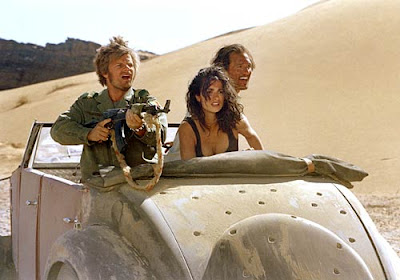 Steve Zahn (left) Penelope Cruz and Matthew McConaughey in Sahara, directed by Breck Eisner, screenplay written by Thomas Dean Donnelly & Joshua Oppenheimer and John C. Richards and James V. Hart from the novel by Clive Cussler . (Photo: Keith Hamshere / Paramount)
Cussler had final say over the director and lead actors (he boasted of turning down Tom Cruise for being too short) as well as wide discretion over the script (he disparaged writers as "hacks.")Writer and blogger John August has some further analysis on the case.
By ceding so much authority to a novelist, Anschutz broke a fundamental rule in the film business: Keep the author out of the screenwriting process. Now Anschutz finds himself cast in a movie mogul's nightmare.
He has lost about $105 million to date on "Sahara," was forced to abandon plans for several Dirk Pitt sequels and is fighting one of Hollywood's most contentious lawsuits since humorist Art Buchwald battled Paramount Pictures over breach-of-contract charges. A jury trial is scheduled next month in Los Angeles.
 Steve Zahn (left) Penelope Cruz and Matthew McConaughey in Sahara, directed by Breck Eisner, screenplay written by Thomas Dean Donnelly & Joshua Oppenheimer and John C. Richards and James V. Hart from the novel by Clive Cussler . (Photo: Keith Hamshere / Paramount)
Monday, December 11, 2006
Blogger beta and blogger comments
We've switched this blog over to Blogger beta - the latest upgrade to the Blogger tool.
It enables quite a lot of new functionality and generally makes the blog easier to manage.
We've also switched back to Blogger comments, rather than the Haloscan system we'd been using. Unfortunately this means that old comments have been lost but there didn't seem to be any way around that. Blogger comments require verification, but the system is more robust and easier to manage.
Any questions, let me know.
It enables quite a lot of new functionality and generally makes the blog easier to manage.
We've also switched back to Blogger comments, rather than the Haloscan system we'd been using. Unfortunately this means that old comments have been lost but there didn't seem to be any way around that. Blogger comments require verification, but the system is more robust and easier to manage.
Any questions, let me know.
Subscribe to:
Posts (Atom)


