Thursday, November 16, 2006

David Ayer interview

Dylan Callaghan interviews screenwriter David Ayer for the Writers Guild of America, west.
David Ayer's story is that oft-adduced, rarely seen example of a unique voice -- a genuine outsider -- finding success in the Hollywood trade. The Training Day screenwriter takes his first turn helming with the new film, Harsh Times, which stars Christian Bale as a Persian Gulf War vet, returning home to South-Central L.A. and its seductive thug life. For Ayer, it is a case study in writing what you know. Instead of going from parents with money and influence to some tony film school, he's a high school dropout, who at 14 was kicked out of home for bad behavior and moved in with a cousin in South-Central. After surviving those mean streets for several years, Ayer eventually wised up enough to escape death or imprisonment via a three-year stint in the U.S. Navy.
Harsh Times Freddy Rodriguez and Christian Bale in Harsh Times, written and directed by David Ayer.
"I think we've ridden the whole Joseph Campbell monomyth to death. The moral universe all Hollywood movies have to take place in is familiar ground to moviegoers. So writers have to do things like chopping up the narrative or telling stories backwards to get ahead of the audience.

There's a moral map that everyone has to use -- the studios push the moral universe in a certain direction that's very action-consequence, you know? You do something bad; something bad's going to happen to you in the next scene. I think real life is definitely more complex than that. In real life, good people get punished and bad guys don't. That's common. In my scripts I like to have a little moral complexity there."

Burger King to drop children's TV ads

Fast food giant Burger King is axing TV advertising aimed at children amid mounting concerns about a British obesity crisis.

The move comes as the TV watchdog, Ofcom, is about to announce its own plans to restrict the TV advertising of junk food.
More from The Daily Mail.

Comment: While most people are sympathetic to the need to protect children from inappropriate advertising, there is concern among writers that loss of revenue could further weaken commercial TV production for children.

Channel Four to offer 99p downloads

Channel 4 is to offer a "catch-up" service for viewers by offering much of its programming online for 30 days after transmission for 99p per episode.

Current series such as Hollyoaks and Ramsay's Kitchen Nightmares will be available, alongside archived output from the network's 24 years on air.

The agreement covers all "homegrown" shows commissioned since June.

Each programme will "disappear" from users' computers 48 hours after they start to watch it.

It will be kept in a personalised library until it is first viewed, and then can be accessed an unlimited number of times during that two-day period.
More from BBC News.

Tuesday, November 14, 2006

jaWiki

Screenwriter and blogger, John August, has launched a screenwriting wiki (jaWiki). Wikis are collaborative editing tools, most famously used by the fantastically useful Wikipedia.

If you register on John August's site you can edit or create entries, helping to create an online encyclopedia of screenwriting. Certain entries might get controversial, however. What, for example, would you say about screenwriting 'guru' Robert McKee?

Science Fiction Britannia

Science Fiction Britannia
A treat for fans of British sci-fi, BBC Four are running a special season of programmes under the heading Science Fiction Britannia (it started yesterday, in fact).

In The Times, Ian Johns previews some of the treats in store. These include my own personal favourite, Blake's 7.
Like Star Trek, this had an interplanetary band championing democracy and freedom but in a far less shiny future. Blake, framed on a child molestation charge (!) by a fascist oligarchy, went on the run with a small group of disillusioned outlaws. Democracy and freedom were comprehensively trounced when our heroes died in a welter of mistrust and bullets.

Is such pessimism a peculiarly British trait? It certainly produced the two most enduring dystopian visions, both informed by class anxieties: George Orwell’s Nineteen Eighty-Four with spy gadgets in every television and Stalinist/Nazi oppression; and Aldous Huxley’s Brave New World with its bred-to-order society controlled by sex and drugs.

Kings Cross New Writing Award 2007 - updated

An update to the information in our earlier post, from Melanie Branton:
Ooops! Just a few corrections since I first sent out publicity on this several months ago. The Courtyard has now moved to 55 East Road, London N1 6AH, and entries should be sent there, not to the York way address. Also, the prize this year is £2500 in cash and a staged rehearsed reading to an invited audience of theatre professionals (literary agents, directors, producers and the like). E-mail me for further details. Also, our website, www.thecourtyard.org.uk should contain more information shortly.

Monday, November 13, 2006

Women TV writers in America

In The New York Times, talks to some of American TV drama's leading women writers.
When Ms. [Melinda] Hsu worked on “Medium,” she had a “bring-your-own-nanny” day care space in the next building that the show’s lead actress, Patricia Arquette, had designed for her own toddler. “It was fully stocked with every kind of educational toy you can imagine,” said Ms. Hsu, who returned to work when Penny was 5 weeks old and found that the setup allowed her to nurse. But because workplace culture varies, some women had to choose jobs carefully. Ms. Newton, 41, a single mother, froze her embryos when she was 36 and waited for the right show to get pregnant. She found it with “Las Vegas,” where she takes Oscar to the Sony lot every Tuesday. “It’s such a male show,” she said, “but the guys are great.” Photos of Oscar adorn a hallway bulletin board and his toys fill a large basket in her office.

Stephen King interview

In The Telegraph, Nigel Farndale talks to novelist Stephen King.
He tells me wearily that he is bound to be described as a 'horror writer' in the first line of his obituary. He wants to be taken more seriously, is that it?

'That doesn't bother me,' he says, 'it's never that I've felt that much need for respect. My family has been eating. My house is paid for. And, in the end, after you're gone, the work finds its own level.

"The critics don't have much say in that. Some of the books which everyone sneered at for being disposable, such as Agatha Christie, have actually survived the longest on the bookshelves. No, what drives me crazy is when I am treated as a sociological artefact. No one wants to be reduced to a human beetlewig or a hallowe'en mask.'

David Hare on Broadway

As David Hare's new play, The Vertical Hour, is prepared to open on Broadway, Gaby Wood on The Observer went behind the scenes.
Hare wrote The Vertical Hour - which has at its centre a character named Nadia Blye, former war correspondent, now star professor of political studies at Yale - because he was interested in the liberal pro-Iraq war position. 'All those academics,' as he puts it, 'who were in favour of the war for sound idealistic reasons.' He sees it as a companion piece to his last play, Stuff Happens, which dramatised the events leading up to the Iraq war with real politicians as its core characters. 'Whereas one's the public story of what actually happened,' he explains, 'this one - for me - is about: in what way are our lives different than five years ago, and in what perspective do we need now to see our lives? Western life is like a painting: our colour has been changed by another colour being painted at the top - we're looking at ourselves very differently from the perspective of what our so-called enemies believe about us. It's led to a rich period of self-examination.'

Friday, November 10, 2006

Suzan-Lori Parks's 365 play cycle

There are your everyday whims, and then there are the whims of a Pulitzer Prize-winning writer. The writer in this case is Suzan-Lori Parks, who decided one afternoon in 2002 that she would write a play a day for a year. Ha! Neat idea.

Well, four years later those plays are about to be presented in what may be the largest and most elaborate theatrical premiere ever, involving some of the most prominent institutional theaters in the country as well as summer-stock theaters in Montana, community ensembles on the South Side of Chicago, a nursing home in Atlanta and an abandoned movie house in the valley of the Rio Grande.
More from Campbell Robertson in The New York Times.

Erin Cressida Wilson interview

In The Hollywood Reporter, Martin A. Grove talks to screenwriter Erin Cressida Wilson about her new film Fur: An Imaginary Portrait of Diane Arbus (from a book by Patricia Bosworth).
What Wilson had in mind was "to not go by the normal rules of a biopic, which can often (mean) going through all of the episodes of a person's life, but to look more at the background and the details and the themes of Diane Arbus's life and to create a film that might attempt to show the moments where her creativity ignited into her becoming an artist in her mid-30s. I still notice in biopics the problem that happens in the connective tissue between events. It always seems to be this shuffling to get to the next event because, in fact, the writer doesn't know what happened in-between. And none of us knows what happens in-between to these people. So I didn't want to pretend that I knew what happened in-between or to try to re-enact the moments of her life that we all know, but to try to create something that we could feel. I wanted to walk out of this picture feeling what it was like to become this artist rather than to know some high points of her life."
Fur

Charles Frazier interview

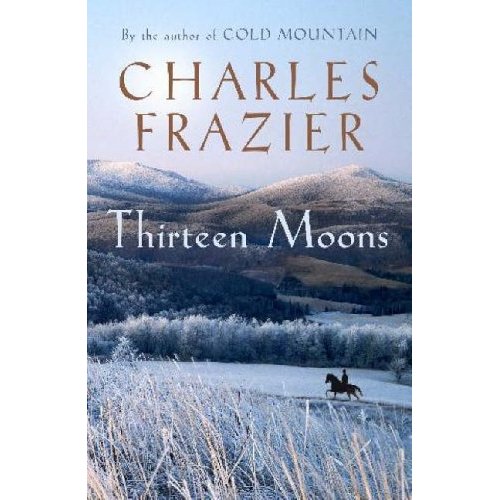
Thirteen moonsIn The Independent, John Freeman talks to American novelist Charles Frazier.
There are many things that Charles Frazier would like to preserve in his home state of North Carolina, but right now two loom large in his mind: independent bookstores and the Cherokee language. The chances are that Thirteen Moons, his much-anticipated new novel, could make a difference with both. Sitting in Quail Ridge Books in Raleigh, North Carolina, Frazier has begun to set this plan in motion. Rather than hit the road and barnstorm the big US cities and morning talk shows, he has chosen to unveil Thirteen Moons - perhaps the most hotly desired novel in America in the last decade - at this tiny independent store.

Thursday, November 09, 2006

Kings Cross New Writing Award 2007

The Courtyard Theatre in London is seeking entries for its biennial Kings Cross New Writing Award.

The cost of entry is £5 per play. The winning play will receive a professional staging at The Courtyard.

QuickMuse

Watch poems being written in real time at QuickMuse. Weirdly compelling. Thanks to The Telegraph's Ceri Radford for the link.

What's QuickMuse?


QuickMuse is a cutting contest, a linguistic jam session, a series of on-the-fly compositions in which some great poets riff away on a randomly picked subject. It's an experiment, QuickMuse, to see if first thoughts are indeed the best ones. We're not entirely sure about this, but we suspect QuickMuse will bring readers closer to the moment of composition than they have ever been before. Best part: our "playback" feature lets you watch the poems unfold, second by second. Or as Thlyias Moss says, it's "the chance for a poem to find its/audience fast," in which words don't "have as much/time to stale, pale/lose the relevance of the moment" to which they belong.
There's an article by Ken Gordon, the man behind QuickMuse, in Poets and Writers.

SteveThompson interview

Playwright Steve Thompson talks to Brian Logan in The Times, ahead of the opening of his new play Whipping It Up.
Thompson is...a novice playwright — at 39, he has written professionally only since 2004. He was a schoolteacher for ten years, before quitting to play house-husband and childcarer while his barrister partner worked. That’s when he started writing.

His first play, Damages, about a night lawyer in a scurrilous tabloid newspaper office (the play was based on his wife’s experiences), had a sell-out run at the Bush two years ago.

Whipping It Up is the second in a trilogy of what Thompson describes as his “work plays” — plays set in work environments rather than (as theatre tends to prefer) living rooms, bedrooms or pubs. “I love the rhythm of the workplace,” says Thompson. “Nobody can sit still and do an aria and talk about their life and loves. Real life seeps out quietly while you’re busy doing your job.”

(Thompson’s next instalment, currently under commission, is to be set in the City of London.) Is his interest in “work plays” related to the fact that, unlike most writers, he spent years working nine-to-five in a proper job? “If I had tried to write a play when I was 21,” he agrees, “I wouldn’t have had anything to write about.”

Wednesday, November 08, 2006

Jules Dassin

America blacklisted the man. Italy exiled him. France embraced him. Greece considers him a national hero. The man is legendary writer-director Jules Dassin who, despite hostile treatment from his own government, still claims, “I am American, and that I will stay.” This coming from a writer forced to flee the United States in 1950 and who has lived in Greece since the early 1960s.

The name Jules Dassin might not be immediately recognizable to most people, but his classic films are known throughout the world-Rififi, Topkapi, Never on Sunday, Naked City, Thieves' Highway.
More from Sandra Berg for the Writers Guild of America, west.

Tuesday, November 07, 2006

The future of film finance

Screenwriter and blogger Craig Mazin on a new dawn in movie financing and production.
In the future, a filmmaking unit will not work as employees for a studio. Rather, the filmmaking unit (writer and director and perhaps star) will present their vision of a movie to a group of independent financiers, who will form a partnership with the filmmakers. Obviously, this is nothing new. Hell, just about every indy art film is made this way. What’s changing is the amount available.

Carnival boosts drama production

Hotel Babylon producer Carnival Films will boost its drama output to a record 22 hours next year after BBC1 commissioned a two-part Sea of Souls special and ITV ordered an adaptation of Charles Dickens' Old Curiosity Shop.

BBC1 has commissioned three new supernatural dramas from Carnival, which will also produce a second eight-part series of glamour drama Hotel Babylon.
More from Leigh Holmwood in Media Guardian.

Any announcement of new drama commissions is good news, but this story particularly caught my eye because the writer of one the supernatural dramas is Stephen Gallagher - Guild member and friend of this blog. Nice one, Stephen.

Art is useless

In The Observer, Paul Auster argues that art is 'useless' - in a good way.
Some like to think that a keen appreciation of art can actually make us better people - more just, more moral, more sensitive, more understanding. Perhaps that is true - in certain rare, isolated cases. But let us not forget that Hitler started out in life as an artist. Tyrants and dictators read novels. Killers in prison read novels. And who is to say they don't derive the same enjoyment from books as everyone else?

In other words, art is useless, at least when compared, say, to the work of a plumber, or a doctor, or a railroad engineer. But is uselessness a bad thing? Does a lack of practical purpose mean thatbooks and paintings and string quartets are simply a waste of our time? Many people think so. But I would argue that it is the very uselessness of art that gives it its value and that the making of art is what distinguishes us from all other creatures who inhabit this planet, that it is, essentially, what defines us as human beings.

Monday, November 06, 2006

Ryan Murphy interview

Dylan Callaghan talks to writer-director Ryan Murphy for the Writers Guild of America, west.
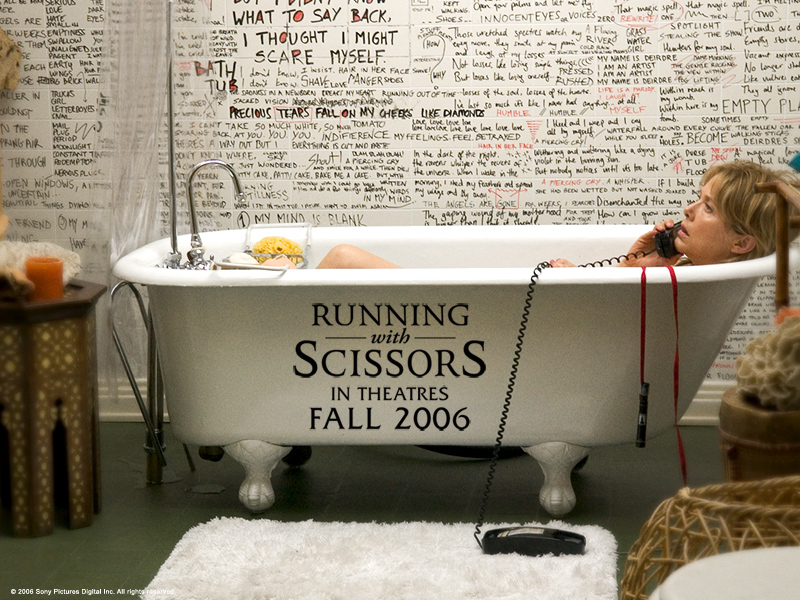
It follows that writer-director Ryan Murphy's debut feature, Running With Scissors is founded in actual events. After all, the Nip/Tuck creator spent years as a journalist, writing for dozens of publications from the Los Angeles Times and The Miami Herald, to Entertainment Weekly. Rather than make up the story for his first film, he based it on the tragic-comic 2001 memoir by then-first-time author, Augusten Burroughs. The book is the eminently singular chronicle of an off-kilter childhood that included being dropped off by his mother to live with her psychiatrist's family.
Running With ScissorsAnnette Bening in Running With Scissors, written and directed by Ryan Murphy from the book by Augusten Burroughs.

How disciplined of a writer are you?

Very. Because I used to be a journalist, I was never allowed the benefit of writer's block. I'd have to write three stories a day, so that's never been a problem. You know, I think I had done 30 drafts of Running With Scissors before Annette read it. I work with a writer's group, and we meet once a week, and I'd go and they'd say, “Do it again.” It went on forever. It was complicated, and it took me a while to get it right. Some of the Nip/Tuck episodes just came out letter-perfect, so it just depends. This piece was a struggle because I had to be responsible to someone's life, and I was very particular with it. Plus it's such a weird story.

Literary partnerships

When writers live together, by Lesley McDowell in The Independent.
Leonard Woolf recorded his regret about the influence Middleton Murry had on Katherine Mansfield's writing: "She got enmeshed in the sticky sentimentality of Murry and wrote against the grain of her own nature", and for most of the 10 years she spent with Wells, West got very little writing completed. Yet in general, their literary partnerships seem to have served these women writers well. Middlebrook notes that the intrusion of [Ted] Hughes's language in [Sylvia] Plath's writing improved her poetry, and [Martha] Gellhorn's letters to [Ernest] Hemingway show a more masculine, hardy tone, one that seems to have stood her in good stead for war reporting.

BBC Children's TV to be revamped

The BBC is to revamp its digital channels CBeebies and CBBC, with "fewer but higher quality" programmes.

"CBBC is due for refreshing, we were losing four to five-year-olds, especially boys," said CBeebies creative director Michael Carrington.

He said there would be "fewer, bigger and better" programmes and boys had already started returning with shows like Lunar Jim and Underground Ernie.

CBeebies, aimed at pre-schoolers, will now target those up to the age of six.

More from BBC News.

Friday, November 03, 2006

Jeremy Brock interview

Jeremy Brock
Jeremy Brock, who was one of the creators of BBC TV's Casualty, is now a seasoned feature film writer. Driving Lessons, his first film as a writer-director, was released in the UK a couple of weeks back. In Creative Screenwriting he talks to Danny Munson.
A lot of your past writing leaned toward the dramatic side of film, so why the sudden shift to comedy?

I think probably these are the kinds of films that I go to the movie theaters to see, but I'm always looking for ways to inject something ironic, because I enjoy that take on people. Our lives aren't strictly dramatic or strictly comical. We don't live by genre; we live by haphazard chance, so our lives are full of some strange mixture of bathos and pathos. The movie I suppose I was trying to do here has bathos and pathos right up against each other, and some people find that disconcerting and irritating. But for my tastes, I like that. I like having someone being sick and then be funny the next scene. I have no problem with that.

Audiobooks

Audiobooks - sold on CD as MP3s - are a growing part of the publishing trade. John Morrison's extensive survey of the audiobook market, and what it means for writers, first published in the Writers' Guild of Great Britain's magazine, UK Writer, is now online.
For the BBC, the biggest download hits so far have been the mainstream works of PD James and Bill Bryson. Philip Nixon of Spoken Network says that in his view over-45s are the key market. “This is why publishers are excited,” he says. “There are new sub-groups coming into the marketplace who are not traditional audiobook buyers, but now have broadband.”

So it’s not the impecunious Napster generation but the time-poor, cash-rich generation between 30 and 50 who are going to be the new customers. “Listening is fundamentally a background experience,” says Jonathan Korzen of Audible. “Your eyes are busy but your mind is free, so you can listen while you’re out walking or weeding the garden.”

Liberating spelling

If you're someone who gets vexed by bad spelling, Simon Jenkins in The Guardian has a simple message for you: don't.
It is plain silly to regard doughnut as "better" than donut. The same goes for alternatives to night, through, colour and wholesome. When the great Noah Webster invented American spelling after independence, he left British English immured in bigotry. He chided "even well-bred people and scholars for surrendering their right of private judgment to literary governors". To Americans, spelling reform was the sovereignty of common sense. For that reason the British treated it as foreign, vulgar and, worst of all, American.

I have no quarrel with grammatical authoritarianism. Grammar is a vehicle that needs a highway code of human communication. To parse is to prosper. Grammar evolves to reflect the new uses that language requires of it, as dictionaries include new words. Adverbs and adjectives fight the good fight against poverty-stricken nouns and verbs. Prepositions and conjunctions are hurled into the fray. A controversial time is had by all.

In contrast, spelling has become a no-go area, an intellectual tundra. While plain writing is considered a stylistic virtue, plain spelling is a vice. English orthography is an edifice of unreason. Word endings are the last gasp of the Anglo-Saxon and Norman invasions, embedded in the cultural DNA of literary Brahmins. Not to spell properly is a sign of being common, as once was ignorance of Latin. Knowing your "ie" from "ei" or -ible from -able does not affect a word's meaning one jot. It is a caste mark, its distinction deriving from its very obscurity.

Thursday, November 02, 2006

New London Writers' Collective

New London Writers' CollectiveOne of the biggest problems with producing plays on the fringe is the cost of hiring a venue. Most insist on a run of at least three weeks and rental is normally at least £150 per night. That's a big outlay and, unless you have a very large family or get rave reviews, you're likely to make a significant loss.

Writer and producer Kieron Barry has addressed the problem by creating the New London Writers' Collective, which brings together four new plays for a run at The Tabard Theatre in London, starting next week.

With plays staged in double bills on alternate nights, costs are shared and each production has a more manageable run of nine performances. Kieron has also conceived the season as being writer-led - a hook from which to hang the much-needed publicity.

A declaration of interest: I'm one of the writers. My play, Antigua, opens at The Tabard on Tuesday 7th November at 9pm.

For anyone new to writing for theatre I've also written a piece for Danny Stack's blog about getting started as a playwright.

Theatre against censorship

Playwright David Edgar, National Theatre artistic director Nicholas Hytner and Behzti director Janet Steel are to unite against the threat to freedom of artistic expression posed by fundamentalist religious groups and the attempted censorship of plays such as Jerry Springer - the Opera.

A one-day conference, organised by Equity and sponsored by The Stage, is to be held at the National Theatre later this month, with a number of high-profile panellists also including director Michael Bogdanov, writer John Mortimer and freedom of expression campaigner Lisa Appignanesi, which will attempt to confront what organisers warn is a growing danger to theatre in the UK.
More from Alistair Smith in The Stage.

Nigel Kneale 1922-2006

Nigel Kneale, one of the great pioneering TV drama writers, has died at the age of 84. Although he disliked being known as a science fiction writer, Kneale's Quatermass Experiment in 1953 was the UK's first sci-fi serial. Other work included The Year Of he Sex Olympics (1968, The Stone Tape (1972) and, more recently, episodes of Sharpe and Kavanagh QC.

BBC News has a summary of his career, and tributes from readers.

There are obituaries in The Guardian, The Times, and The Independent.

The Guardian also has an appreciation of Kneale by writer and actor Mark Gatiss.
Born in Lancashire but raised on the Isle of Man, he brought a strange, outsider's perspective to his work. Originally an actor, Kneale began writing short stories, including Jeremy in the Wind and The Photograph.

The acclaim Kneale received brought him to the attention of pioneering BBC producer Rudolph Cartier, and Kneale became a staff writer. The two men struck up an immediate rapport and collaborated on The Quatermass Experiment in 1953. Kneale wrote that it was "an over-confident year" and he piloted his hugely influential tale like a rocket into the drab schedules of Austerity Britain.

Over the decade, Kneale and Cartier produced two more Quatermass serials that emptied pubs, were spoofed by the Goons and Hancock, and cemented themselves in the psyche of a generation. What sci-fi piece of the past 50 years doesn't owe Kneale a huge debt? The "man into monster" theme of Experiment and the paranoid conspiracy of Quatermass II and, particularly, the "ancient invasion" of Quatermass and the Pit cast a huge shadow. The latter - with its brilliant blending of superstition, witchcraft and ghosts into the story of a five-million-year-old Martian invasion - is copper-bottomed genius.

A true pioneer has passed - and the light of Mars will shine a little brighter tonight.

Wednesday, November 01, 2006

William Broyles Jr. interview

Flags Of Our Fathers Flags Of Our Fathers, written by William Broyles Jr. and Paul Haggis from the book by James Bradley.

Dylan Callaghan talks to William Broyles Jr. for the Writers Guild of America, west.
Since serving in Vietnam as a Marine Lieutenant, William Broyles, Jr. has gone on to successful careers as a both a journalist and a Hollywood screenwriter, but he's still very much the war veteran that led a platoon of men in combat. Though he's scribed for films as disparate as Polar Express and Planet of the Apes, nothing is more personal to him than the war movies he's worked on, including last year's Jarhead and the new Clint Eastwood-helmed Flags of Our Fathers.

Broyles put his heart and the better part of two years into adapting James Bradley's same-titled novel, hoping Steven Spielberg would direct the film, but as is so often the case in Hollywood, things didn't quite go as planned. Instead, Oscar-winning writer-director Paul Haggis penned a second incarnation of Broyles' script and was able to persuade Clint Eastwood to shoot it. In a trade where being rewritten is anathema, Broyles is not only a dutiful warrior without a hint of bitterness, but says flatly that Haggis did a better job and that, in the final assessment, he is grateful the film he was so passionate about was finally made.

Jane Tranter interview

BBC Writersroom has a new video interview with Jane Tranter, Controller of Fiction Commissioning.

She's responsible for drama commissioning across BBC television.

International Radio Playwriting Competition

BBC World Service and the British Council have teamed up to find the next Pinter, Brecht or Soyinka with the launch of their tenth annual International Radio Playwriting Competition.

Writers who are new to radio are invited to submit an original 60-minute radio play on a subject of their choice. The competition, which has no age limit, is open to those living outside the UK and closes on Monday 30 April 2007.

More from the BBC.

Tuesday, October 31, 2006

The State Within

The young man glances across the table. Behind designer glasses, his gaze is penetrating, analytical. “If I told you that,” he says, quietly, “I’d have to kill you.” A chilling moment, but this is not a line from The State Within, the BBC’s all-crashing, all-exploding new conspiracy thriller. It’s a different kind of “ line” from Daniel Percival, who co-wrote the show with Lizzie Mickery. His annoying phrase is a national cliché, particularly among TV folk desperate not to give too much away too soon.

Percival is referring to the new show’s plot. And the issues it raises. And its themes and preoccupations. The effect isn’t so much chilling as frustrating. When I meet the writers in a Soho café, I haven’t even seen episode one. Getting them to explain what it’s about is like trying to suck juice out of a cream cracker. “It’s set in the British Embassy in Washington, so is it a political thriller like State of Play?” “No.” “A spy thriller — is it a bit like Spooks?” “Not at all.”
More from Paul Hoggart in The Times. The State Within is on BBC One this Thursday at 9pm.

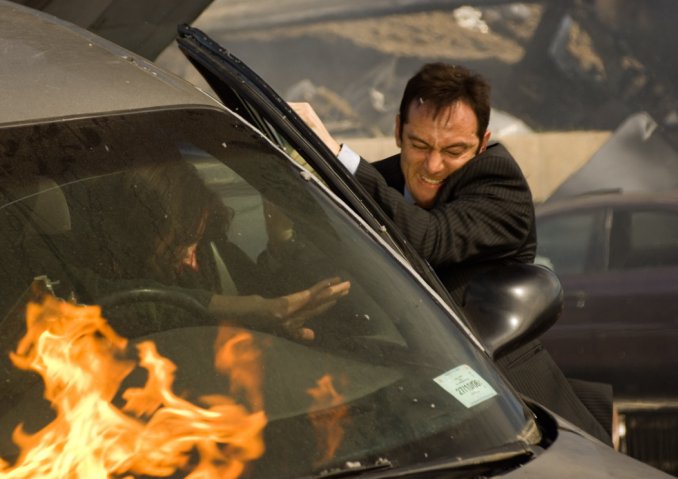
The State WithinJason Isaacs in The State Within, written by Daniel Percival and Lizzie Mickery. (Photo: BBC/Ben Mark Holzberg)

Where have the good new playwrights gone?

In The Guardian, Lyn Gardner laments a lack of new playwriting talent.
A decade ago this week British theatre was enjoying its greatest flowering of new writing since the Jacobeans. Mark Ravenhill's Shopping and Fucking had just opened at the Royal Court Upstairs at the Ambassadors, just one of an abundance of new plays written by emerging talents such as Martin McDonagh, David Eldridge, Simon Bent, Nick Grosso and David Greig who all premiered their first major plays during 1996.

A decade on, all those writers are going strong, but where are the emerging talents of today? My guess is that they are clogged up somewhere in Britain's burgeoning playwrighting schemes unable to find their way out. Over the last few years many theatres have put in place extensive play development programmes, yet despite these schemes there has been a tailing off in good new plays by great new writers since the heady days of the mid-90s.

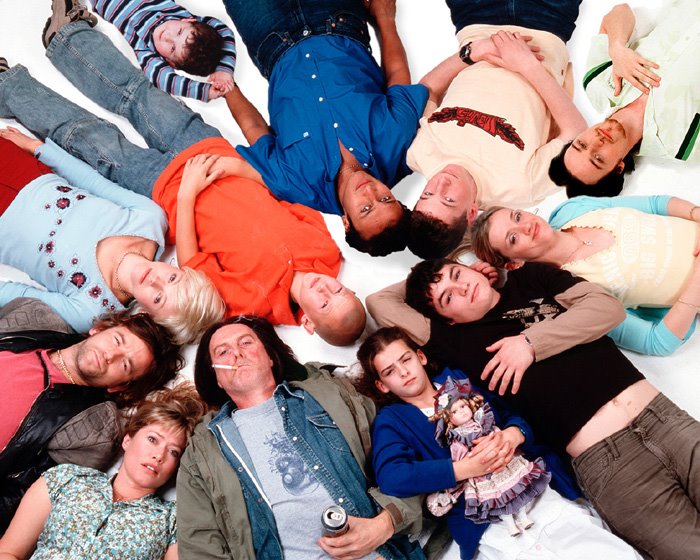
Paul Abbott sounds off

Paul AbbottIn The Independent, Paul Burrell talks to Paul Abbott
Press references that place the word "scriptwriter" ahead of his name are often "pejorative", he claims. "There's one journalist who does it quite often and says 'the scriptwriter Paul Abbott'. I think, 'You can't still be saying that.' I've got five lifetime achievement awards and a better writing style than you."
As ever, Abbott has numerous projects on the go. As well as the new series of Shameless, and various productions through his company, Tightrope Pictures, he is writing new work for stage and screen.
He will shortly ... make a musical feature film about the BNP in Burnley. He won't be asking the locals to contribute suggestions for the script. "I don't want putting off. I'm not going to canvass their opinions - I don't want them to shape my film. If you import too many of other people's philosophies you can't be a writer."

Abbott, whose production company Tightrope Pictures has offices in London and Manchester, is also working on a new project for Channel 4, Mrs In-Betweeny, a sort of transsexual Mrs Doubtfire. "It's about stripping away gender to teach kids that are divorced that there's no superior authority one way or the other," he explains.

Monday, October 30, 2006

Tim Kring - the man behind Heroes

On Tuesday, after NBC got the ratings for the latest episode of its new serial drama “Heroes,” Kevin Reilly, the president of NBC Entertainment, was ready to make it official.

“We have the only real hit of the fall, and it’s growing,” Mr. Reilly said.
In The New York Times, Bill Carter profiles Heroes creator/writer/producer, Tim Kring.
That “Heroes” broke through came as a surprise in some quarters; but NBC, putting more marketing effort behind “Heroes” than any other fall series, had pegged it, Mr. Reilly said, as its best hope.

All of those expectations rested on the slim shoulders of Tim Kring, a veteran writer and producer whose previous credits would hardly have foretold the creation of a show so sublimely in tune with the Internet-television-comic-book nexus that it was the hit of last summer’s Comic-Con International convention in San Diego.

When Mr. Kring and the cast appeared there for a screening of the pilot, the reaction was electric. “The first thing I saw was a guy jumping up and down with a horn coming out of his head,” Mr. Kring said. “The next thing I saw was a 400-pound Harry Potter sitting there with a wand.”
There's another interview with Kring on the NBC website

M.R. James - storyteller

In The Telegraph, Robert Lloyd Parry pays tribute to the storyteller M.R. James.
One hundred and 13 years ago tonight, the Chitchat Society convened their 601st meeting, in the Dean's rooms of King's College, Cambridge. At previous get-togethers, this confraternity of Old Etonians had played poker, eaten anchovy toast and listened to undemanding scholarly papers.

Earlier that term, Dr Waldstein had delivered his thoughts on English sports and pastimes. But the host on the evening of October 28, 1893 had a different agenda. The simple entry in the society's minute book records a cardinal moment in the history of supernatural literature: M R James read two ghost stories.

Screenwriters' Festival podcasts

Podcasts from last summer's first Cheltenham Screenwriters' Festival are now available (mostly for £2.99 each). Be interesting to hear from anyone who buys one.

Thursday, October 26, 2006

Arriaga versus Iñárritu

BabelA battle seems to be raging between screenwriter Guillermo Arriaga and director González Iñárritu, says Terrence Rafferty in The New York Times.
The Los Angeles Times recently reported that Mr. Arriaga, in May, had been forbidden to attend the Cannes Film Festival premiere of the latest movie he had written, “Babel” (opening Friday in New York) — forbidden, that is, by his principal collaborator, the film’s director, Alejandro González Iñárritu, with whom he had previously worked on “Amores Perros” (2000) and “21 Grams” (2003). The director, according to the article, was “apparently miffed that Arriaga claimed much of the credit for the critical success of ‘21 Grams.’ ”

Although the Cannes embargo makes Mr. González Iñárritu look petulant, it should be noted that Mr. Arriaga has, since the success of “Amores Perros,” been a vocal and remarkably insistent promoter of the importance of screenwriters. “People go to films for the stories,” he has said. “They remember the films for the stories.” And he has been known to claim personal responsibility for “95 percent of the structure of ‘21 Grams’ ” and “almost 99 percent of the structure of ‘Amores Perros’ ” — both films, of course, having been widely praised for the ingenuity and complexity of their narrative construction. Healthy debate? This is shaping up as something more like one of those ugly, acrimonious rock-band breakups. Or a dogfight.
Photo: Brad Pitt in Babel, written by Guillermo Arriaga and directed by González Iñárritu.

The Nolans

Christopher and Jonathan Nolan, the sibling writing team behind the new magic-centered period piece The Prestige, are a bit like doppelgangers from different worlds. As like-minded as they claim to be, Christopher, who also directs the duo's films, (Memento, Insomnia ), is six years older and was born and schooled in England -- a fact evidenced by his distinctly posh accent. Jonathan was raised in a suburb of Chicago and sounds as American as a John Hughes film.
More from Dylan Callaghan for the Writers Guild of America, west.

Wednesday, October 25, 2006

Austin Film Festival

Only at the Austin Film Festival can legendary director-actor-producer Sydney Pollack wander through the 120-year-old Driskill Hotel's grand lobby entirely unmolested while "Mystic River" screenwriter Brian Helgeland gets mobbed by fans. As one repeat attendee put it, "This is the only festival where writers are treated like rock stars."

The lively event, which will close its 13th incarnation on Thursday, remains the only major screenwriter-focused festival on the circuit. The weeklong array of panels, pitch competitions, parties and screenings is all about honoring the ingenuity and allure of the screenplay and the writers who craft them (well, it's also occasionally about drinking, but that goes with the territory).
More from Jay A. Fernandez in The LA Times, including the best overheard stories.
Most deadpan studio anecdote: Jessica Bendinger ("Bring It On") was once brought in to adapt a dark coming-of-age story about a girl with anorexia who suffers through a date rape, among other things. The major studio head who owned the book rights pitched it by saying, "We think it could be like 'Bridget Jones.' "

Jimmy Carr calls for more radio comedy

Jimmy Carr has warned that original writing and performing talent is struggling to break through, and has called for more opportunities for comedy on radio.

The controversial stand-up and TV host said that there was a lack of comedy being commissioned on BBC radio networks, which would create problems in the long term.
More from Liz Thomas in The Stage.

Tuesday, October 24, 2006

Shameless gets its own home

Shameless
The hit Channel 4 drama Shameless [created by Paul Abbott] is to be given a Coronation Street-style, purpose-built home.

The producers of the programme are building a permanent set of council estate streets in Wythenshawe, Manchester, in preparation for extending the series.

The new set will allow the number of Shameless episodes to double from the current eight a year to 16 a year by 2008.
More from Maggie Brown in Media Guardian.

Phony agents

Beware 'agents' asking for cash up-front - a cautionary tale from Richard Lea for The Guardian's Culture Vulture blog.
Earlier this month a number of authors who had signed contracts with the Hill and Hill literary agency, supposedly based in Edinburgh, received an email telling them that the agency's operations had been "frozen", blaming adverse coverage in writers' forums such as Absolute Write.

These writers had all paid upfront fees of about £100 to an agent calling himself Christopher Hill, who promised to submit their work to major publishing houses and send bi-weekly reports on their progress. And at least some of them were doing rather well - or so it seemed ...

Monday, October 23, 2006

Russell T. Davies interview

As his new Doctor Who spin-off, Torchwood, starts on BBC 3, screenwriter Russell T. Davies talks to Cathy Pryor in The Independent.
The name Torchwood is already familiar to fans. Apart from being an anagram of Doctor Who, it's been referred to on Doctor Who several times in a mysterious manner. In fact, Davies rather likes repeating names and references. He's used the names Harkness and Tyler for characters several times, something he says helps him get a grip on the blank page. He also does that with concepts, and not always his own: for instance, the first episode of Torchwood features two obvious steals - a prison cell straight out of Silence of the Lambs and an "amnesia pill" that will seem familiar to anyone who's seen Men in Black. But Davies defends this as simple storytelling. "It's all there for the taking, I do it gladly. The ending of Doctor Who, where we had to separate the Doctor and Rose, that was unashamedly taken from the Phillip Pullman novels. They're brilliant, and every child reads them. So that creates a resonance, when they've got a story in one part of their minds and they see Doctor Who and think, 'Oh right! You can change stories!' If you want to get pretentious about it, it's exactly what Shakespeare did. As long as you put yourself into it I think it's all there for the grabbing."
Pic: Indira Varma as Suzie in Torchwood, written by Russell T. Davies (Photo Steve Brown/BBC)

Helen Edmundson interview

Playwright Helen Edmundson tells Brian Logan in The Times why she has become master of the adaptation.
Her style has also been defined by the exigencies of adapting sprawling literary epics for the stage. “If I’m doing an adaptation,” she says, “and I have to have the Battle of Borodino in the middle of it, or somebody has to die in a flood, that pushes me to be more daring and more theatrical.” For Edmundson’s first adaptation, Anna Karenina in 1992, Nancy Meckler told her to “think about how I would do it if I were doing an opera or a ballet. To free myself from naturalism and go somewhere beyond that.” She hasn’t looked back since, she adds.

There are those, however, who turn their noses up at literary adaptations. Who believe that the novel (an interior, psychological medium) and the theatre (an external, dramatic medium) are incompatible, and that a staged novel can never be more than a compromised version of its source. Edmundson gives this school of theatrical thought predictably short shrift. “These days we make very strong distinctions between adaptations and original work. But they’re all plays, and they all have to tell the audience a story with a particular voice behind it. Shakespeare plundered other people’s stories shamelessly. And people didn’t say, ‘That’s not a play, it’s an adaptation’.”

Theatres for writers

On the Writers' Guild of Great Britain website, Richard Bevan talks to the people responsible for new writing at the Soho and Hampstead theatres.

Friday, October 20, 2006

NBC restructures

NBC Universal on Thursday outlined a sweeping restructuring plan that will cut 700 jobs throughout the company and save $750 million annually in an effort to remake the company in the digital world.

NBCU 2.0 is an effort to not only respond to NBC Uni's changing fortunes after its fall from longtime dominance on broadcast TV but also to successfully navigate the shifting media landscape in a company that executives said was built on an old business model.

Plans include moving most high-cost scripted NBC dramas and sitcoms away from 8 p.m
More from Paul J. Gough and Nellie Andreeva in The Hollywood Reporter, including the depressing news that scripted drama and comedy will be reduced in favour of cheaper reality shows.

Over on Media Guardian (free registration required), Jason Deans wonders if the announcement signals the beginning of the end for American network TV.
Network audiences have been shrinking for 20 years or so, as the growth of cable TV channels such as HBO, Showtime and Discovery ate into their ratings. But even with annual audience shares for each of the main channels falling to around 10% in the last few years, network TV remained a profitable business.

Now, with the growth of broadband and digital rivals such as Google, Yahoo! and YouTube, it seems a tipping point has been reached.

This will have repercussions in the UK - for one thing, if the supply of US drama and comedy begins to dry up.

And for ITV. If NBC, for years the most successful player globally in the ad-funded network TV business, cannot make the sums add up anymore, how long before ITV's owners follow its lead and cut back on news and entertainment programming investment?
Meanwhile, spare a thought for comedy writer and blogger Ken Levine who will today be trying to pitch a new show to NBC.
Putting my own little needs aside, eliminating 8:00 comedies seems to me like a really short sided idea. Remember the last time NBC was in last place? What show completely saved their ass? Hint: it wasn’t THE WEAKEST LINK. COSBY in the 80’s and more recently FRIENDS became the saviors of the network.

In this new “reorganization” I question whether NBC will even need a comedy department. Perhaps those duties could just be added to the Facility Manager’s responsibilities.

Does "European literature" exist?

What do European writers share in common? And, to hoist the stakes from the speculative to the metaphysical, does or could such a beast as a true "European literature" exist?
In The Independent, Boyd Tonkin reports from the Writing Europe conference in Amsterdam.
The cities of liberal Europe, said Abdelkader Benali, a fast-rising star of Dutch literature, are "wonderful places to doubt. You start from an assumption and at the end of the evening you have chaos - because chaos means liberty." James Meek, from Scotland, doubted so deeply that he - rhetorically - denied the existence of any shared Euro-culture or history. True-Brit scepticism? Not really, but a post-Enlightenment skit in the vein of Voltaire, or even David Hume.

Thursday, October 19, 2006

Screenwriting by computer

A lengthy but thought-provoking article by William Gladwell in The New Yorker looks at how computerised neural networks might be used to analyse screenplays, predict their likely box office return and modify them accordingly.
The way the neural network thinks is not that different from the way a Hollywood executive thinks: if you pitch a movie to a studio, the executive uses an ad-hoc algorithm —perfected through years of trial and error to put a value on all the components in the story. Neural networks, though, can handle problems that have a great many variables, and they never play favorites which means (at least in theory) that as long as you can give the neural network the same range of information that a human decision-maker has, it ought to come out ahead.
Apparently such approaches are starting to take hold in the music business. But, as Gladwell's article goes on to illustrate, a 90-minute screenplay is rather more complicated than three minutes of music.

Thanks to Billy Mernit for the link.

BBC TV drama series set for longer runs

The BBC have lined up a 12-episode second series for conspiracy thriller The State Within (written by Lizzie Mickery and Daniel Percival) before the show has even broadcast, reports Liz Thomas in The Stage.
There has been a shift away from the traditional format of six or eight episodes for programmes, with big budget shows such as Doctor Who, Rome and Robin Hood already running to 12 or 13 shows, a move that was recommended as part of BBC director-general Mark Thompson's Creative Futures policy blueprint for the Corporation's future. It stated it was necessary to consolidate the number of titles broadcast and invest in fewer quality dramas that make an impact.

Online residuals

In a digital free-for-all, Hollywood trumpets another round of ventures nearly every week making TV series and films accessible on the Internet.

But with each splashy announcement, resentment builds among writers and actors who believe studios are ducking the issue of how to properly pay them when their work is viewed via the Web. With major labor contracts expiring over the next two years, fears are growing that digital distribution will become such a contentious issue that it could prompt a strike.
More from Richard Verrier in The LA Times.

Of course, the WGGB has been grappling with similar issues in this country. There have been initial agreements but discussions and negotiations are bound to continue as the online market develops.

Wednesday, October 18, 2006

Lucilla Andrews 1919 - 2006

I have to confess that I'd never even heard of 'hospital fiction' as a genre. But Lucilla Andrews, who died last week, was, it seems, the leading exponent. There's an obituary by Julia Langodon in The Guardian.
Lucilla Andrews, who also wrote under the names of Diana Gordon and Joanna Marcus, was a founder member of the Romantic Novelists Association (which honoured her shortly before her death with a lifetime achievement award). Her first novel was published in 1954 and her last in 1996. She is regarded by today's contemporary authors of romantic fiction as having set a standard, and many of her books now sell for hundreds of pounds in the second-hand trade.

Peter Fincham on the future of TV

Peter Fincham, Controller of BBC One, delivered a speech on the future of TV to the Royal Television Society earlier this week.
YouTube's great. Google's great. It's all great. But if the conclusion you draw – and some people love drawing it - is that television is over, I think you might just be wrong.

Agatha Christie's legacy

In The Guardian, writer Frances Fyfield looks back at Agatha Christie's mysterious disappearance in 1926 and argues that she transformed the public's perceptions of female crime writers.
She established a fascination for the female crime-writing species that has stood others, such as me, in good stead. She inadvertently created the idea that women are ideally suited to the writing of murder mysteries, even though this talent means that they are possibly intriguingly warped, manipulative and unfeminine personalities to do it in the first place. She gave all who followed an edgy mystery and the suggestion of hidden depths. It's a wonderfully helpful slander. Her disappearing act contributed to the allure and the status. There will always be queens of crime, but rarely kings.

Tuesday, October 17, 2006

New partnership for BBC and S4C

The BBC Governors and the S4C Authority have announced a new strategic partnership for the development of programming and services for Welsh language television audiences.

The governing bodies described the settlement as a "significant milestone" in the relationship between the two public service broadcasters.

As part of the settlement, annual funding for S4C programming will increase from just under £22m in 2006/07 to just over £25m by 2008/09.

More from the BBC press office.

Axe falls on Where The Heart Is

ITV has axed long-running drama Where the Heart Is [created by Ashley Pharoah and Vicky Featherstone], it has been confirmed.

Set in the fictional Yorkshire town of Skelthwaite, it has proven a reliable ratings draw with viewing figures regularly topping 6m.

ITV has not commissioned a new series to allow programmes aimed at a younger audience to air in the so-called Sunday evening "golden slot".
More from BBC News.

Peter Hepple 1927 - 2006

The former editor of The Stage, Peter Hepple, died last week at the age of 79.

As The Stage's Mark Shenton writes.
It is difficult to imagine the paper without him. Absolutely one-of-a-kind, he had a passion for journalism and the theatre industry rooted in an affection for being there every night. He died on Wednesday night and was in the office only the day before. When I ran into a West End press agent yesterday, she told me that Peter reviewing a show that she was handling next week; I had to tell her the news that Peter would not, after all, be there. But I know he will be there in spirit – he never missed an opening if he could help it.
There is also an obituary by Michael Coveney in The Guardian.
Hepple may not have been a dazzling critical writer, but he was a first-rate journalist, someone who took as much pleasure in Ken Dodd or Tony Bennett as he did in the latest new play at the National Theatre or the Bush. He emerged from the postwar twilight of nightclubs and vaudeville - his real stomping ground was the old Talk of the Town at Leicester Square, the London Palladium, and the West End clubs such as the Embassy, the Pigalle and Quaglino's - to embrace the new theatrical realities of the Royal Shakespeare Company, the far-flung London fringe and regional pantomimes. He regarded the latter, unfashionably but correctly, as the lifeblood of the nation's theatrical tradition and prosperity, the place where popular art could be seen at its best.

Monday, October 16, 2006

Jerry Belson 1938-2006

Ken Levine remembers American comedy writer Jerry Belson who died last week.
Jerry was truly an original. His work was always a little daring, verrrry dark, his comic voice was always strong. Satisfying the mainstream was not his goal. He’d pitch a joke and Garry would say, “Jerry, only four people will get that,” to which Jerry would say, “More than enough.”
There's also an obituary in The LA Times.

Sarah Ruhl profile

American playwright Sarah Ruhl, profiled by Dinitia Smith for The New York Times.
Jockeys have the Triple Crown, hockey players have the three-goal hat trick, but there is no equivalent in the theater for what has been happening to Sarah Ruhl lately. Her highly praised 2004 play, “The Clean House,” is finally having its New York premiere on Oct. 30 at Lincoln Center, one of nine productions of it scheduled this year around the country. Another of her plays, “Eurydice,” a version of the Greek myth, has been winning outstanding reviews at the Yale Repertory Theater. (“Devastatingly lovely,” Charles Isherwood wrote of it in The New York Times, “and just plain devastating.”) Then, last month, Ms. Ruhl won a $500,000 MacArthur “genius” award, $100,000 a year for five years.

John Morrison's theatre blog

Guild member John Morrison has started a theatre blog, not as a critic but as a regular playgoer. Or non-playgoer, given his experiences last week...
Tonight, Friday the 13th, was the night I should finally have seen Terry Johnson's Piano/Forte at the Royal Court. Third time lucky, perhaps? Alas, I had what I can only describe as a Ryanair experience. You know how angry you feel when your flight is cancelled at the last minute, after you've checked in, and there's no proper explanation or apology, just a few low-level checkin staff who have to bear the brunt? Of course, this was Sloane Square, so good manners were observed all round without Sturm und Drang, but there was quite a bit of Brechtian alienation in the air.

The Screenwriters Network

Any of you who are members of Shooting People will have received this email message on Friday.
From Monday the American and British networks are merging into what will be called...

The Screenwriters Network!

There's going to be a new editor too -– please welcome Andy Conway. He's based in Birmingham in the UK and he's been a Shooter since 2002. His job is to host one big transatlantic talking shop. There is lots we can learn from each other and we are keen to open up new collaborations between directors and writers on opposite sides of the pond.
It's quite a big step to join up the two networks, and there'll be no more posting by email - you'll now have to log-in to the website. Plus:
The new Screenwriters Bulletin won't carry any Script Pitches. The existing UK Script Pitch Network is now the.. Script Pitch Network and will be the place for ALL script pitches for all our writers. This bulletin is already read by directors and producers in the UK but will now be promoted to US based ones as well.
I have a slightly love-hate relationship with the daily Shooting People screenwriters email. Some of the 'debates' can get very tedious and there's a lot of advertising but the network has also helped me rent out a room in Cannes and get a play staged. It will be interesting to see how the new transatlantic tie-up works out.

Friday, October 13, 2006

Nobel Prize for Orhan Pamuk

Orhan Pamuk has won the 2006 Nobel Prize For Literature. The Academy said: "In the quest for the melancholic soul of his native city, (Pamuk) has discovered new symbols for the clash and interlacing of cultures."

BBC News has an overview of Pamuk's career so far.
Turkey's best-known author has also clashed with his country's government and Turkish nationalists.

He has been outspoken about Turkey's treatment of its minorities and its record on human rights.

"We have to be able to talk about the past," he has said.

Last year he faced charges of "insulting Turkishness" that could have seen him jailed for up to three years. The charges - which drew international condemnation - were dropped in January.

Damazer wants returning radio drama

Mark Damazer, Controller of Radio 4, has told The Stage that he wants to develop high profile returning drama for the station, the radio equivalent of Cracker and Our Friends In The North.
“My aspiration is to have a number of big pieces that we can run across the year on top of the singles that we do already. We are talking six or eight pieces with big story arcs but which also work so that each episode can stand alone in its own right.

“I want productions where listeners know the characters and know their strengths and weaknesses. What I want is the radio equivalent of Our Friends in the North, Cracker or Prime Suspect. This is an obvious gap in the station’s portfolio. We do a lot of single plays and that isn’t going to change but I do think we need to try new things.”

Thursday, October 12, 2006

Writers' rituals

In The Times, eight writers, including William Boyd, reveal their routines.
I tend to write in the afternoons, between lunch and cocktail hour. I used to feel terrified about the house burning down and my manuscript being destroyed, so I kept it in the fridge. A fridge will protect anything, even an atomic bomb blast apparently.

I belong to that pre-computer generation, and a lot of my contemporaries still write in longhand — Julian Barnes, Martin Amis. I think there is something special about the brain-hand interface, certain cadences. I do notice a difference in prose style from stuff typed on to a screen. There is something about preserving that old connection. I am sure I will never let it go.
There's more in a similar vein from blogger and writer, Billy Mernit, about having music on while writing.
Some prefer caffeine. Some have (infamously) depended on alcohol, others even a toke or a toot. But out of all the stimulants I’ve ever heard of writers using to help practice and sustain their craft, the overwhelming drug of choice appears to be music.

J. Michael Straczynski's struggle

J. Michael Straczynski's "Changeling" is one of those blessed and doomed screenplays that periodically floats around Hollywood: a truly gripping read that actors and directors respond to with passion but that nonetheless has a hard time getting made. For a screenwriter, this can be an excruciating reality that only gets more painful when an A-list director is among those flirting with it.
More from Jay A. Fernandez in The LA Times.

YouTube and copyright

Having taken over the online video company, YouTube, Google must now wrestle with the fact that much of the content infringes copyright. So far copyright owners have rarely complained but if YouTube starts to become profitable, content owners (including writers of shows that get illegally distributed) are likely to want a share.

There's analysis across the press and the web, including from Stephen Foley in The Independent.
"What characterises Google is its very aggressive approach to copyright law," said Lee Bromberg, a partner at the Boston-based law firm Bromberg & Sunstein. "My own view, as someone who often defends intellectual property, is that in every area where Google has pushed it has been over the line, but it has an interesting carrot-and-stick approach.

"The carrot is your content gets to be displayed to Google's vast army of users, which increases rather than diminishes its commercial value to you. The stick is that it says it is just going to access your content as part of the plan to control and organise our knowledge, and that it is up to you to opt out. Well, you can't burden the copyright holder with an obligation to demand their content is not used."

Wednesday, October 11, 2006

Jon Plowman interview

BBC Head of Comedy, Jon Plowman, interviewed for the BBC Writersroom.

Kiran Desai wins Booker Prize

Kiran Desai has won the 2006 Man Booker Prize, for her novel The Inheritance of Loss.
Booker Prize winner Kiran Desai was born in India in 1971, and was educated in India, England and the US.

She is the daughter of the noted Indian author Anita Desai, who has been shortlisted for the Booker Prize three times herself.

Her first book was 1998's Hullabaloo in the Guava Orchard, which won the Betty Trask Award.

The Inheritance of Loss is her second novel. She is currently a creative writing student in New York.
More from BBC News.

Tuesday, October 10, 2006

Tom Perrotta and Todd Field interviewed

Little Children, adapated from Tom Perrotta's novel by Todd Field and Perrotta himself, is one of the most eagerly anticipated films at this year's London Film Festival.

Little ChildrenKate Winslet and Patrick Wilson in Little Children. Photo: Robert Zuckerman

Denis Faye spoke to both writers for the Writers Guild of America, west.
Why did you feel Little Children needed third-person narration?

Todd Field: When I read Tom's book, what initially attracted me more than anything was his voice and his finely-tuned passive observation about these characters. When I started, I found myself really laughing out loud and thinking this is going to be a rip-roaring comedy. Then, slowly, it began to turn and that was through his prose. It wasn't through the characters' exchanges, it wasn't through the settings. It was through his observational skills, so it seemed very natural to do that.

Having said that, in the abstract, if I hadn't read that book, and if you'd asked me would you ever do a film that has some kind of narration, I'd say you're out of your mind.

Tom Perrotta: When I first talked to Todd, it may have been the first thing that he told me that he wanted to do with the film. So I will credit him with the idea. I don't think it's a matter of “needed to do,” I think it was an attempt to capture something about the tone of the book, which is hard to do in movies. At times, the book looks at characters with a kind of clinical, skeptical eye, and at times it gets kind of close into their heads. The effect of the narration is to try to recreate that a little bit. When the narrator's talking, you see the characters from afar in a kind of skeptical, ironic commentary on them -- and when he goes away, you see the characters in their own reality. It gives you a kind of duel perspective on them.

Are there ever times when a third-person narration is just sloppy writing?

Todd Field: Of course, but most of the time it's not the screenplay. They've added it in post because people don't have the shots or something's not understandable. I've been in those films. I started out buttering my bread as a young actor in Roger Corman movies where they bring someone in to say, “And then Bob and Cathy went up the canyon to see the old cave and there was a prospector there. Meanwhile, back at the ranch, Grannie's beating off the Indians.”

We all have those things we think of as cinematic truths, the dos and don'ts, what's considered sloppy or hackneyed work and what isn't, but there are plenty of examples of films I admire that use third-person narration that are effective.

Reviews of Bent

Anyone thinking that a revival of Martin Sherman's Bent would be outdated in today's more enlightened times should look at some of the reviews. Most notably shocking are comments from Christopher Hart in The Sunday Times, as noted by Mark Shenton in his blog for The Stage.
Judging the gay lifestyle portrayed on stage to be “seedy, boring – and a little insulting”, he [Hart] asks, “Are gay men always so childishly hedonistic and self-absorbed?” (No more so than the average theatre critic, I’d say) He then suggests, “We’re supposed to see Gay Berlin as wonderfully hedonistic and liberated, a happy place of sexual permissiveness and excess before the beastly Nazis shut it down.” And then comes the killer blow: “There is no recognition that the individualistic anarchy of these solipsistic bores often leads to a tyrannical backlash.”

Hip in Hollywood

BBC America is opening up new opportunities for British drama and comedy (from commercial channels as well and the BBC) to sell in the USA, writes in Stephen Armstrong in MediaGuardian (free registration required).

He talks to the head of BBC America, Kathryn Mitchell, about her plans for growth and the elusive prize of a British-produced show getting a slot on a mainstream network or cable channel.
"The world is so much smaller, technology makes it easier to work internationally, and British TV is very hip in Hollywood," says Jane Featherstone, joint managing director of Kudos Film and Television, the company that makes Life On Mars. "Of course, a format deal doesn't make us huge amounts of money. What we've got is David Kelley working on a script for ABC, which is great, but the real Holy Grail is for a UK company to actually make a primetime show in America. That's where the money is."

Featherstone believes it will happen, probably via HBO, she is just not sure when. Mitchell agrees with her. After all, a long-form drama on network television can pay $3m an hour. "I'm not going to say who I think will win this race," says Mitchell, "but the Americans love our writers and our actors so much. There are some cultural considerations producers should remember, though," and she grins. "Like the drama Blackpool - I had to rename it Viva Blackpool because Americans thought it was about a deadly, haunted lake."

Monday, October 09, 2006

Literary editors

In The Independent, Jo Lo Dico profiles the editors of literary pages of UK newspapers.

Pinter in Krapp's Last Tape

If you've managed to get a ticket to see Harold Pinter in Samuel Beckett's Krapp's Last Tape at The Royal Court this month, congratulations. In The Daily Telegraph novelist Colm Tóibín looks forward to what is sure to be a memorable performance.
The idea that now, having won the Nobel Prize and when his reputation as a playwright is higher than it has ever been, he is going to perform Beckett's Krapp's Last Tape is a testament to his bravery and his need, like a gambler needs chance, to put his life and his happiness in the uneasy hands of an audience.

Outlaw writers

As Dominic Minghella's Robin Hood begins on BBC One, Dewe Matthews in The Guardian looks back to the 1950s series on ATV, The Adventures Of Robin Hood, that was scripted mostly by American writers who had been blacklisted following the McCarthy hearings.
The ATV version was conceived, written and produced as a means of employing communist scriptwriters who had been blacklisted from the Hollywood studios by the House Un-American Activities Committee (HUAC), headed by Senator Joseph McCarthy. For this reason, the scriptwriters wrote under pseudonyms, so the first episode, "The Coming of Robin", for example, is credited to Lawrence McClellan. "McClellan" was really Ring Lardner Jr, a member of the Hollywood Ten who refused to give up the names of communist comrades to the HUAC. (Lardner was hustled out of the Washington hearings in 1947, after he told the committee: "I would answer that, but I couldn't face myself in the morning if I did.")

Friday, October 06, 2006

Ed Richards takes over at Ofcom

The media industries regulator, Ofcom, has appointed Ed Richards as its new Chief Executive.
Ed Richards joined the Ofcom Board in March 2003. In July 2005 he was promoted to Chief Operating Officer, in which role his responsibilities included strategy, research, consumer policy, business planning, finance, human resources and OfcomÂ’s functions in the Nations and Regions.

Prior to his appointment to Ofcom, Ed was the Prime MinisterÂ’s Senior Policy Advisor on Media, Telecoms, Internet and e-Government. Before that he was Controller of Corporate Strategy at the BBC. He also worked in consulting at London Economics Ltd.

Ofcom Chairman David Currie said: "Ed has played a critically important role in the establishment of Ofcom. He has a profound understanding of the markets we regulate and is ideally placed to lead the organisation into the future."

Ed Richards said: "This is a fascinating job in a fascinating and fast changing area. We have a strong organisation, committed people and a track record that we intend to build on. I am thoroughly looking forward to the challenges."
Media Guardian (free registration required) has a profile and assessment of the challenges he faces.

BAFTA Video Games Awards

The winners were announced last night of the BAFTA Video Games Awards, with the prize for best screenplay going to Psychonauts (Majesco/DoubleFine) . The team behind the development of the game was led by Tim Schafer and the main credited writer seems to be Erik Wolpaw.

The prize for best game went to Tom Clancy's Ghost Recon Advanced Warfighter (Ubisoft/Ubisoft Paris).

Steven Zaillian interview

Screenwriter and director, Steven Zaillian, interviewed by F.X. Feeney for the Writers Guild of America, west about his adaptation of All The King's Men by Robert Penn Warren.
“There are six main characters,” observes Zaillian, “and I don't think you can tell the story if you drop any one of them. That's a testament to the brilliance of Robert Penn Warren-to have no extraneous main characters, yet have enough of them to tell a rich, complicated tale that's extremely simple and elegant at the same time-like a Chinese box. The book is so well constructed that the writing went quickly-just under five months, which is very fast for me. Structure is often the most time-consuming part of writing any script, I find. The biggest challenge was to fit the whole thing into a two hour time-frame.”
All The King's MenJude Law and Kate Winslet in All The King's Men, written and directed by Steven Zaillian.

Thursday, October 05, 2006

Tinniswood and Imison radio Awards

This year's Tinniswood Award for the best original radio drama script broadcast during 2005 has been won by Guild member Nick Warburton for Beast. The play, , directed by Peter Kavanagh, will be repeated on Radio 4 on 23 October at 14.15.

The Award is jointly administered by the Writers’ Guild of Great Britain and The Society of Authors and a year’s free membership was given along with PURE Digital’s latest digital radio, the PURE One.

Dead Code: Ghosts of the Digital Age by Jeff Noon (directed by Nadia Molinari) was highly recommended. He received a year’s free membership of the Writers’ Guild and the Society of Authors.

Gordon House, Jury Chair, said that Beast was:
"A beautifully understated play with real emotional power that creates strong and believable characters, and reverberates in the mind long after you’ve finished reading it. A play totally conceived for radio; it would be diminished by being performed in any other medium."
At the same awards ceremony in London on Tuesday, Guild member Nazrin Choudhury was presented with the Imison Award, administered by The Society of Authors, for best original radio drama script by a writer new to radio, for her play Mixed Blood. The play, directed by Naylah Ahmed, will be repeated on Radio 4 on 24 October 2006 at 14.15.

The Peggy Ramsay Foundation donated the £1,500 prize-money and Nazrin was given a year’s membership of the Society. Naomi Gryn, Jury Chair, commented:
"The play had great humanity, a clear plot and emotional depth - both in terms of a young woman escaping from the shadow of her late mother and the backdrop of arranged marriages and mixed relationships. Skilfully propelled by dialogue the story seemed wholly authentic, with not a false line anywhere, and which also had the effect of creating characters you could easily identify with. You cared about them."
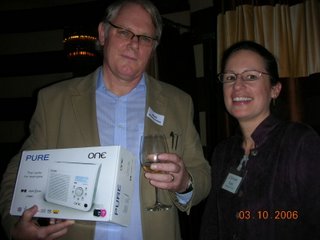
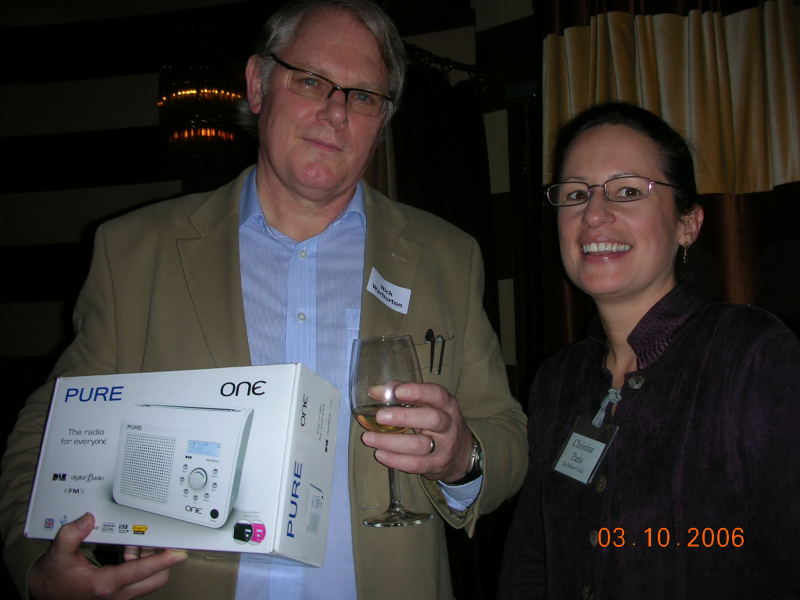
Nick Warburton and Christine ParisTinniswood Award winner Nick Warburton with Guild Assistant General Secretary, Christine Paris (Photo: Anne Hogben)
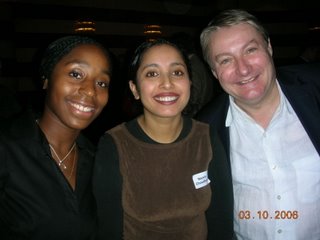
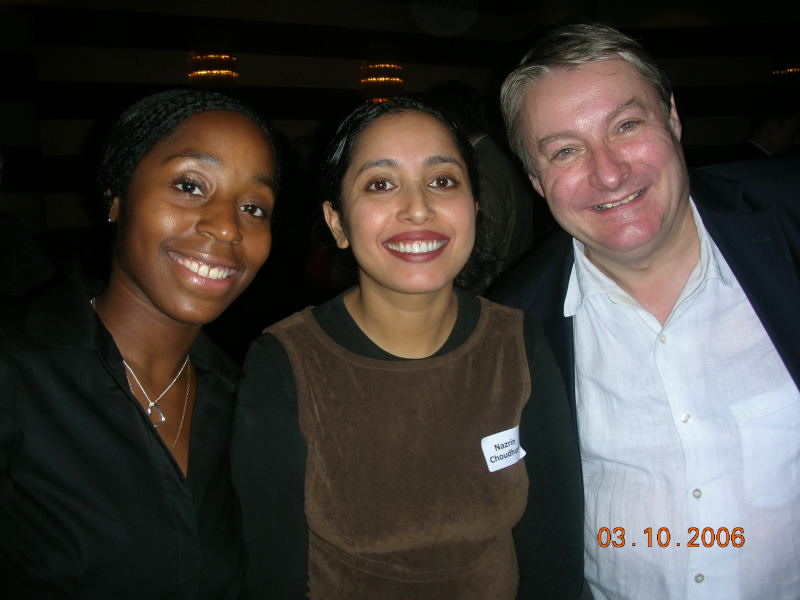
Moe, Nazrin Choudhury, BernieImison Award winner, Nazrin Choudhury (centre), with the Guild's Acting Membership Manager, Moe Owoborde and Guild General Secretary, Bernie Corbett (Photo: Anne Hogben)

Forward Poetry Prize winners

The £10,000 Forward Prize for Poetry has been won by Robin Robertson for his collection Swithering.

Robertson, 50, from Scone, Perthshire, is the first poet to have won both the best collection prize and the best first collection prize.

The first, A Painted Field, was a winner in 1997. Swithering is the third collection he has released.

Indian-born Tishani Doshi, 31, won the £5,000 best first collection prize for Countries of the Body.

Sean O'Brien won the £1,000 best single poem prize with Fantasia On A Theme Of James Wright.
More from BBC News.

Tuesday, October 03, 2006

Tony Kushner on film

Not many writers have been the subject of feature film documentaries, so maybe Wrestling with Angels: Playwright Tony Kushner, directed by Freida Lee Mock, will start a trend.

In The New York Times Kushner tells Sylviane Gold why he ageed to be followed by cameras over the course of the past three years.
Why, exactly, would someone who is often described as shy, who is palpably “anxious” (Mr. Kushner’s term) and “self-flagellating” (Ms. Mock’s term) and whose work, when he’s not being what he calls “delinquent,” often entails sitting alone in a room, agree to be the central figure in a documentary?

Mr. Kushner, 50, who is also famous for his garrulousness, has a number of answers, one of which has to do with the appeal of “Project Runway.”

“I can’t sew two dishcloths together,” he said. “Watching these people actually make clothing is fascinating to me. I think most people are interested in how people actually do the things that they do. The life of a working playwright is maybe something people have some curiosity about.”

Martin Sherman interview

Thirty years after its first production, Martin Sherman's play Bent is being revived in London. In The Times he tells Tim Teeman why the play still matters.
In a strange way, says Martin Sherman, he wishes — “quite against my own wishes for financial stability” — that his play Bent wasn’t being performed again; that gay life had fundamentally moved on from nearly 30 years ago when it was first performed. But his story of two men fatefully falling in love in a Nazi detention camp is being revived in a new production at the Trafalgar Studios in London. Back then it shocked because it told of horrors we knew nothing about; today, he hopes, it might shock gays out of complacency.

“In the Seventies we thought we had progress but gays were being discriminated against,” Sherman, 67, says. “There were bars, clubs. There was commercial progress, a lot of people were making money out of gays, but not social progress. When I wrote it I remember seeing gay men wearing Nazi uniforms in Greenwich Village which shocked me. I wanted to say, ‘Don’t you realise what you’re doing?’ Beneath all that talk of liberation there was such self-hatred. There was no real freedom or real inner joy about who we were.”

There is a concordance today, he claims.

Monday, October 02, 2006

Writing Peter Pan: The Sequel

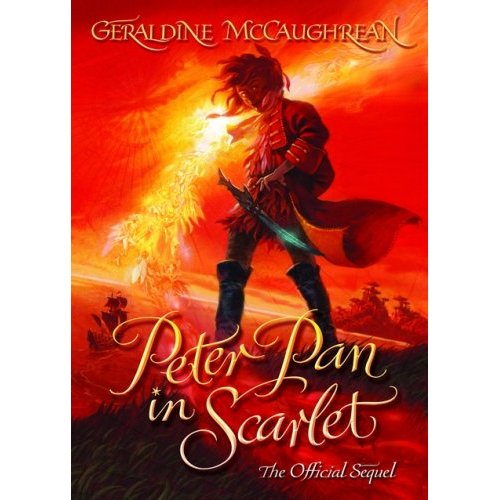
Peter Pan In Scarlet
Some commissions come with more pressure than others. Imagine, for example, being asked to write a sequel to one of the world's best loved children's books. In The Guardian, Geraldine McCaughrean explains how she tackled the challenge after winning a contest to write the sequel to J.M. Barrie's Peter Pan.
I only discovered the extent of Peter Pan's popularity when my win was announced in the press. It is a Pandemic, you might say: he is the darling of countless fans; big business; the subject of raging controversy. There are Tinker Bell fetishists and Hook aficionados, Wendy worshippers and Neverland neophytes. How could I possibly satisfy them all? My other 140 books have not warranted - or have not attracted - large-scale PR. This one will.
Peter Pan in Scarlet, by Geraldine McCaughrean, will be published by Oxford University Press on October 5, price £12.99.

Will Mobile TV catch on?

In recent months a number of new TV services for mobile phones have been launched. But, asks Ian Young for BBC News, will anyone actually watch?
Escaping into a bit of comedy or catching up on last night's TV on the way home is an attractive option. But regularly whiling away my bus journeys this way could become an expensive habit.

Snacking is a word often used when describing mobile TV viewing habits, and "snackable" shows are considered by many in the industry to be the way ahead.

Commuting and lunch breaks have been popular times for people to tune in on their handsets, while some also use them as back-up TV sets at home.

Getting angry with age

Mark Ravenhill, who has just turned 40, argues in The Guardian argues that writers don't necessarily mellow with age.
...the idea that the older you get, the less angry you are is clearly wrong. Very wrong. Look at pensioners on buses - pushing, grumbling, snarling at the driver - and you see a whole generation who are definitely not reconciled with the world. And having experienced some very alarming internal shifts - huge doubts and anxieties about myself and my place in the world as that 40th birthday loomed - I can safely say that you don't become comfortably reconciled to yourself after 30.

Friday, September 29, 2006

Seeing like a screenwriter

Writer, teacher and blogger Billy Mernit says that screenwriters should write what they see.
The seemingly heretical (to some) subtext here is that a screenplay can be pre-directed - that instead of "leaving the visuals to the director" (let alone the aurals, thematic image systems, etc.), the alert and imaginative writer can imbue his/her writing with enough use of the medium to hand any director a fully realized vision on a platter - to make a script, in a sense, moviemaker-friendly and/or director-proof.

Guild Theatre Awards 2006

In 2005, the Guild's Theatre Committee initiated awards for the encouragement of new writing. Members were asked to nominate anyone in any capacity who had given them an exceptional experience in new writing.

Today the winners of the 2006 awards were announced. They are:
  • The Watford Palace Theatre (Joyce Branagh, Lawrence Till and Mary Caws), nominated by both Sarah Daniels and Ian Kershaw;
  • Claire Malcolm, Director, and Anna Disley, Deputy Director, New Writing North, nominated by Carina Rodney;
  • Joe Sumsion of Action Transport Theatre Company, nominated by Kevin Dyer;
  • Gwenda Hughes, currently Artistic Director of the New Vic Theatre, Newcastle under Lyme, nominated by Lisa Evans.
Full details can be found on the Guild website.

Thursday, September 28, 2006

Arts Council England loses theatre experts

Arts Council England’s theatre department is set to lose two of its most senior figures as part of a radical shake-up, only months before the sector learns of its fate in the forthcoming comprehensive spending review.

Director of theatre Nicola Thorold and director of touring Elizabeth Adlington are leaving the organisation following a comprehensive restructuring of ACE’s national office, due to come into force on October 31.
More from The Stage.

The irresistable rise of Allan Loeb

There are few bets with longer odds than making a living as a screenwriter. And then there's Allan Loeb. A compulsive gambler since age 10, he's currently riding one of the hottest streaks in Hollywood — screenwriting's equivalent of the "It Boy."
More from Jay A. Fernandez in The LA Times.

Public Service Publisher

The communications industries regulator, Ofcom, has published a new report on Public Service Broadcasting post Digital Swtichover.

The most eye-catching recommendation is that:
Further consideration also needs to be given to the possible role of and funding for a Public Service Publisher (PSP), proposed by Ofcom’s PSB Review as the first provider of public service content rooted in the ideas, creativity and ethos of new media.
The idea would be to have public service content produced by someone other than the BBC, for use through commercial distributors.
In conjunction with a small group of experts from within the new media industry, work is underway to develop a creative vision for the PSP as an entity rooted in the ideas, creativity and ethos of new media (although this will not preclude it from making use of broadcasting distribution where appropriate).
The report also promises that Ofcom will be undertaking a full review of Channel 4's public service provision.

Peter Ling obituary

Script writer and editor Peter Ling has died at the age of 80. There's an obituary in The Guardian by Philip Purser.
Peter Ling, who has died aged 80, was a radio and television writer especially successful in the discipline of soap opera, and one of its first exponents to apply professional guidelines to the maintenance of these popular, in theory never-ending, serials as they took off in the late 1950s and 60s.

Though Tessa Diamond still wrote most, if not all, of her pioneering (1957-66) Emergency - Ward 10, it was becoming apparent that few authors could furnish every script for a twice-weekly show crowded with characters. Coronation Street (born 1960) was a team effort almost from the outset. In the case of Crossroads, which Ling and Hazel Adair devised for ATV in 1964, even a pair of writers would have been hard pressed, for at first this saga set in a Midlands motel went out five times a week.

The customary practice was for each member of a team to be allotted a short run of episodes - perhaps three or four - for which they were solely responsible, as long as the story conformed to an agreed general plot. The trouble was that the fate one writer had in mind for a character might be inadvertently scuppered by the next hand on the tiller.

At the suggestion of the producer, Reg Watson, Ling switched to assigning a writer to each individual storyline as it evolved, whether it was a dawning romance or someone heading for trouble with local villains. The chosen writer would then stay with this strand until it - or his contract - fizzled out. Another innovation of Ling's was to change the writers every six months, to prevent staleness.

Wednesday, September 27, 2006

Theatre Museum to close

It's been a long slow death, but now the Theatre Museum in Covent Garden is set to close. On The Guardian's Culture Vulture blog, Michael Billington laments its passing.
The V&A have said they will re-house the Museum's collection and ultimately open a new gallery in South Kensington. But it will be impossible to store everything under one roof. And the whole point of having a Museum in Covent Garden was that it was at the very heart of Theatreland itself, and shared in all its glitz and glamour.

So the Museum's impending closure, as it reaches its 20th year, is devastating news. A reminder that, although the British have a genius for making theatre, they have little desire to celebrate it.

Tuesday, September 26, 2006

Murakami wins Short Story Award

Haruki Murakami has won the second Frank O'Connor International Short Story Award for Blind Willow, Sleeping Woman, his third collection of short stories to be published in English.

The €35,000 (£23,000) prize, which is awarded to new collections published in English during the last 12 months, is the world's richest short story prize. The prize will be shared between Murakami and his translators, Philip Gabriel and Jay Rubin.
More from Richard Lea in The Guardian.

Diane Setterfield tops US bestseller list

Diane Setterfield, a former French teacher from Yorkshire whose first novel - a book that she spent five years writing - has just been published, is embarking this week on a promotional tour of the United States buoyed by the remarkable news that The Thirteenth Tale has gone straight to the top of the New York Times bestseller list.
More from Louise Jury in The Independent.